


In Nepal, volunteers struggle to get aid to people despite govt bottlenecks
A writer documents the plight of the Nepali people in a remote area a month after the massive earthquake.

by Qazi Zaid Roughly 150 kilometres from the capital city of Kathmandu, Ganeshstan in Haldekalika Village Development Community (VDC) is preparing to distribute aid. A young group of students from the Kathmandu Medical College (KMC) have arrived in the village, carrying with them mosquito nets and food items. The sun is high up in the sky and the premises of the Shri Ganesh School is packed with people who are expecting the relief material.In a village situated two kilometres off-road from the last connected point, Shri Ganesh School has been turned into a makeshift relief camp where people have lined up with coupons in their hands, waiting for their turn. Across a stream and a steep uphill climb, groups of quake affected villagers have taken shade under the nearby tree to escape the harsh sun, others prefer to stand near the gate of the school to be the first ones to collect what they need.[caption id="attachment_2277548" align="alignleft" width="800"]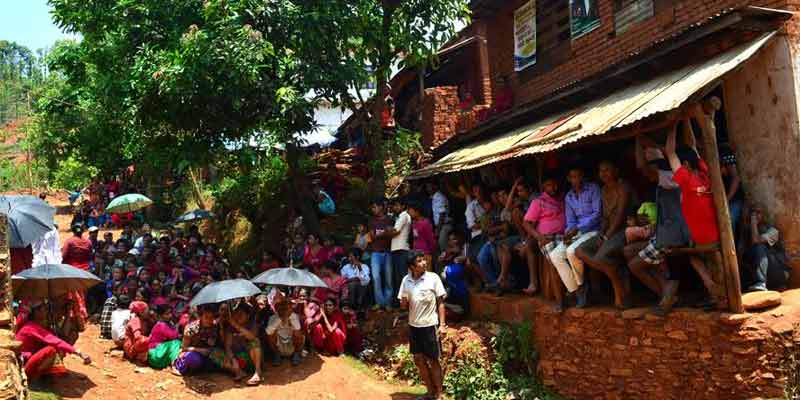 Villagers collect outside a school in Ganeshstan village in the Haldekalika VDC in Nuvakot district in Nepal. Image courtesy: Qazi Zaid[/caption]How the group formed after the earthquakeThe first year students from KMC spontaneously formed ‘Amigos 18’, an online page on the social networking site Facebook and started collecting donations to launch relief operations in a response to the 7.9-magnitude earthquake. After raising a considerable amount the students checked the requirements online and headed out to buy relief material."We got phone numbers of volunteers from Google play in our android phones and got in touch with local volunteers from this village," Deepak Shah, one of the members of Amigos18, said.The first one to respond to their calls was Rajan Giri, a volunteer from Ganeshstan village and a member of a village organisation called ‘Community Development Plan’ (CDP). A police officer by profession, Rajan has been working continually with relief efforts in the region. With better knowledge of the terrain and the interiors of the village, Rajan coordinated with ‘Amigos 18’ and went around the mountains surrounding the village to look for affected people. More people then joined the effort.Raju Giri, the president of the village organisation CDP and a well respected person in the village, surveyed the mountains for destruction along with Rajan. They decided to hand out coupons to people after surveying the villages, with the requirements written on it, to ensure that the relief material reaches the people who need it the most. The same coupons are now being held in the hands of the people who have lined up outside the school to collect the items which they need the most.[caption id="attachment_2277550" align="alignleft" width="800"]
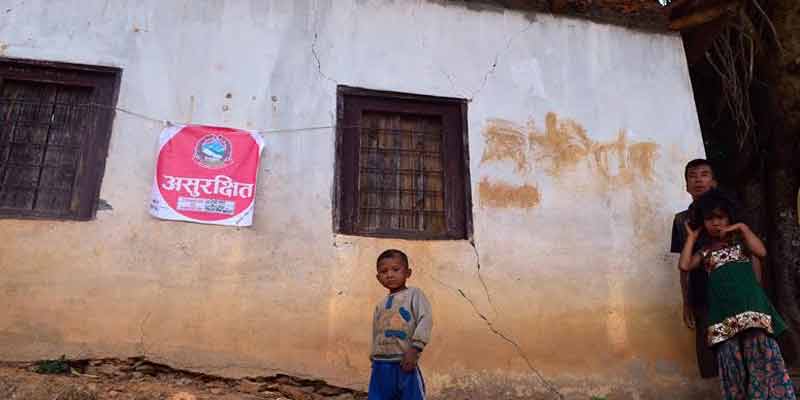 Children stand outside a school in Gangdada village in the Nuvakot District marked ‘Unsafe’ by the government. Image courtesy: Qazi Zaid[/caption]The plight of people in rural areasMany people in the remote areas are still living under the open sky one month after the first earthquake hit. In small clusters of hamlets consisting of five to twenty houses at one spot, every house is affected, every home has a story to tell.According to the villagers in Gangdada village located in the Haldekalika VDC, no one has come to help. The only government officials they have seen were engineers who hung signs saying 'Unsafe' on structures that have obvious damage even visible to the lay person."While surveying the surrounding areas we found that there is a visible damage of 100%. Most of the houses have collapsed and those that are still standing only look fine, but are extremely unsafe and can collapse at any time," Rajan said. “There are many who are living under the trees and because of lack of tarpaulins they have to bear the brunt of the weather.” he added.The worst hit areas of and Gurkha district have been the prime focus of relief efforts due to the extent of damage. In what may have been a concentrated effort by the government and NGOs to get aid to Sindhupalchwok and Gurkha, the District of Nuvakot, where the VDC lies, has been largely ignored.Other districts which have not been as badly hit as Sindhupalchowk need immediate assistance. At multiple spots in Nuvakot, camps of the army and police can be seen, from where rescue and relief operation have been launched regularly.The forces’ efforts in rescue have been commendable but relief operations on a large scale and carried out over a long period of time need to keep running through civil organisations. Other relief material like tarpaulins and basic toiletries was provided by the India based organisation Goonj.Ramesh Sanjal who is posted in Nuvakot currently was in Kathmandu when the earthquake hit."My immediate thoughts went to my family but I had to rush for the help of quake affect people in the worst hit districts, I got in touch with my family over phone and once I knew they were fine I could completely concentrate on fulfilling my duty,” Sanjal said.The forces have helped the villagers in many parts in clearing debris, taking out dead bodies and providing immediate help, but the area is too large and the extent of damage too huge.Bhimla Kumari lived in a mud house that was partially flattened after the major quake. The remaining structure which was already weak was destroyed by the aftershocks and the following rain."Even if my house was standing I would not go back there, I’ve seen two of my family members’ dead bodies being taken out from the rubble there," Kumari said while waiting in a queue to collect mosquito nets, tarpaulins and food.[caption id="attachment_2277556" align="alignleft" width="800"]
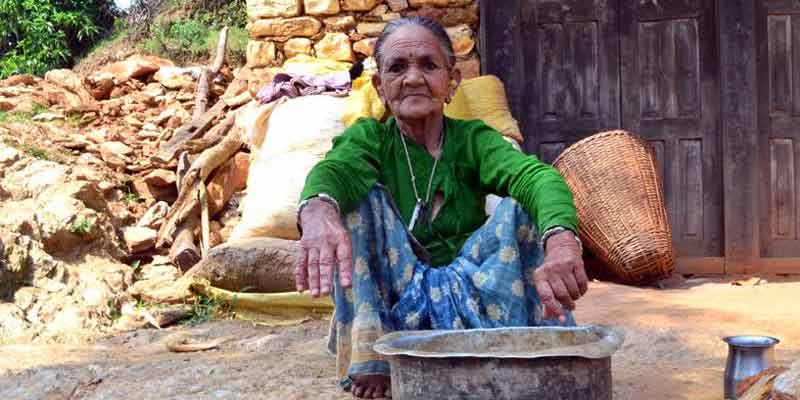 Bhimla Kumari,72, waits outside the school in Ganeshstan where relief is being distributed. Kumari lost three members of her family. Image courtesy: Qazi Zaid[/caption]Organised civilian effort There are other organisations like Goonj, Amigos 18 and CDP, which have been working together as a well structured unit of contributors and distributors. ‘I4Nation’ and ‘Mission Gorkha’ which runs a blog by the same name are working on a similar model.The organisations have modelled themselves in a two-step flow where one plays the role of contributor and the other, with more knowledge of the place and terrain plays the role of a distributor. Effort is required for better coordination between different groups operating in isolation for equal distribution and to prevent duplication of effort. The list of homes surveyed in the Haldekalika VDC has been updated online and shared on social media to inform other working groups about the effort."Our team went with shelter, talked with villagers and started work on the ground. First we levelled the land and shared our shelter plan with the local people," Ritesh Garg from ‘I4Nation’ wrote on Facebook.To make the process more sustainable, the team shared the technique with the locals so that maintenance can be done by the villagers themselves. They also used the techniques learnt from disaster management to aid in the building of houses which are easily installable and provide shelter from sun and rain in the worst-hit district of Sindhupalchowk.The government bottlenecksVolunteers have to seek permission from the government which has decided to route all relief though one common channel before distribution, in what is being termed as ‘one door system’. It's a move that comes with the intention of keeping a check on the quality of relief, discourage smuggling and maintaining a check on the genuineness of the organisations, but it risks slowing the relief effort considerably."It has been a month since the earthquake now and the donations are not the same as what they were immediately after the quake. The government has also put tax on all aid that is coming here which is absurd. This has caused a lot of aid being stuck in warehouses waiting for clearances, when it is badly needed by people in the affected areas," Nasir Lone, a member of Goonj, said.The government of Nepal has started Post Disaster Needs Assessment (PDNA), in an effort to rebuild after the earthquake, but better coordination with non-governmental organisations is needed. The government may be at a risk of delaying the much needed help, unless it finds a more efficient and faster way which meets the government’s requirements but maintains a steady flow of supply to those affected at the same time.Qazi Zaid is a freelance journalist and filmmaker from Kashmir. His recent work includes an award winning documentary film on the September 2014 floods in Kashmir.

Are Chinese UN peacekeepers spies? Trump’s UN envoy sends out a warning
Why has Bangladesh’s choice of India spokespersons raised eyebrows?
Indian judo contender withdrawn from 2026 Commonwealth Games after failed dope test
US House passes $1 trillion defence bill despite concerns over Iran war and Israel ties
Explorers discover wreckage of plane 72 years later. Will this help in finding MH370?