


Mexico: Missing students' bodies not found in mass graves
None of the bodies found in five mass graves in southern Mexico belonged to 43 college students who have been missing for nearly three weeks since a clash with police.

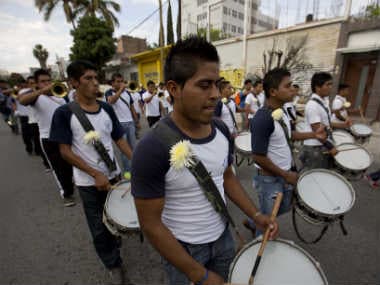
Students from the Isidro Burgos rural teachers college marching band play their instruments to protest the disappearance of 43 of their students, in Chilpancingo, Mexico. AP[/caption]"There's a connection. We will determine if it was coordination or subordination, but it's clear to me that they were working together," he said of police and drug traffickers in the area.An alleged leader of the Guerreros Unidos killed himself after being cornered by security forces who were trying to capture him Tuesday, National Security Commissioner Monte Alejandro Rubido said. The official said he had no details on how Benjamin Mondragon, or "Benjamon," killed himself.Rubido said it was unclear whether Mondragon was involved in the students' disappearance in Iguala.Police opened fire on about 100 students who had hijacked buses to return to campus after arriving in Iguala to pass the hat for their school. Teachers college students are known throughout Mexico for using radical tactics to raise money and spread their leftist philosophy.Six people were killed, 25 wounded and dozens of students rounded up by police. There has been no sign of the missing in nearly three weeks, leading investigators to comb for clandestine burial sites outside Iguala where drug cartels are believed to dump their enemies.One forensic expert, who works with federal investigators, said identification is an arduous process that takes time. Charred remains like those recovered at the first mass graves can leave very little DNA for testing."If a bone is burned at more than 300 degrees, it's almost impossible to identify because the collagen is burned. Because of that, criminal organizations started to adopt that technique," said Jorge Arturo Talavera, head of the bio-archaeology team at the Mexico's National Institute of Anthropology and History.He said the way the remains are exhumed also can affect identification. If they're pulled out in a hurried manner, other identifying articles like jewelry or teeth get discarded.Hundreds of teachers, students and relatives of the missing marched to the center of the state capital, Chilpancingo, on Tuesday, taking a much more solemn tone after angry protests and vandalism Monday that badly damaged the state capital building and other government buildings.They lined up in silence as organizers passed out white flowers. Some carried candles with a sprawling billboard offering a 1 million peso ($75,000) reward for information.Rodriguez, 46, said he felt empowered by the march. He and his wife and daughter have been coming to the school every morning for any news. Rodriguez has a truck and sells jugs of water. His wife makes and sells tortillas.Standing beside the college's basketball court, where families lined up for a simple meal of chicken, rice and tortillas, Rodriguez explained that his son started his first year at the school in July. He wanted to study to help his family get ahead, especially his three sisters, Rodriguez said."We're a humble family," Rodriguez said.Associated Press

Are Chinese UN peacekeepers spies? Trump’s UN envoy sends out a warning
Why has Bangladesh’s choice of India spokespersons raised eyebrows?
Indian judo contender withdrawn from 2026 Commonwealth Games after failed dope test
US House passes $1 trillion defence bill despite concerns over Iran war and Israel ties
Explorers discover wreckage of plane 72 years later. Will this help in finding MH370?