


Lebanon's government resigns amid widespread anger over last week's Beirut blast
In March, as the economy faltered, Lebanon defaulted on a $1.2 billion payment for foreign bonds for the first time in the country’s history

The protesters said Diab’s resignation fell far short of their demands for the ouster of the country’s political elite, many of whom gained prominence during the country’s brutal 15-year civil war, which ended in 1990.“The government resignation is not enough,” said one protester, Ahmed el-Mohamed, 27, whose head was wrapped in gauze and bleeding from the clashes. “We have to bring down the president and the Speaker of Parliament. It’s a matter of days, and we’ll do it.”Beirut has been shaken by other violent protests over the worsening economic crisis and what many consider decades of corruption and mismanagement. The local currency has lost much of its value, and unemployment and inflation rates have soared.Those problems will hamper Lebanon’s ability to recover from the blast, and now it is unclear who will take charge of that process, which includes negotiating aid packages with potential donors and putting in place long-delayed reforms.In his address, Diab cast himself on the side of the protesters and blamed the country’s problems on chronic corruption.“I discovered that the system of corruption was bigger than the State and that the State is bound by this system, and that it is not possible to confront it or get rid of it,” he said.Diab said he and his Cabinet ministers found their efforts to make reform blocked at every turn by entrenched power brokers in the country’s government.“They are the true tragedy of the Lebanese people,” Diab said. “We are going to step back to stand with the people, to wage the battle for change with them.”Before Diab’s announcement, three of his 20 Cabinet ministers had already resigned, as had at least seven members of the country’s 128-member Parliament. But those moves were not enough to either topple the government or prompt new elections.Cabinet ministers had already resigned, as had at least seven members of the country’s 128-member Parliament. But those moves were not enough to either topple the government or prompt new elections.[caption id="attachment_8693441" align="alignnone" width="640"]
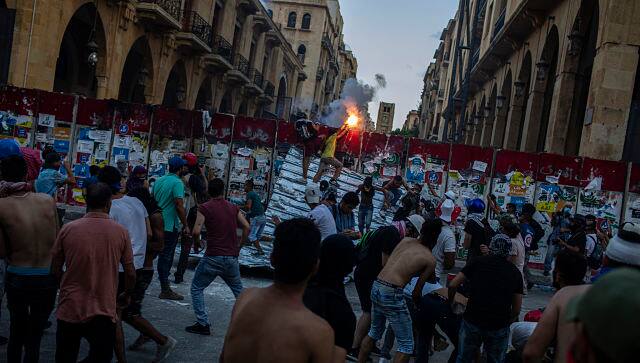
Protesters outside the Lebanese Parliament in downtown Beirut on Monday. By Diego Ibarra Sanchez © 2020 The New York Times[/caption]Diab will continue in a caretaker capacity as the political parties represented in parliament consult with President Michel Aoun to choose a new prime minister.But caretaker prime ministers usually lack the political backing to pursue significant initiatives, meaning that the Lebanese government could coast, or become even less responsive, until a new Cabinet is in place. That could take many months.Diab, an engineering professor and former minister of education, came to office with the backing of Hezbollah, the powerful militant group and political party, and its political allies after his predecessor, Saad Hariri, resigned in October.Diab was widely seen as an inexperienced but ambitious outsider. Many of Lebanon’s problems were deeply entrenched before he took office, but he found few ways to slow the country’s decline.In March, as the economy faltered, Lebanon defaulted on a $1.2 billion payment for foreign bonds for the first time in the country’s history. Diab’s government released a recovery plan on 30 April that said the economy was “in free fall,” and that Lebanon would seek $10 billion in aid from the International Monetary Fund. But multiple rounds of talks failed to reach an agreement, and the aid never came.The currency continued to slide, losing 80% of its value since last fall as many Lebanese lost jobs and shuttered businesses.The economic crisis has continued to anger protesters convinced that nothing will fix the country short of far-reaching political change and the banishment of the very political leaders who helped Diab come to office.“I have nothing to lose,” said Krystel El Khoury, a 24-year-old protester. “I just graduated. I’m an architect. I’m unemployed, and I don’t have hope. Either we do this or we leave this country.”Lebanese officials have said the blast occurred when a fire ignited 2,750 tons of ammonium nitrate, a chemical used to make fertiliser and bombs, which had been stored in the Beirut port since 2014, despite warnings from a number of officials that it was dangerous.Many in Lebanon considered the blast the latest manifestation of poor governance that had also caused the economic crisis.Ben Hubbard c.2020 The New York Times Company

'We don't need straits': Trump says Iran war isn't about Hormuz as US strikes for 12th night
Iran claims to stop three oil tankers transiting Strait of Hormuz
Globe at a glance: From Houthis striking Saudi tankers in Red Sea to wildfires in Europe
Houthis claim responsibility for attack on two Saudi oil tankers in Red Sea as a new chokepoint emerges
Air India to cut Delhi-Toronto flight time by 3 hours, resume non-stop services from August 1