


In a move to expand control, China tightens internet laws further enhancing censorship
China is consolidating its ability to censor the Internet by drafting new rules requiring businesses that serve domestic Internet users to register their Web addresses inside the country, a move seen as targeting Chinese companies but that has raised concerns among foreign businesses.

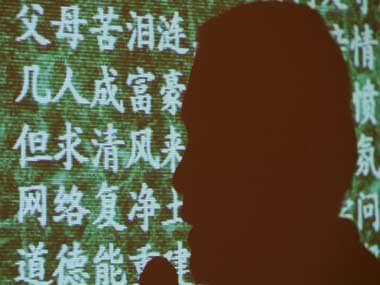
Representational image.[/caption]Requiring them to shift their registration to a domestic provider under Chinese government control would allow censors to react more quickly in blocking access to certain sites, said Long Weilian, an IT consultant based in the southern Chinese city of Shenzhen who has blogged extensively on the issue."Before, they had to contact the server, get the address, talk to the manager and then ask them to censor something," Long said. "If the domains are all domestic, they can directly stop traffic going to your domain with a command."Jacob Parker, vice president for China operations with the US-China Business Council, which lobbies the Chinese government on trade policy, said his group was concerned that the rules would block the free flow of information."Any kind of restrictions would undermine China's broader economic development goals," Parker said.Concerned that a borderless, US-led global Internet could weaken its political control, China's government has repeatedly issued cyber regulations that have drawn criticism from Western trade groups. Following pushback from the White House last year, China dropped a provision in a cybersecurity law that would require companies to keep Chinese user data at facilities in China, allowing the government access to personal information.Questions remain about the new rules' true purpose and how strictly they would be enforced. The ministry is currently soliciting feedback on the proposed registration regulations, and Chinese laws are often softened during the revision process.Fang Xingdong, the director of a top Chinese technology think tank, said he believes Chinese leaders are seeking to enhance their control, but not to wall China off from the rest of the world."Under the current wording, all this is doing is integrating large Chinese Web service providers under a more rigorous supervision framework, while most small businesses won't be affected," said Fang, whose organization regularly submits opinions to the government on Internet issues.Any attempt to seal off the Chinese Internet "would hurt China as much as America," he said.AP

Are Chinese UN peacekeepers spies? Trump’s UN envoy sends out a warning
Why has Bangladesh’s choice of India spokespersons raised eyebrows?
Indian judo contender withdrawn from 2026 Commonwealth Games after failed dope test
US House passes $1 trillion defence bill despite concerns over Iran war and Israel ties
Explorers discover wreckage of plane 72 years later. Will this help in finding MH370?