


Gulf diplomatic crisis: Why Saudi Arabia-Egypt ties are linked to the failed ban on Qatar
There are three reasons why the ban on Qatar went wrong.

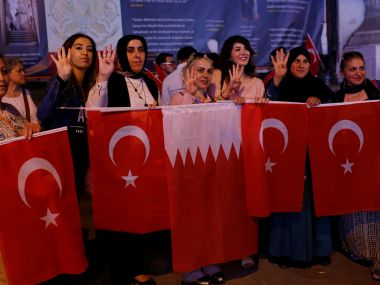
Turkey can play both a broker and an ally of Qatar. Reuters[/caption]By now, it is clear that Turkey can, both, play a broker and an ally of Qatar; Iran will support Turkey; most of the European countries did not support the ban and French president Emmanuel Macron was the first to have called both sides of the dispute. Those who supported are now gradually easing or finding a way out. Morocco and Jordan lowered their diplomatic relations with Qatar but they have now offered assistance to Qatar. The Jordanian King will be visiting Kuwait this week to break the deadlock. Kuwait and Oman remain staunchly in favour of a negotiated settlement and Kuwait Emir is the main contact person to find a breakthrough. Major world powers — Russia, China, Germany and Britain — did not subscribe to the Saudi-Emirati version of the conflict.There are three reasons why the ban on Qatar went wrong.The terrorism discourse advanced by the Saudi-Emirati-Egypt troika was reduced to Muslim Brotherhood and Hamas which sent a clear message that the move was extremely political and taken up to appease the Egyptian authorities because of their strained relation with the Saudis. Hamas, despite its extreme anti-Israeli rhetoric, enjoys immense support in Arab nations because of its two major battles against Israel and managing the Gaza Strip under regional and international sanctions.By singling out Hamas as a terrorist group, without resolving the Arab-Israeli conflict and without providing people with clear alternative to replace Hamas in Gaza and West Bank, people easily related it to Israeli rhetoric against Hamas. On Muslim Brotherhood, the troika ignored the long history of repression of Muslim Brotherhood in Egypt and how the Gulf countries, particularly Saudi Arabia, had rescued and sheltered the escaping Brotherhood leaders from Nasser's Egypt.There are at least three generations who were taught and educated by Egyptian teachers many of whom belonged to the Muslim Brotherhood. Perhaps, Yousuf al Qardawi enjoys more respect and support that any Gulf Cooperation Council monarch. The Muslim Brotherhood story that they are the main victims of Egyptian state's repression is still the story most of the Arabs believe. This is what the US State Secretary Rex Tillerson meant when he said that it was problematic to place the entire Muslim Brotherhood organisation on a terror list.
The second reason that the ban is failing is that it was clearly disproportionate, compared to the previous diplomatic restrictions imposed on Qatar in 2002 and 2014.This round of sanctions created a war-time panic among the Qatari citizens with air, land and naval blockade which stopped essential supplies shipped mostly through Saudi land routes. The ban was disproportionate to the objectives set by the banning countries. The story of Qatar supporting Hamas and Muslim Brotherhood was not new; its relations with Iran is not a secret. None of the stated reasons warranted such urgency. The controversial statements attributed to the Qatari Emir were under investigation as Qatar claimed the website of its official news website and its Twitter was hacked.
The third reason is about Egypt and UAE with whom Qatar has serious differences on issues related to regional security.Qatar has been a key supporter of forces behind the Arab uprisings. United Arab Emirate has now adopted a pro-active foreign policy to rollback the uprisings starting from Egypt where it actively supported General Al-Sisi in overthrowing Mohammad Morsi, the first elected president of Egypt. In Libya as well, UAE, Egypt and Qatar are supporting opposite groups. UAE's role in facilitating a separate South Yemen council is one more example how UAE has gone beyond the original plan Saudi Arabia had decided about Yemen. As Saudis remain focused on Yemen, UAE and Egypt are collaborating everywhere to stop the Islamist forces, mostly by force.
Turkey took no time to sense that the Qatar ban is primarily a UAE and Egyptian design which has Saudi green light. President Erdogan's statements have referred to both UAE and Egypt and Turkish media has even reported that the UAE hand in Turkey's 15 July failed coup attempt. Turkey's Qatar diplomacy is clearly focused on sidelining UAE and Egypt while mending ties between Saudi Arabia and Qatar. The Turkish diplomacy has approached all regional leaders except UAE and Egypt.The 2014 compromise and then King Salman's policies were more in favour of Qatar. As Saudi Arabia remains preoccupied by Yemen, where its immediate security is at stake, UAE and Egypt were in a position to force King Salman to change his approach towards Qatar.As Europe, Turkey, Russia and Iran opposed the Qatar ban, Egypt and UAE are handing over the charge to King Salman to take the final call on the crisis. The anti-Qatar rhetoric is declining and ban is being eased. The misadventure, however, has questioned the leadership of Saudi Arabia's young and ambitious deputy prince Mohammad Bin Salman. Saudis will prefer not to let this crisis allow Iran to manipulate and align with Saudi allies Turkey, Pakistan and other Arab and European countries now opposed to Saudi-UAE imposed ban on Qatar.The author is a Delhi-based analyst and a Research Fellow at Indian Council of World Affairs.

Pakistan's deep state weaponising LeT to counter Asim Munir critic Maulana Fazlur Rehman: Report
No premium queues, 30-minute target: What changes for Indian passport applicants in UAE
'We don't need straits': Trump says Iran war isn't about Hormuz as US strikes for 12th night
Iran claims to stop three oil tankers transiting Strait of Hormuz
Globe at a glance: From Houthis striking Saudi tankers in Red Sea to wildfires in Europe