


Ganymede, Jupiter's biggest moon, has an ocean underneath its surface: NASA
The ocean on Jupiter's Ganymede is estimated to be much deeper than the oceans on Earth — about 60 miles (100 kilometers) thick and buried under 95 miles (150 kilometers) of ice.

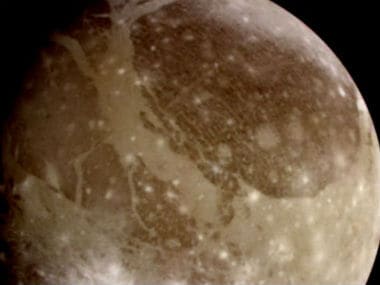
This June 2000 image provided by NASA taken by NASA’s Galileo spacecraft shows Ganymede, Jupiter’s largest moon. AP[/caption]Hubble's observations are the most convincing yet, said Joachim Saur, professor of geophysics at Germany's University of Cologne, who led the study published in the Journal of Geophysical Research.Ganymede is one of about five dozen moons circling Jupiter. It's the largest moon around the giant planet and the biggest moon in the solar system. With a diameter of 3,270 miles (5,260 kilometers), it's slightly larger than the smallest planet, Mercury.Ganymede is among several big Jupiter moons discovered in 1610 by Galileo, who called it Jupiter III. It was later named after Ganymede, a Trojan prince in Greek mythology.The European Space Agency is planning to launch a mission in 2022 on an eight-year journey toward Jupiter. After circling Jupiter and flying by three of its largest moons, the spacecraft plans to slip into orbit around Ganymede for a close-up look — the first attempt at orbiting an icy moon.NASA is building radar for the mission that's designed to pierce through ice and peer deep into Jupiter's moons.Associated Press

Pakistan's deep state weaponising LeT to counter Asim Munir critic Maulana Fazlur Rehman: Report
No premium queues, 30-minute target: What changes for Indian passport applicants in UAE
'We don't need straits': Trump says Iran war isn't about Hormuz as US strikes for 12th night
Iran claims to stop three oil tankers transiting Strait of Hormuz
Globe at a glance: From Houthis striking Saudi tankers in Red Sea to wildfires in Europe