
Advertisement


Sections
China's second heavy-lift carrier rocket 'Long March-5 Y2' launch fails due to abnormity
China's attempt to launch its second heavy-lift carrier rocket 'Long March-5 Y2' failed on Sunday after abnormity was detected during the flight, official media reported

Beijing: China's attempt to launch its second heavy-lift carrier rocket 'Long March-5 Y2' failed on Sunday after abnormity was detected during the flight, official media reported.Abnormity was detected during the flight of the rocket, which blasted off at 7.23 pm local time from Wenchang Space Launch Center in southern province of Hainan, state-run Xinhua news agency reported.Further investigation will be carried out, it said.The rocket was due to carry the heaviest Shijian-18 satellite.[caption id="attachment_3768431" align="alignleft" width="380"]![File image of China's second heavy-lift carrier rocket Long March-5 Y2. Image courtesy: Youtube/New China TV]() File image of China's second heavy-lift carrier rocket Long March-5 Y2. Image courtesy: Youtube/New China TV[/caption]The launch was the last test for the Long March-5 series before its mission to send the Chang'e-5 lunar probe into space in the latter half of this year, which was to return with samples.With a weight of 7.5 tonnes, Shijian-18 is China's latest technology experiment satellite and the heaviest satellite China has ever launched into space, an earlier report by Xinhua said.It was aimed at testing China's new Dongfanghong-5 (DFH-5) satellite platform and carry out in-orbit experiments including Q/V band satellite communication, satellite-ground laser communication technologies and an advanced Hull electric propulsion system, it said.The Long March-5 made its maiden flight in November 2016 from Wenchang. It can carry a payload of 25 tonnes into low Earth orbit and 14 tonnes in geostationary orbit, over twice the capacity of previous Long March models.The rocket uses environmentally friendly fuel, including kerosene, liquid hydrogen, and liquid oxygen, rather than highly toxic propellants, the report said.In April this year, China had launched its first cargo spacecraft, Tianzhou-1, into space using the country's heaviest Long March-7 Y2 carrier rocket to dock with the orbiting experimental space station which was expected to be operationalised by 2022.Tianzhou-1 was larger and heavier than Tiangong-2, which is 10.4 meters in length and has a maximum diameter of 3.35 meters,weighing 8.6 tonnes.
File image of China's second heavy-lift carrier rocket Long March-5 Y2. Image courtesy: Youtube/New China TV[/caption]The launch was the last test for the Long March-5 series before its mission to send the Chang'e-5 lunar probe into space in the latter half of this year, which was to return with samples.With a weight of 7.5 tonnes, Shijian-18 is China's latest technology experiment satellite and the heaviest satellite China has ever launched into space, an earlier report by Xinhua said.It was aimed at testing China's new Dongfanghong-5 (DFH-5) satellite platform and carry out in-orbit experiments including Q/V band satellite communication, satellite-ground laser communication technologies and an advanced Hull electric propulsion system, it said.The Long March-5 made its maiden flight in November 2016 from Wenchang. It can carry a payload of 25 tonnes into low Earth orbit and 14 tonnes in geostationary orbit, over twice the capacity of previous Long March models.The rocket uses environmentally friendly fuel, including kerosene, liquid hydrogen, and liquid oxygen, rather than highly toxic propellants, the report said.In April this year, China had launched its first cargo spacecraft, Tianzhou-1, into space using the country's heaviest Long March-7 Y2 carrier rocket to dock with the orbiting experimental space station which was expected to be operationalised by 2022.Tianzhou-1 was larger and heavier than Tiangong-2, which is 10.4 meters in length and has a maximum diameter of 3.35 meters,weighing 8.6 tonnes.
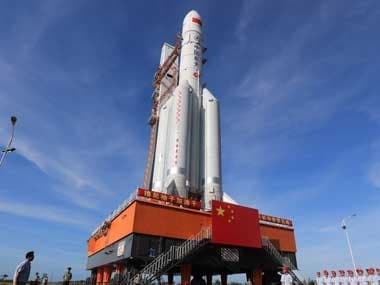 File image of China's second heavy-lift carrier rocket Long March-5 Y2. Image courtesy: Youtube/New China TV[/caption]The launch was the last test for the Long March-5 series before its mission to send the Chang'e-5 lunar probe into space in the latter half of this year, which was to return with samples.With a weight of 7.5 tonnes, Shijian-18 is China's latest technology experiment satellite and the heaviest satellite China has ever launched into space, an earlier report by Xinhua said.It was aimed at testing China's new Dongfanghong-5 (DFH-5) satellite platform and carry out in-orbit experiments including Q/V band satellite communication, satellite-ground laser communication technologies and an advanced Hull electric propulsion system, it said.The Long March-5 made its maiden flight in November 2016 from Wenchang. It can carry a payload of 25 tonnes into low Earth orbit and 14 tonnes in geostationary orbit, over twice the capacity of previous Long March models.The rocket uses environmentally friendly fuel, including kerosene, liquid hydrogen, and liquid oxygen, rather than highly toxic propellants, the report said.In April this year, China had launched its first cargo spacecraft, Tianzhou-1, into space using the country's heaviest Long March-7 Y2 carrier rocket to dock with the orbiting experimental space station which was expected to be operationalised by 2022.Tianzhou-1 was larger and heavier than Tiangong-2, which is 10.4 meters in length and has a maximum diameter of 3.35 meters,weighing 8.6 tonnes.
First Published:Jul 02, 2017, 18:55:30 IST
Advertisement
Advertisement

Secret Service agent on JD Vance security detail put on leave over alleged leak of travel plans
A US Secret Service agent assigned to Vice President JD Vance's security detail has been placed on administrative leave after being suspected of leaking sensitive information about the vice president's travel plans to the media
2 min read
China has dominated Myanmar’s rare earth mines — now India eyes deal to harness country’s critical minerals
India is deepening rare earth cooperation with Myanmar as New Delhi seeks alternative sources of critical minerals dominated by China, including dysprosium and terbium used in EVs, defence systems and clean energy technologies
6 min read
Cruise missiles, drones and more... The deadly arsenal of the Houthis
The Houthis have evolved into one of the world's most formidable non-state military forces, deploying anti-ship ballistic missiles, cruise missiles, drones and explosive boats to threaten Red Sea shipping. Their latest attacks on Saudi oil tankers have raised concerns over shipping through the Bab el-Mandeb Strait amid the Strait of Hormuz crisis
10 min read
Epstein's model scout Daniel Siad found dead at his home near Paris amid rape case trial
A modelling scout who recruited women for the late sex offender Jeffrey Epstein has been found dead at his home in Paris.
2 min read
South China Sea tensions rise as China claims it expelled Philippine ships
China said on Thursday it tracked and drove away two Philippine vessels it accused of having "intruded into" waters near the disputed Scarborough Shoal despite warnings
1 min read
Advertisement
Advertisement