


Chile presidential election: Billionaire Sebastian Pinera to return to power with 55 percent votes
Billionaire Sebastian Pinera will return to power as Chile's president next year, according to near-complete results from a runoff election held on Sunday.

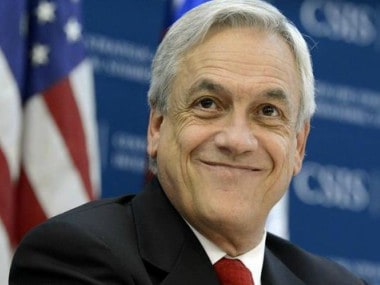
File image of Sebastian Pinera. Wikimedia Commons[/caption]His leftist rival Alejandro Guillier, a 64-year-old TV presenter turned senator who ran as an independent backed by outgoing center-left President Michelle Bachelet, recognised his own "tough defeat" after receiving 45 percent.Pinera will lead the South American nation — the world's top copper producer — for four years starting in March.He will once again take over from Bachelet, who was barred by the constitution from running for re-election.Bachelet and Pinera have tag-teamed the presidency since Bachelet first took office in 2006. Since then, they have alternated in power, switching Chile's politics between center-left and center-right each time.Pinera supporters were gathered outside his election headquarters in anticipation of his victory speech.Uncertain raceThe outcome of the runoff had been far from certain after Pinera scored a much lower than expected 37 percent in the first round of the election held 19 November.Analysts had speculated that Guillier could bolster his 22 percent from that round by getting votes from other leftist candidates who were defeated.But in the end, most voters appeared to come down in favor of the experience of Pinera, who is worth some $2.7 billion and painted himself as a safe pair of hands for Latin America's fifth-biggest economy.Voting had taken place under a somber cloud Sunday, following the deaths of five people and the disappearance of 18 more in a mudslide in the country's south.Both candidates had projected confidence, with Pinera stating as he cast his ballot: "I have the firm conviction that we are going to win these elections and that better times are going to come for all Chilean households."With no recent reliable voter surveys in the weeks before Sunday's runoff, however, the outcome had been seen as wide open.Marco Moreno, of Central University, had called it "the most uncertain election since the return of democracy" after the end of Augusto Pinochet's dictatorship in 1990.Lower growthAlthough copper exports, which contribute greatly to Chile's wealth, are increasing thanks to demand from China and from the burgeoning manufacture of electric cars, the country is struggling relative to previous years.Its GDP is forecast to expand a modest 1.4 percent this year, the slowest pace in eight years. Forecasts suggest it will grow 2.8 percent next year.Pinera and Guillier also promised to expand free university tuition brought in under Bachelet — a measure with historical resonance in Chile because paid tuition was introduced under Pinochet's 1973-1990 rule.For Pinera, the vow was a U-turn, contradicting an earlier statement he had made that "free things mean less commitment."

Pakistan's deep state weaponising LeT to counter Asim Munir critic Maulana Fazlur Rehman: Report
No premium queues, 30-minute target: What changes for Indian passport applicants in UAE
'We don't need straits': Trump says Iran war isn't about Hormuz as US strikes for 12th night
Iran claims to stop three oil tankers transiting Strait of Hormuz
Globe at a glance: From Houthis striking Saudi tankers in Red Sea to wildfires in Europe