
Advertisement


Sections
Attacks, criticism: How politicians like Donald Trump are using social media to attack mass media
In this spectacle of hatred towards journalists, Trump has conscientiously made this an 'us vs them' battle. While the media bats for an inclusive American society, backing human rights and criticising racism, Trumps messages of new found nationalism reek of fascism and invokes fear of the 'outsider'.

By Marya ShakilEarly morning on 25 August 2015 when the Battle for America was still being conceived, one of the key contenders Donald Trump ranted in a sexist tweet — 'The bimbo is back in town. I hope not for long' — against Fox News anchor Megyn Kelly. Trump's tweet wasn't without thinking. It was retweeted over a 1,000 times in a matter of a few minutes but had unravelled a disturbing trend, giving a sneak peak into the deep rooted sexist American society.[caption id="attachment_2690952" align="alignleft" width="380"]![Donald Trump in a file photo. Reuters]() Donald Trump in a file photo. Reuters[/caption]Trump didn't stop at that, he continued to post nasty tweets against the popular presenter indulging in name calling on several occasions in the last few months. This display of aggression and desire for feuds with mass media may have already become modus operandi to grab eye balls for anti-establishment politicians, but Trump mastered the art as he reached out to his Twitter constituency of 6.7 million followers.He is the most popular Republican candidate on Twitter with his adversaries — Senator Marco Rubio at 1.2 million and Senator Ted Cruz at 728.6k — still playing catch up in the virtual world. More than the number of followers of his opponents within his own party, it's Hillary Clinton's lack of relative Twitter popularity at 5.6 million that makes him feel like a victor already.In this spectacle of hatred towards journalists, Trump has conscientiously made this an 'us vs them' battle. While the media bats for an inclusive American society, backing human rights and criticising racism, Trumps messages of new found nationalism reek of fascism and invokes fear of the 'outsider'.Trump in a recent tweet after a debate had tweeted:It was a green signal to his Twitter army. Troll the mass media, crush the messenger. He criticised Fox News presenters with the most uncharitable words:His rebuke and disdain went several steps further with another tweet:His supporters on Twitter questioned the editorial bias of Fox News, many egging on to "sue the channel as the debate was a coordinated set up". Some called Brooks an "idiot, who is biased, has no facts". It's however, intriguing that most of his followers may like the tweets, but don't really come out vociferously backing his line of argument.However, there is a pattern to this criticism and questioning of mass media by populist, anti-establishment politicians world over. A phenomenon being observed in the democracies where mass media is far more independent. With 18.1 million followers Indian Prime Minister Narendra Modi is the second most popular politician on Twitter after Barack Obama. His party believes he became India's 15th Prime Minister 'despite' a hostile mass media. Social media helped him communicate directly with citizens bypassing the traditional mediums of TV and print. Twitter is the mode of communication in his government, which uses it as a medium to generate an illusion of engagement.Like Trump, Modi's ministers too rebuke and take pot shots at mass media on Twitter. The dissenters, mostly journalists celebrating freedom of speech and expression, are trolled with insinuations, with threats of rape and murder, forcing many to register complaints with Twitter. Several have also filed FIRs. HRD Minister Smriti Irani often takes on journalists on Twitter. Any criticism of the government’s policies and Modi's politics are converted into binaries of nationalist vs anti-nationalist.When Michael Warner talked about counterpublics, he had foreseen Twitter emerging as a broadcast medium. He had emphasised how the essence of a platform is in complex ideas, diverse and plural voices who are taking back and opinions expressed freely in an uncensored manner. But when one medium becomes a tool in the hands of a few to crush the messenger of the other medium, it's the message that's lost. Trump may be positioning himself as the saviour by using a hashtag #MakeAmericaGreatAgain as his bio on Twitter, he knows well that it's a battle of survival between him and the medium.
Donald Trump in a file photo. Reuters[/caption]Trump didn't stop at that, he continued to post nasty tweets against the popular presenter indulging in name calling on several occasions in the last few months. This display of aggression and desire for feuds with mass media may have already become modus operandi to grab eye balls for anti-establishment politicians, but Trump mastered the art as he reached out to his Twitter constituency of 6.7 million followers.He is the most popular Republican candidate on Twitter with his adversaries — Senator Marco Rubio at 1.2 million and Senator Ted Cruz at 728.6k — still playing catch up in the virtual world. More than the number of followers of his opponents within his own party, it's Hillary Clinton's lack of relative Twitter popularity at 5.6 million that makes him feel like a victor already.In this spectacle of hatred towards journalists, Trump has conscientiously made this an 'us vs them' battle. While the media bats for an inclusive American society, backing human rights and criticising racism, Trumps messages of new found nationalism reek of fascism and invokes fear of the 'outsider'.Trump in a recent tweet after a debate had tweeted:It was a green signal to his Twitter army. Troll the mass media, crush the messenger. He criticised Fox News presenters with the most uncharitable words:His rebuke and disdain went several steps further with another tweet:His supporters on Twitter questioned the editorial bias of Fox News, many egging on to "sue the channel as the debate was a coordinated set up". Some called Brooks an "idiot, who is biased, has no facts". It's however, intriguing that most of his followers may like the tweets, but don't really come out vociferously backing his line of argument.However, there is a pattern to this criticism and questioning of mass media by populist, anti-establishment politicians world over. A phenomenon being observed in the democracies where mass media is far more independent. With 18.1 million followers Indian Prime Minister Narendra Modi is the second most popular politician on Twitter after Barack Obama. His party believes he became India's 15th Prime Minister 'despite' a hostile mass media. Social media helped him communicate directly with citizens bypassing the traditional mediums of TV and print. Twitter is the mode of communication in his government, which uses it as a medium to generate an illusion of engagement.Like Trump, Modi's ministers too rebuke and take pot shots at mass media on Twitter. The dissenters, mostly journalists celebrating freedom of speech and expression, are trolled with insinuations, with threats of rape and murder, forcing many to register complaints with Twitter. Several have also filed FIRs. HRD Minister Smriti Irani often takes on journalists on Twitter. Any criticism of the government’s policies and Modi's politics are converted into binaries of nationalist vs anti-nationalist.When Michael Warner talked about counterpublics, he had foreseen Twitter emerging as a broadcast medium. He had emphasised how the essence of a platform is in complex ideas, diverse and plural voices who are taking back and opinions expressed freely in an uncensored manner. But when one medium becomes a tool in the hands of a few to crush the messenger of the other medium, it's the message that's lost. Trump may be positioning himself as the saviour by using a hashtag #MakeAmericaGreatAgain as his bio on Twitter, he knows well that it's a battle of survival between him and the medium.
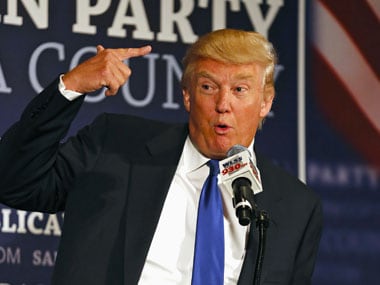 Donald Trump in a file photo. Reuters[/caption]Trump didn't stop at that, he continued to post nasty tweets against the popular presenter indulging in name calling on several occasions in the last few months. This display of aggression and desire for feuds with mass media may have already become modus operandi to grab eye balls for anti-establishment politicians, but Trump mastered the art as he reached out to his Twitter constituency of 6.7 million followers.He is the most popular Republican candidate on Twitter with his adversaries — Senator Marco Rubio at 1.2 million and Senator Ted Cruz at 728.6k — still playing catch up in the virtual world. More than the number of followers of his opponents within his own party, it's Hillary Clinton's lack of relative Twitter popularity at 5.6 million that makes him feel like a victor already.In this spectacle of hatred towards journalists, Trump has conscientiously made this an 'us vs them' battle. While the media bats for an inclusive American society, backing human rights and criticising racism, Trumps messages of new found nationalism reek of fascism and invokes fear of the 'outsider'.Trump in a recent tweet after a debate had tweeted:It was a green signal to his Twitter army. Troll the mass media, crush the messenger. He criticised Fox News presenters with the most uncharitable words:His rebuke and disdain went several steps further with another tweet:His supporters on Twitter questioned the editorial bias of Fox News, many egging on to "sue the channel as the debate was a coordinated set up". Some called Brooks an "idiot, who is biased, has no facts". It's however, intriguing that most of his followers may like the tweets, but don't really come out vociferously backing his line of argument.However, there is a pattern to this criticism and questioning of mass media by populist, anti-establishment politicians world over. A phenomenon being observed in the democracies where mass media is far more independent. With 18.1 million followers Indian Prime Minister Narendra Modi is the second most popular politician on Twitter after Barack Obama. His party believes he became India's 15th Prime Minister 'despite' a hostile mass media. Social media helped him communicate directly with citizens bypassing the traditional mediums of TV and print. Twitter is the mode of communication in his government, which uses it as a medium to generate an illusion of engagement.Like Trump, Modi's ministers too rebuke and take pot shots at mass media on Twitter. The dissenters, mostly journalists celebrating freedom of speech and expression, are trolled with insinuations, with threats of rape and murder, forcing many to register complaints with Twitter. Several have also filed FIRs. HRD Minister Smriti Irani often takes on journalists on Twitter. Any criticism of the government’s policies and Modi's politics are converted into binaries of nationalist vs anti-nationalist.When Michael Warner talked about counterpublics, he had foreseen Twitter emerging as a broadcast medium. He had emphasised how the essence of a platform is in complex ideas, diverse and plural voices who are taking back and opinions expressed freely in an uncensored manner. But when one medium becomes a tool in the hands of a few to crush the messenger of the other medium, it's the message that's lost. Trump may be positioning himself as the saviour by using a hashtag #MakeAmericaGreatAgain as his bio on Twitter, he knows well that it's a battle of survival between him and the medium.
First Published:Mar 23, 2016, 07:41:16 IST
Advertisement
Advertisement

Pakistan's deep state weaponising LeT to counter Asim Munir critic Maulana Fazlur Rehman: Report
A deepening military-terror nexus is reportedly emerging in Pakistan in a bid to neutralise the JUI-F chief, Maulana Fazlur Rehman, after he openly criticised Pakistan's Army Chief Asim Munir.
2 min read
No premium queues, 30-minute target: What changes for Indian passport applicants in UAE
Indian passport applicants in the UAE can now access passport, visa and attestation services through Alhind’s 16 centres, with no premium queues, a Dh19 service fee and a target of completing applications within 30 minutes
4 min read
'We don't need straits': Trump says Iran war isn't about Hormuz as US strikes for 12th night
US President Donald Trump on Wednesday declared that the country does not need the Strait of Hormuz as Washington bombards Iran for the 12th consecutive night.
2 min read
Iran claims to stop three oil tankers transiting Strait of Hormuz
In recent weeks, Iran has targeted tankers using a route along the Omani coast to cross the strait, in what it says is an effort to force vessels to use Iranian waters and pay for safe passage
1 min read
Globe at a glance: From Houthis striking Saudi tankers in Red Sea to wildfires in Europe
Your window to world news: As Yemen's Houthi rebels claimed to have struck two Saudi oil tankers in the Red Sea on Wednesday, the United States has announced a landmark deal with Saudi Arabia that would establish a civilian nuclear program in the Gulf country
2 min read
Advertisement
Advertisement