
Advertisement


Sections
A closer look at Emmanuel Macron, President-elect of France's pre-poll promises
Emmanuel Macron was seen as the antidote to Far Right candidate Marine Le Pen, and his poll promises focused on revival of the economy and a more inclusive agenda that doesn't shut migrants out

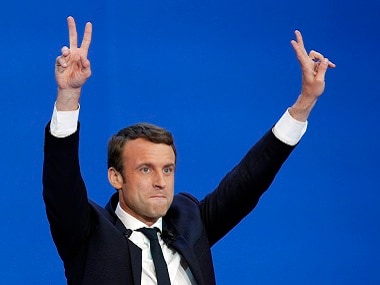
Emmanuel Macron, who at 39, became the youngest president of France, contested the election on a centrist plank, with his 'En Marche' movement finding resonance among over 65 percent of the country's population. He was seen as the antidote to Far Right candidate Marine Le Pen, and his poll promises focused on revival of the economy and a more inclusive agenda that doesn't shut migrants out.Here's a detailed look at what Emmanuel Macron had promised in his election manifesto:[caption id="attachment_3430340" align="alignleft" width="380"]![Emmanuel Macron. AP]() Emmanuel Macron. AP[/caption]On the European Union: Macron is a strong supporter of a unified European Union. He has often spoken in favour of the EU as a guarantor of peace. He has also said he wants to create a European Security Council to bring together military, diplomatic and intelligence leader of the member states. In cooperation with Nato, he had said, France can host a permanent headquarters for European safety. However, a week before Sunday's election, he had warned of a 'Frexit' if the EU doesn't reform.On the economy: Macron has said he will cut corporate tax in France from 33 percent to 25 percent, to bring it par with the EU average. He has often spoken out against France's Welfare State system, calling it "sclerotic". This would entail merging together 37 different State-run schemes into one comprehensive plan that would benefit public and private sector workers.On immigration: Among the main things on which Macron and rival Marine Le Pen differed is the topic of immigration. Instead of shutting doors to immigrants altogether, Macron emphasised French language proficiency as a prerequisite, and also a six-month processing time for asylum seekers looking to migrate to France. He has also proposed reducing the time and steps involved in obtaining "talent visas", that allows skilled workers to find employment in France.On secularism: Macron had outlined his vision for the role of the State in promoting secularism, saying France had often mistakenly targeted Muslims. "No religion is a problem in France today. If the state should be neutral, which is at the heart of secularism, we have a duty to let everybody practice their religion with dignity," he had said, which could be at the heart of his views on secularism.On national security: Macron has publicly pledged to increase defence spending to two percent of the country's GDP by 2025. Security investments include hiring 10,000 extra police officers and creating an additional 15,000 prison places. Furthermore, men and women between the ages of 18 and 21 who are in physical shape, would face upto mandatory military service in a bid to strengthen links between the nation and the armed forces.On crime and security: He has spoken of his zero tolerance towards crime, but has also spoken out against police brutality and selective targeting of racial groups. To this end, he has said he wants to improve relations between law enforcement agencies and minority groups.
Emmanuel Macron. AP[/caption]On the European Union: Macron is a strong supporter of a unified European Union. He has often spoken in favour of the EU as a guarantor of peace. He has also said he wants to create a European Security Council to bring together military, diplomatic and intelligence leader of the member states. In cooperation with Nato, he had said, France can host a permanent headquarters for European safety. However, a week before Sunday's election, he had warned of a 'Frexit' if the EU doesn't reform.On the economy: Macron has said he will cut corporate tax in France from 33 percent to 25 percent, to bring it par with the EU average. He has often spoken out against France's Welfare State system, calling it "sclerotic". This would entail merging together 37 different State-run schemes into one comprehensive plan that would benefit public and private sector workers.On immigration: Among the main things on which Macron and rival Marine Le Pen differed is the topic of immigration. Instead of shutting doors to immigrants altogether, Macron emphasised French language proficiency as a prerequisite, and also a six-month processing time for asylum seekers looking to migrate to France. He has also proposed reducing the time and steps involved in obtaining "talent visas", that allows skilled workers to find employment in France.On secularism: Macron had outlined his vision for the role of the State in promoting secularism, saying France had often mistakenly targeted Muslims. "No religion is a problem in France today. If the state should be neutral, which is at the heart of secularism, we have a duty to let everybody practice their religion with dignity," he had said, which could be at the heart of his views on secularism.On national security: Macron has publicly pledged to increase defence spending to two percent of the country's GDP by 2025. Security investments include hiring 10,000 extra police officers and creating an additional 15,000 prison places. Furthermore, men and women between the ages of 18 and 21 who are in physical shape, would face upto mandatory military service in a bid to strengthen links between the nation and the armed forces.On crime and security: He has spoken of his zero tolerance towards crime, but has also spoken out against police brutality and selective targeting of racial groups. To this end, he has said he wants to improve relations between law enforcement agencies and minority groups.
 Emmanuel Macron. AP[/caption]On the European Union: Macron is a strong supporter of a unified European Union. He has often spoken in favour of the EU as a guarantor of peace. He has also said he wants to create a European Security Council to bring together military, diplomatic and intelligence leader of the member states. In cooperation with Nato, he had said, France can host a permanent headquarters for European safety. However, a week before Sunday's election, he had warned of a 'Frexit' if the EU doesn't reform.On the economy: Macron has said he will cut corporate tax in France from 33 percent to 25 percent, to bring it par with the EU average. He has often spoken out against France's Welfare State system, calling it "sclerotic". This would entail merging together 37 different State-run schemes into one comprehensive plan that would benefit public and private sector workers.On immigration: Among the main things on which Macron and rival Marine Le Pen differed is the topic of immigration. Instead of shutting doors to immigrants altogether, Macron emphasised French language proficiency as a prerequisite, and also a six-month processing time for asylum seekers looking to migrate to France. He has also proposed reducing the time and steps involved in obtaining "talent visas", that allows skilled workers to find employment in France.On secularism: Macron had outlined his vision for the role of the State in promoting secularism, saying France had often mistakenly targeted Muslims. "No religion is a problem in France today. If the state should be neutral, which is at the heart of secularism, we have a duty to let everybody practice their religion with dignity," he had said, which could be at the heart of his views on secularism.On national security: Macron has publicly pledged to increase defence spending to two percent of the country's GDP by 2025. Security investments include hiring 10,000 extra police officers and creating an additional 15,000 prison places. Furthermore, men and women between the ages of 18 and 21 who are in physical shape, would face upto mandatory military service in a bid to strengthen links between the nation and the armed forces.On crime and security: He has spoken of his zero tolerance towards crime, but has also spoken out against police brutality and selective targeting of racial groups. To this end, he has said he wants to improve relations between law enforcement agencies and minority groups.
First Published:May 08, 2017, 11:50:30 IST
Advertisement
Advertisement

China has dominated Myanmar’s rare earth mines — now India eyes deal to harness country’s critical minerals
India is deepening rare earth cooperation with Myanmar as New Delhi seeks alternative sources of critical minerals dominated by China, including dysprosium and terbium used in EVs, defence systems and clean energy technologies
6 min read
Cruise missiles, drones and more... The deadly arsenal of the Houthis
The Houthis have evolved into one of the world's most formidable non-state military forces, deploying anti-ship ballistic missiles, cruise missiles, drones and explosive boats to threaten Red Sea shipping. Their latest attacks on Saudi oil tankers have raised concerns over shipping through the Bab el-Mandeb Strait amid the Strait of Hormuz crisis
10 min read
Epstein's model scout Daniel Siad found dead at his home near Paris amid rape case trial
A modelling scout who recruited women for the late sex offender Jeffrey Epstein has been found dead at his home in Paris.
2 min read
South China Sea tensions rise as China claims it expelled Philippine ships
China said on Thursday it tracked and drove away two Philippine vessels it accused of having "intruded into" waters near the disputed Scarborough Shoal despite warnings
1 min read
Choke terror funding, keep international shipping lanes safe: Jaishankar at Asean Regional Forum
Jaishankar's remarks came against the backdrop of recent terror attacks targeting India and growing threats to commercial shipping amid conflicts in West Asia and Europe
2 min read
Advertisement
Advertisement