


HuJI

A high intensity blast outside the Delhi High Court on Wednesday morning claimed 11 lives and left 76 injured. Harkat-ul-Jihad-al-Islami (HuJI), an Islamist fundamental outfit operating mostly from neighbouring Bangladesh, has sent out e-mails to several news organisation claiming responsibility for the attack.Although it was expected that the HuJI which was banned by Bangladesh in 2005 and is among the terrorist organisations banned by the UN would lose strength after the reported killing of its leader Ilyas Kashmiri in a US drone attack in South Waziristan in June this year. But it continues its operations with equal freedom, reflecting a strong command network.Harkat-ul-Jihad-al-Islami (HuJI) means the "Islamic Struggle Movement." HuJI is an Islamist terrorist organisation active in Pakistan, Bangladesh and India since the early 1990s. HuJI was originally formed by jehadists Fazalur Rehman Khalil and Qari Saifullah Akhtar during the Soviet-Afghan War in 1984. Khalil later broke away to form his own outfit, Harkat-ul-Ansar.[caption id="attachment_78648" align="alignleft" width="380" caption="Delhi Police Special cell personnel show alleged Harkat-ul-Jihadi Islami (HUJI) militant Abdul Rehman to media representatives. AFP"]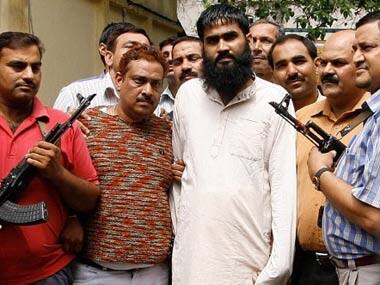 [/caption]In the early 90s, HuJI set up operations in Bangladesh. Strongly backed by the Taliban, HuJI profess a Taliban-style fundamentalist Islam and espouses a pan-Islamic ideology. It holds that Kashmir should be a part of Pakistan.HuJI first shot to international limelight in 1995 when a plot involving the group and some fundamentalist elements in the Pakistan army was uncovered. The planned coup was designed to terminate the then Pakistan military leadership, overthrow the Benazir government and impose Islamic dictatorship on the country.In India, HuJI announced its presence outside Kashmir in 2002 when the American Centre in Kolkata was attacked. The attack was executed in collaboration with the Dawood Ibrahim-linked mafia operative.During 2008, Bangalore, Ahmedabad and Delhi witnessed serial blasts. HuJI hand was strongly suspected. However, till date, no conclusive evidence has emerged.In 2010, Washington banned HuJI and included it in the US list of terror organisations.An e-mail, allegedly sent by HuJI, claimed responsibility for the 7 September, 2011, blast inside the Delhi High Court premise. Till this piece was put together, 11 people had died and over 76 others injured. But the National Investigation Agency (NIA) has not confirmed HuJI hand behind the act.HuJI attacksSecurity agencies believe that HuJI has been involved in most major terror strikes in India over the past decade.Hyderabad bombings, August 2007: Two bombs exploded almost simultaneously. The first bomb exploded in Lumbini Amusement Park and the five minutes later at in Gokul Chat Bhandar, a popular restaurant. At least 42 people were reported to have died in the two bombings.Varanasi bombings, March, 2006: A series of bombings that occurred across the Hindu holy city of Varanasi killed at least 28 people and as many as 101 others were injured. The first blast took place at the crowded Sankat Mochan Hanuman Temple near the Banaras Hindu University.Delhi blasts, September 2008: Delhi bombings were a series of five synchronised bomb blasts that took place within a span of few minutes at various locations in the capital. At least 30 people killed and over 100 injured.Delhi High Court blast, September 2011: The most recent terror attack at the Delhi High Court on the Sher Shah Marg killed at least 11 people.HuJi is also suspected to have its hand in other attacks including blasts in Jaipur, Bangalore and Ahmedabad in 2008.
Tags

Holy Cow has become less holy in the Cow Belt
Djokovic vs Nadal: Who will create history today?
Muammar Gaddafi