


Wolf Moon eclipse today at 10.37 IST: What to expect from the spectacle, how to watch it live
Unlike some of the other eclipses, penumbral lunar eclipses are very subtle events to observe.

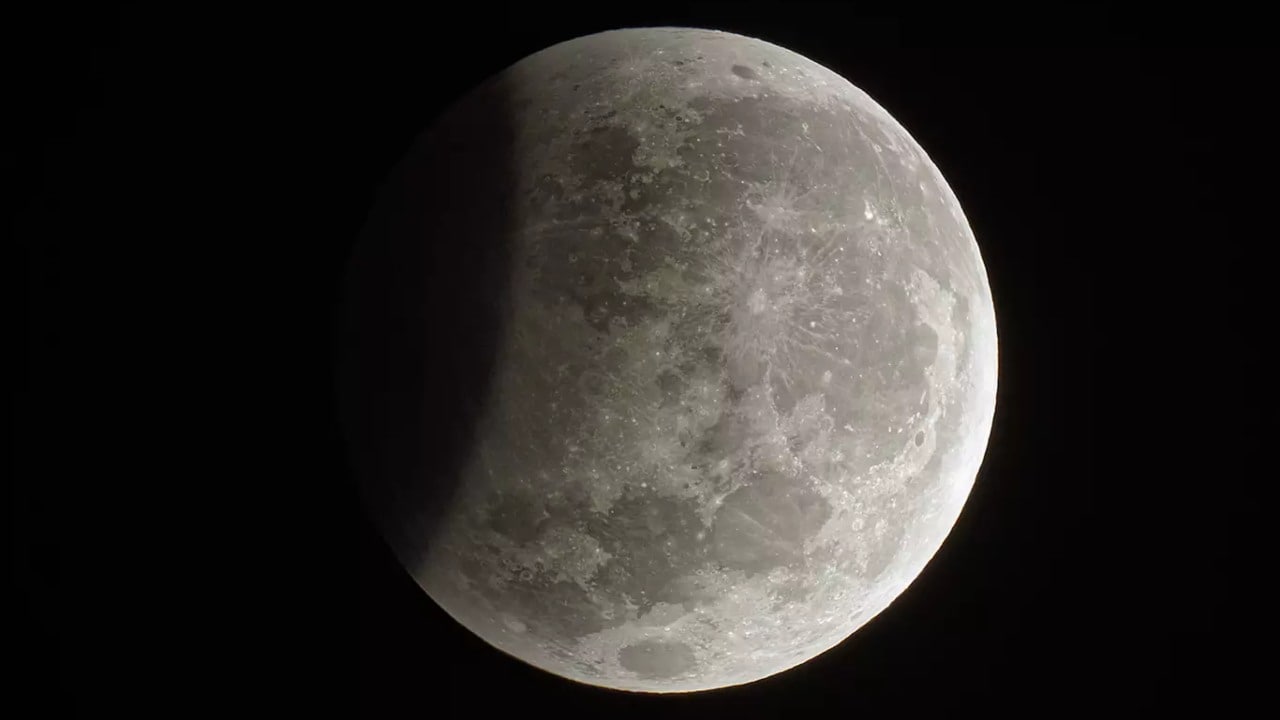
The first penumbral lunar eclipse of 2020 comes on 10 January and will be visible throughout much of the world, except for the US, central Canada, and most of South America. It will be the first of four penumbral lunar eclipses in 2020.[/caption]
Wolf Moon: When to watch the eclipse
You will be able to view the eclipse as long as the Moon is visible from your location. Those viewing the eclipse from the night-side of Earth at 5.07 pm UT on Friday (10.37 pm IST, Friday) — countries in Europe, Africa, Asia, and Australia — can watch the event live. In India, the event will last between 10.37 pm IST on 10 January to and 2.42 am IST on 11 January.[caption id="attachment_7865391" align="alignnone" width="1280"]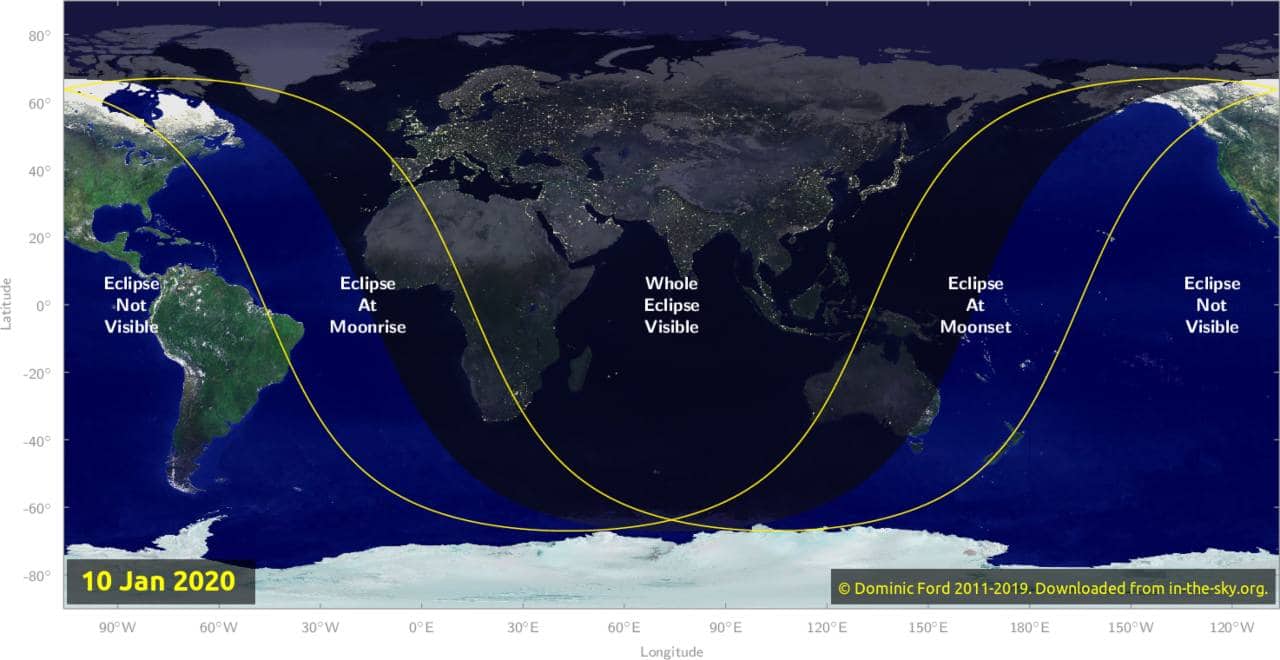
Reverse map of where the Earth's shadow on the moon will be visible on 10 January 2020 around the world. Image: In-The-Sky.org[/caption]
A 'penumbral' eclipse: What to expect
Much like other lunar eclipses, a penumbral eclipse also happens when the Earth passes between the Moon and Sun. It obscures the Sun's light and causes a shadow of the Earth to fall on the Moon's surface. That said, unlike other eclipses, penumbral eclipses are very subtle events to observe.During the eclipse, the Moon passes through the outer region of Earth's shadow, known as the penumbra. At the peak of the eclipse on 10 January, roughly 90 percent of the Moon's outer disc will fall under the Earth's shadow, giving it a slight shadow gradient across its face, with no part of the Moon in its complete shadow. It will appear as if the Earth is covering part of the Sun's disk, but not completely. The Moon's brightness, as a result, will be lower, by the dim illumination from whatever sunlight does makes its way to the Moon's surface.The entire outline of the Moon's disk will still be brightly visible. This effect is only perceptible to those with very astute (20/20) vision or using carefully-controlled cameras.[caption id="attachment_7865651" align="alignnone" width="1280"]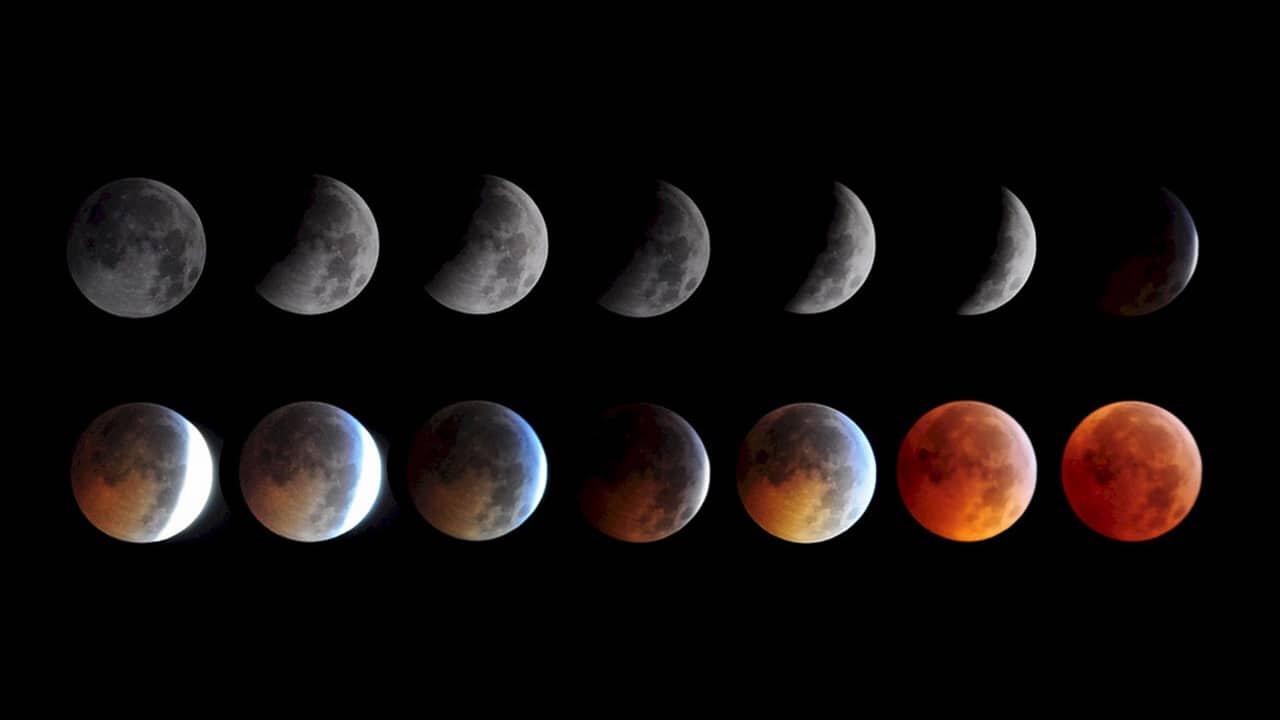
Montage of images of the total lunar eclipse on 20 Dec 2010. The photo also won a NASA contest to become the official wallpaper of JPL for the public. Image: Kieth Burns/NASA-JPL[/caption]So if you're an avid eclipse-watcher or an amateur photographer keen on getting a shot of the spectacle, the penumbral lunar eclipse will offer a view of the full moon losing its milky white brightness and look odd and shaded for a few hours, making it worth the wait and watch. The regular rise of the full moon at dusk will still be an interesting sight, as long as you're somewhere with clear skies.The Moon will be just days away from its perigee (closest point to the Earth), making it relatively large. At its peak, the eclipse will be 2.6 percent larger than average, as per In-the-Sky.org. The other penumbral eclipses to follow this year will be on 5 June, 5 July, and 30 November.The first eclipse this year that the Northern hemisphere can look forward to will be the "Thunder Moon Eclipse" on 5 July 2020.

Careless Whispers: Scientists discover that plants can 'talk' to each other using smells
Life on Mars? European Space Agency’s Orbiter discovers ice water deposits at equator
Microsoft briefly overtakes Apple as the most valuable company, Apple back on top again
Even NASA is facing a tough time, starts layoffs following major budget cuts
ISRO, NASA's NISAR satellite to get ready by Jan-end, will monitor Earth's snow-covered regions