
Advertisement


Sections
Why is the Sun’s atmosphere hotter than the surface? Parker probe's data likely to find out
The intensity of flipping magnetic field Parker observed near the sun could play a key role in solar wind & heating the corona.

If you ask a child to paint a picture of the sun, you will most likely get a bright yellow circle on a piece of paper. This is actually quite accurate, given that the sun is a ball of hot gas and that its surface (called the photosphere) mostly shines in bright yellow light. The yellow colour is determined by the temperature of the photosphere, which is about 5,500°C.In fact, the sun sometimes looks pretty much exactly like a child’s drawing. During a solar eclipse, the sun’s outer atmosphere, called the solar corona, can actually be seen as a bright circle, with the moon blocking the rest of the sunlight. Like the sun below, the corona consists of plasma – a gas of charged particles. About 80 years ago, scientists found that the temperature of the solar corona is actually much hotter than the surface, at a few million degrees celsius. This discovery has puzzled the field of solar physics ever since.The high temperatures of the corona cause it to expand into space as a continuous outflow of plasma called the solar wind. But how the sun accelerates this wind is another giant mystery. Luckily, NASA’s Parker Solar Probe has recently achieved a close encounter with the sun and is starting to answer these and many other questions – with its first results just published in a series of papers in Nature (see here, here, here and here).[caption id="attachment_5519611" align="alignnone" width="1280"]![Parker has made several close approaches, and will continue to weave in and out of the sun's corona over it's remaining 6 years on the job. Image courtesy: NASA Goddard]()
![An artistic rendition of the Parker Solar probe as it approaches the Sun. Image courtesy: NASA]()
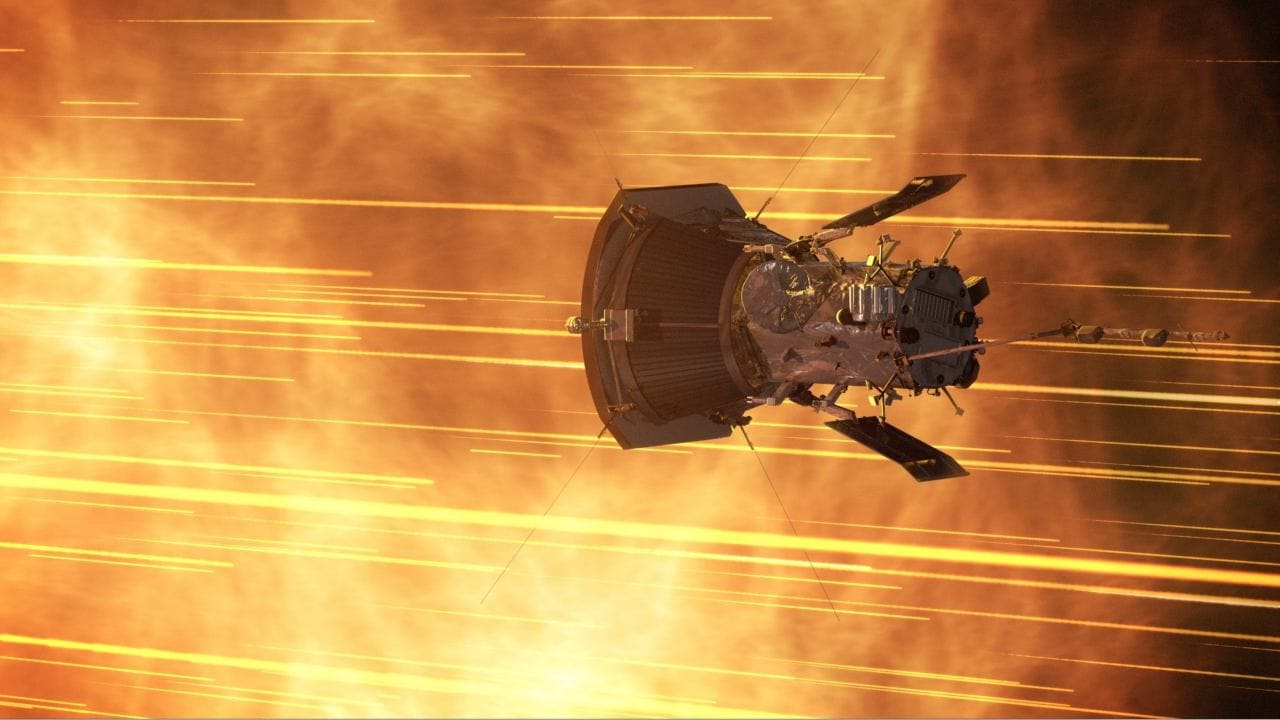
Parker has made several close approaches, and will continue to weave in and out of the sun's corona over it's remaining 6 years on the job. Image courtesy: NASA Goddard[/caption]
Where nobody has gone before
The first ideas for a mission to uncover the mysteries of the sun date back to the 1950s. But the harsh environment near the sun turned out to be too challenging for spacecraft technologies back then.In 2018, NASA finally launched the Parker Solar Probe to pursue this early dream. Its orbit will bring the spacecraft closer and closer to the sun over the coming years. At its closest encounter in 2024, it will be just over six million kilometres away from the sun. Although this number still sounds quite large, it is much closer to the sun than any spacecraft has ever been before. For comparison, the Earth orbits the sun at a distance of 150 million kilometres.The instruments on the spacecraft directly measure the solar-wind plasma and the electromagnetic fields around the spacecraft. The spacecraft also measures energetic particles, which are ions (atoms that have lost electrons) or electrons that travel much faster than the solar wind. The probe even has an imaging instrument onboard that takes photographs of the corona.[caption id="attachment_5469171" align="alignnone" width="1280"]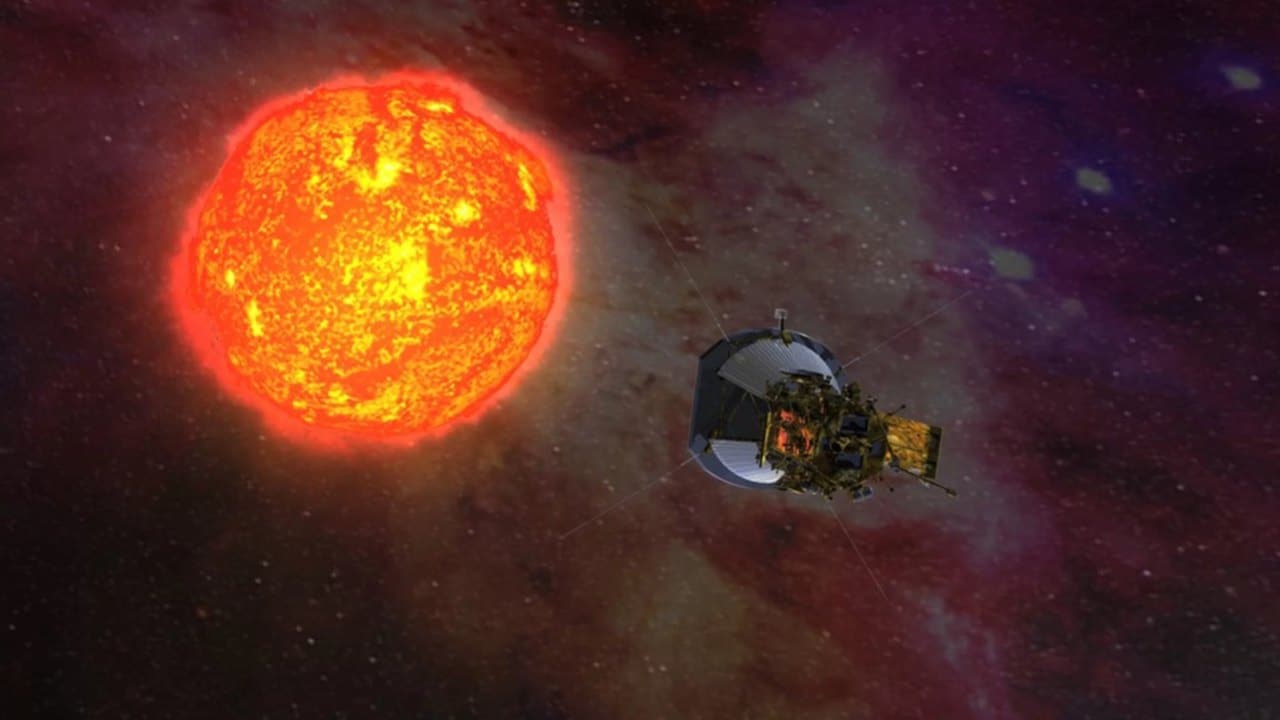
An artistic rendition of the Parker Solar probe as it approaches the Sun. Image courtesy: NASA[/caption]
First results
The Parker Solar Probe’s first measurements show that variations in the wind’s speed and in the magnetic field are much greater than observed near Earth. For example, the magnetic-field sensors detected large flips in the direction of the magnetic field.We have no idea what these “switchbacks” really are. But the measurements show that they coincide with increases in the speed of the solar wind flowing away from the sun. This happens through short and strong “jets” – increases in the flow speed of the solar wind with a duration of just a few minutes.The exact nature of the magnetic switchbacks and jets are certainly a puzzle that we must resolve in the future. They are so intensive that they may actually be a major factor for driving the acceleration of the solar wind.The instruments on the probe also detected many smaller fluctuations in the electromagnetic fields. Like the switchbacks, we have known about their existence from previous measurements, but their intensity near the sun is really surprising. This suggests they may actually have an important role in the heating of the solar corona as well as accelerating the solar wind.Another interesting finding came after the occurrence of a solar flare – a bright eruption of ultraviolet radiation in the corona. The probe’s detectors measured particles that had been accelerated in an active region in the corona. The timing of the arrival of these particles revealed that they had travelled for a longer distance from the sun than expected. Since the energetic particles follow magnetic field lines from the sun, this longer travel time suggests that the magnetic field has more structure between the sun and the probe than previously thought.The imaging instrument also saw signatures of coronal mass ejections near the sun. These are large eruptions of material that originate in the solar corona. The study of these eruptions is quite important for our society. If a large coronal mass ejection hits the Earth, it can cause a lot of disruption, such as power outages, loss of GPS signals, interruptions of radio communication and harm for air travellers and astronauts.Even after the probe’s first results, many questions remain open. However, going closer to the sun has already shown to be absolutely worth it. In the coming years the spacecraft will go even closer – and I’m sure its modern instruments will enable numerous new scientific discoveries.Those of us working in the field are very excited about the prospect that these measurements will soon help us crack the biggest mysteries of the sun – why the solar corona is so hot and how the solar wind is accelerated.![The Conversation]() Daniel Verscharen, Senior Research Fellow of Plasma Physics, UCLThis article is republished from The Conversation under a Creative Commons license. Read the original article.
Daniel Verscharen, Senior Research Fellow of Plasma Physics, UCLThis article is republished from The Conversation under a Creative Commons license. Read the original article.
 Daniel Verscharen, Senior Research Fellow of Plasma Physics, UCLThis article is republished from The Conversation under a Creative Commons license. Read the original article.
First Published:Dec 09, 2019, 08:59:23 IST
Advertisement
Advertisement

Careless Whispers: Scientists discover that plants can 'talk' to each other using smells
Japanese scientists have recorded a video that shows plants, in certain conditions, communicate with each other using mists that carry smells. The discovery, reveals that plants release a fine mist of airborne compounds, to warn nearby plants of potential dangers
Life on Mars? European Space Agency’s Orbiter discovers ice water deposits at equator
European Space Agency's Mars Express Orbiter has identified massive ice and ice water deposits beneath the surface of Mars. The Mars Express orbiter was also the first to confirmed the presence of ice on Mars in 2004
Microsoft briefly overtakes Apple as the most valuable company, Apple back on top again
At its peak during the session, Microsoft's value reached $2.903 trillion, with a 2% surge. As of writing this article, Apple closed at $2.89 trillion, whereas Microsoft closed at $2.86 trillion
Even NASA is facing a tough time, starts layoffs following major budget cuts
NASA is facing some massive budget cuts, because of which, it has been forced to postpone some upcoming missions. NASA's Jet Propulsion Laboratory has been hit hard by recent federal budget cuts, resulting in the layoff of 100 contractors last week
ISRO, NASA's NISAR satellite to get ready by Jan-end, will monitor Earth's snow-covered regions
The NISAR satellite which has been developed jointly ISRO and NASA, should be ready for launch by the end of January 2024. The collaboration between NASA and ISRO on NISAR is the first time the two agencies have cooperated on hardware development for an Earth-observing mission
Advertisement
Advertisement