
Advertisement


Sections
What starts in the Amazon doesn’t stay there: Wildfires are melting Andes glaciers
The Amazon was historically too wet to burn on a large scale, but climate change and deforestation have made it hotter and dryer.

By Liz Kimbrough Fires in the Amazon may be melting Andean mountain glaciers at an increased rate, according to a study published in Scientific Reports.Smoke plumes billow from Amazon forest fires and travel with the wind, carrying aerosols such as black carbon to settle upon the surfaces of mountain glaciers, darkening snow. As a result, the snow’s albedo — the amount of light and radiation reflected from the surface — is reduced as absorption is increases. With less sunlight reflected, the glacial energy balance is disrupted and the glacier melts more rapidly.[caption id="attachment_7851011" align="alignnone" width="1280"]![PORTO VELHO, RONDÔNIA, BRAZIL. Aerial view of burned areas in the Amazon rainforest, in the city of Porto Velho, Rondônia state. image credit: Victor Moriyama / Greenpeace]() Aerial view of burned areas in the Amazon rainforest, in the city of Porto Velho, Rondônia state. Image credit: Victor Moriyama / Greenpeace[/caption]“What we found in our study was that for the tropical Andean glaciers, the main source of black carbon is the Amazon biomass burning. And that the black carbon content in snow due to Amazon fires is sufficient to cause melting,” study lead author Dr. Newton de Magalhães Neto of Brazil’s Rio de Janeiro State University, told Mongabay.The phenomenon may be relatively new, as the Amazon rainforest historically was too wet to burn significantly; climate change coupled with deforestation has caused it to grow increasingly dryer over recent years.The research team used data from past fire events, precipitation, glacial melting and the movement of smoke plumes from the southwestern Amazon to model effects on glacial melting, specifically for the Bolivian Zongo Glacier. The research focused on black carbon deposition in 2007 and 2010, years when fires surpassed the devastating levels seen in 2019.According to the researchers’ model, both black carbon and dust in low concentrations (10 parts per million) on the surface of the snow can increase annual melting on the glacier by three to four percent separately, or by six to eight percent in combination. Higher levels of dust (100ppm) can increase annual glacial melting by 12-14 percent when combined with black carbon.“For us that was not a big surprise. We already knew that in Greenland, surface melting occurs not only due to greenhouse gases warming, but also due to surface deposition of black carbon,” said de Magalhães Neto. “Greenland receives large amounts of black carbon of fossil fuel origin due to North American and European industrialization, boreal forest burning from Canada, and from coal use in Russia, and black carbon plays a key role in the surface melting process.”To make the same connection in the tropics, however, the researchers had to prove that smoke plumes from the southwestern Amazon could reach the altitude of Andean tropical glaciers. The team did this by using CALIPSO (a satellite which utilizes lidar, infrared and imaging analyses to evaluate clouds). CALIPSO could verify that a plume of smoke containing the same aerosol composition was appearing over both the Amazon basin and Andean mountains.[caption id="attachment_7996391" align="alignnone" width="1000"]
Aerial view of burned areas in the Amazon rainforest, in the city of Porto Velho, Rondônia state. Image credit: Victor Moriyama / Greenpeace[/caption]“What we found in our study was that for the tropical Andean glaciers, the main source of black carbon is the Amazon biomass burning. And that the black carbon content in snow due to Amazon fires is sufficient to cause melting,” study lead author Dr. Newton de Magalhães Neto of Brazil’s Rio de Janeiro State University, told Mongabay.The phenomenon may be relatively new, as the Amazon rainforest historically was too wet to burn significantly; climate change coupled with deforestation has caused it to grow increasingly dryer over recent years.The research team used data from past fire events, precipitation, glacial melting and the movement of smoke plumes from the southwestern Amazon to model effects on glacial melting, specifically for the Bolivian Zongo Glacier. The research focused on black carbon deposition in 2007 and 2010, years when fires surpassed the devastating levels seen in 2019.According to the researchers’ model, both black carbon and dust in low concentrations (10 parts per million) on the surface of the snow can increase annual melting on the glacier by three to four percent separately, or by six to eight percent in combination. Higher levels of dust (100ppm) can increase annual glacial melting by 12-14 percent when combined with black carbon.“For us that was not a big surprise. We already knew that in Greenland, surface melting occurs not only due to greenhouse gases warming, but also due to surface deposition of black carbon,” said de Magalhães Neto. “Greenland receives large amounts of black carbon of fossil fuel origin due to North American and European industrialization, boreal forest burning from Canada, and from coal use in Russia, and black carbon plays a key role in the surface melting process.”To make the same connection in the tropics, however, the researchers had to prove that smoke plumes from the southwestern Amazon could reach the altitude of Andean tropical glaciers. The team did this by using CALIPSO (a satellite which utilizes lidar, infrared and imaging analyses to evaluate clouds). CALIPSO could verify that a plume of smoke containing the same aerosol composition was appearing over both the Amazon basin and Andean mountains.[caption id="attachment_7996391" align="alignnone" width="1000"]![The Zongo Glacier, analyzed in this study, sits atop Bolivia’s Huanya Potosi Mountain.]() The Zongo Glacier, analyzed in this study, sits atop Bolivia’s Huanya Potosi Mountain.[/caption]Deforestation is on the rise in the Amazon, and the rainforest drying trend is ongoing, which raises the potential for increased fires in future. However, the quantity of fire emissions isn’t the only contributor to the darkening of Andes glaciers. How easily black carbon can travel from the Amazon to the mountains, according to de Magalhães Neto, is also a consideration. Changes in the atmosphere could mean more efficient transport of dust and carbon to glacial surfaces.“It is difficult to predict what this year’s [2019] fires mean for melting without modelling the process for this year and measuring black carbon on the glaciers,” said de Magalhães Neto. The most important [concept] is to have in mind that such an impact does exist.”A survey of other tropical Andean glaciers found that nearly half of all glacial area has vanished since 1975, with over 80 percent disappearing in areas below 5,000 meters (16,404 feet). Current models predicting the response of Andean glaciers to climate change do not include the contributions of black carbon and dust to melting — meaning that their melt rate could be higher than expected. “Know that the most important cause of glaciers melting in the Andes is climate change (mainly atmospheric warming due to greenhouse gases). Amazonian fires act as an extra forcing that aggravates the situation,” said de Magalhães Neto. “A joint policy of reducing greenhouse gas emissions and stopping deforestation and fires would be the most effective way to mitigate the ongoing melting of glaciers.” However, implementing such mitigation efforts now while Brazil’s President Jair Bolsonaro is in office, pushing his anti-environmental policies, seems unlikely.Communities and ecosystems downstream from glaciers rely on glacial melt as a source of freshwater, especially during dry seasons and times of drought. Increased glacial melting may disrupt the hydrological balance and could have disastrous implications for the freshwater resources in regions already faced with water insecurity in the Andes Amazon.“First, an initial increase in glacier water discharge is expected as a result of the increased melting. However, the melting of the glaciers will reach a point where the discharge will begin to decrease,” explained de Magalhães Neto. This “will result in a water deficit to the ecosystem, which can cause future declines of agriculture, potable water and power generation for people that live in the arid regions of the western Andes and result in a water crisis.” How quickly or soon such a crisis might occur isn’t yet known.This article was originally published on Mongabay.com.Mongabay-India is an environmental science and conservation news service. This article has been republished under the Creative Commons licence.
The Zongo Glacier, analyzed in this study, sits atop Bolivia’s Huanya Potosi Mountain.[/caption]Deforestation is on the rise in the Amazon, and the rainforest drying trend is ongoing, which raises the potential for increased fires in future. However, the quantity of fire emissions isn’t the only contributor to the darkening of Andes glaciers. How easily black carbon can travel from the Amazon to the mountains, according to de Magalhães Neto, is also a consideration. Changes in the atmosphere could mean more efficient transport of dust and carbon to glacial surfaces.“It is difficult to predict what this year’s [2019] fires mean for melting without modelling the process for this year and measuring black carbon on the glaciers,” said de Magalhães Neto. The most important [concept] is to have in mind that such an impact does exist.”A survey of other tropical Andean glaciers found that nearly half of all glacial area has vanished since 1975, with over 80 percent disappearing in areas below 5,000 meters (16,404 feet). Current models predicting the response of Andean glaciers to climate change do not include the contributions of black carbon and dust to melting — meaning that their melt rate could be higher than expected. “Know that the most important cause of glaciers melting in the Andes is climate change (mainly atmospheric warming due to greenhouse gases). Amazonian fires act as an extra forcing that aggravates the situation,” said de Magalhães Neto. “A joint policy of reducing greenhouse gas emissions and stopping deforestation and fires would be the most effective way to mitigate the ongoing melting of glaciers.” However, implementing such mitigation efforts now while Brazil’s President Jair Bolsonaro is in office, pushing his anti-environmental policies, seems unlikely.Communities and ecosystems downstream from glaciers rely on glacial melt as a source of freshwater, especially during dry seasons and times of drought. Increased glacial melting may disrupt the hydrological balance and could have disastrous implications for the freshwater resources in regions already faced with water insecurity in the Andes Amazon.“First, an initial increase in glacier water discharge is expected as a result of the increased melting. However, the melting of the glaciers will reach a point where the discharge will begin to decrease,” explained de Magalhães Neto. This “will result in a water deficit to the ecosystem, which can cause future declines of agriculture, potable water and power generation for people that live in the arid regions of the western Andes and result in a water crisis.” How quickly or soon such a crisis might occur isn’t yet known.This article was originally published on Mongabay.com.Mongabay-India is an environmental science and conservation news service. This article has been republished under the Creative Commons licence.
 Aerial view of burned areas in the Amazon rainforest, in the city of Porto Velho, Rondônia state. Image credit: Victor Moriyama / Greenpeace[/caption]“What we found in our study was that for the tropical Andean glaciers, the main source of black carbon is the Amazon biomass burning. And that the black carbon content in snow due to Amazon fires is sufficient to cause melting,” study lead author Dr. Newton de Magalhães Neto of Brazil’s Rio de Janeiro State University, told Mongabay.The phenomenon may be relatively new, as the Amazon rainforest historically was too wet to burn significantly; climate change coupled with deforestation has caused it to grow increasingly dryer over recent years.The research team used data from past fire events, precipitation, glacial melting and the movement of smoke plumes from the southwestern Amazon to model effects on glacial melting, specifically for the Bolivian Zongo Glacier. The research focused on black carbon deposition in 2007 and 2010, years when fires surpassed the devastating levels seen in 2019.According to the researchers’ model, both black carbon and dust in low concentrations (10 parts per million) on the surface of the snow can increase annual melting on the glacier by three to four percent separately, or by six to eight percent in combination. Higher levels of dust (100ppm) can increase annual glacial melting by 12-14 percent when combined with black carbon.“For us that was not a big surprise. We already knew that in Greenland, surface melting occurs not only due to greenhouse gases warming, but also due to surface deposition of black carbon,” said de Magalhães Neto. “Greenland receives large amounts of black carbon of fossil fuel origin due to North American and European industrialization, boreal forest burning from Canada, and from coal use in Russia, and black carbon plays a key role in the surface melting process.”To make the same connection in the tropics, however, the researchers had to prove that smoke plumes from the southwestern Amazon could reach the altitude of Andean tropical glaciers. The team did this by using CALIPSO (a satellite which utilizes lidar, infrared and imaging analyses to evaluate clouds). CALIPSO could verify that a plume of smoke containing the same aerosol composition was appearing over both the Amazon basin and Andean mountains.[caption id="attachment_7996391" align="alignnone" width="1000"]
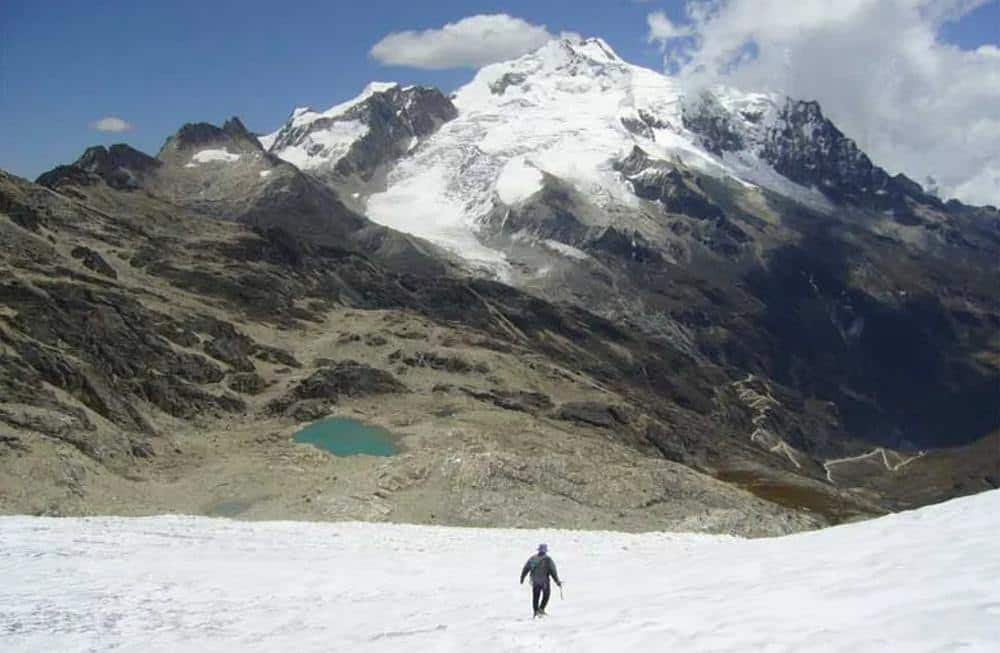 The Zongo Glacier, analyzed in this study, sits atop Bolivia’s Huanya Potosi Mountain.[/caption]Deforestation is on the rise in the Amazon, and the rainforest drying trend is ongoing, which raises the potential for increased fires in future. However, the quantity of fire emissions isn’t the only contributor to the darkening of Andes glaciers. How easily black carbon can travel from the Amazon to the mountains, according to de Magalhães Neto, is also a consideration. Changes in the atmosphere could mean more efficient transport of dust and carbon to glacial surfaces.“It is difficult to predict what this year’s [2019] fires mean for melting without modelling the process for this year and measuring black carbon on the glaciers,” said de Magalhães Neto. The most important [concept] is to have in mind that such an impact does exist.”A survey of other tropical Andean glaciers found that nearly half of all glacial area has vanished since 1975, with over 80 percent disappearing in areas below 5,000 meters (16,404 feet). Current models predicting the response of Andean glaciers to climate change do not include the contributions of black carbon and dust to melting — meaning that their melt rate could be higher than expected.
First Published:Feb 03, 2020, 16:34:47 IST
Advertisement
Advertisement

Careless Whispers: Scientists discover that plants can 'talk' to each other using smells
Japanese scientists have recorded a video that shows plants, in certain conditions, communicate with each other using mists that carry smells. The discovery, reveals that plants release a fine mist of airborne compounds, to warn nearby plants of potential dangers
Life on Mars? European Space Agency’s Orbiter discovers ice water deposits at equator
European Space Agency's Mars Express Orbiter has identified massive ice and ice water deposits beneath the surface of Mars. The Mars Express orbiter was also the first to confirmed the presence of ice on Mars in 2004
Microsoft briefly overtakes Apple as the most valuable company, Apple back on top again
At its peak during the session, Microsoft's value reached $2.903 trillion, with a 2% surge. As of writing this article, Apple closed at $2.89 trillion, whereas Microsoft closed at $2.86 trillion
Even NASA is facing a tough time, starts layoffs following major budget cuts
NASA is facing some massive budget cuts, because of which, it has been forced to postpone some upcoming missions. NASA's Jet Propulsion Laboratory has been hit hard by recent federal budget cuts, resulting in the layoff of 100 contractors last week
ISRO, NASA's NISAR satellite to get ready by Jan-end, will monitor Earth's snow-covered regions
The NISAR satellite which has been developed jointly ISRO and NASA, should be ready for launch by the end of January 2024. The collaboration between NASA and ISRO on NISAR is the first time the two agencies have cooperated on hardware development for an Earth-observing mission
Advertisement
Advertisement