


Wasn't always frigid, astronomers think Pluto might've once upon a time been a warm body
Pluto may possess an icy outer shell hundreds of km thick atop an ocean of water perhaps mixed with salts and ammonia, with a solid rocky core below.

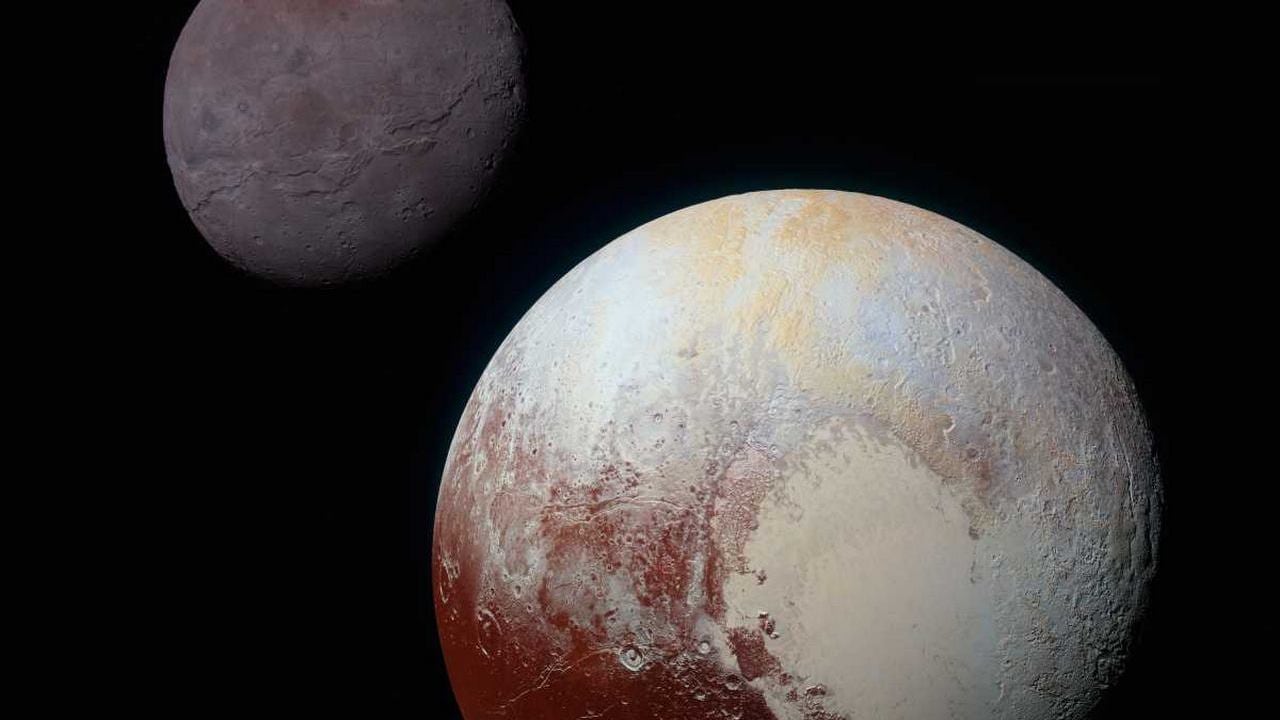
Pluto along with Charon in the background. Image credit: NASA[/caption] “If Pluto formed slowly, the surface would cool between each impact and generally stay very cold. If Pluto formed quickly, you have impact on top of impact and the surface doesn’t have time to cool. We calculate that if Pluto formed in less than 30,000 years, the heat from these impacts could have been sufficient to lead to an early ocean,” Bierson added.Pluto, orbiting the sun about 40 times further than Earth in a region called the Kuiper Belt, may possess an icy outer shell hundreds of miles (km) thick atop an ocean of water perhaps mixed with salts and ammonia, with a solid rocky core below, Bierson said.Under this scenario, parts of the ocean would gradually freeze over time. Water expands as it freezes, and cracks on Pluto’s surfacing may be evidence of this. Pluto’s surface temperature is about minus 230 degrees Celsius. Because water is considered a vital ingredient for life, a subsurface ocean could make Pluto a long-shot candidate for harbouring living organisms.“Water could have been interacting chemically with the rocky core beneath the ocean, giving you more chemical ingredients to work with,” Bierson added. “Are those the right ingredients for life? We don’t know. We need to learn more about how life forms, or how life could form, to find these answers.”

Careless Whispers: Scientists discover that plants can 'talk' to each other using smells
Life on Mars? European Space Agency’s Orbiter discovers ice water deposits at equator
Microsoft briefly overtakes Apple as the most valuable company, Apple back on top again
Even NASA is facing a tough time, starts layoffs following major budget cuts
ISRO, NASA's NISAR satellite to get ready by Jan-end, will monitor Earth's snow-covered regions