
Advertisement


Sections
Virgin Hyperloop completes its first journey transporting two passengers in just 15 seconds
Virgin said once brought into regular use, the pods will be able to transport up to 28 people at a time.

The Virgin Hyperloop made its first journey carrying passengers Sunday, in a test the company claimed represented a major step forward for the "groundbreaking" technology capable of transporting people at 1,000 kilometres (620 miles) an hour.The Hyperloop is intended to carry passengers in small pods through a vacuum tube, with proponents arguing it could revolutionize high-speed travel.Virgin says the Hyperloop will be able to reach top speeds of 1,080 kilometres an hour (671 mph) -- projecting a 45-minute journey from Los Angeles to San Francisco -- and will produce no carbon emissions.[caption id="attachment_8999231" align="alignnone" width="1280"]![The two virgin hyperloop employees that were the first passengers in the pod. Image credit: Virgin Hyperloop]()
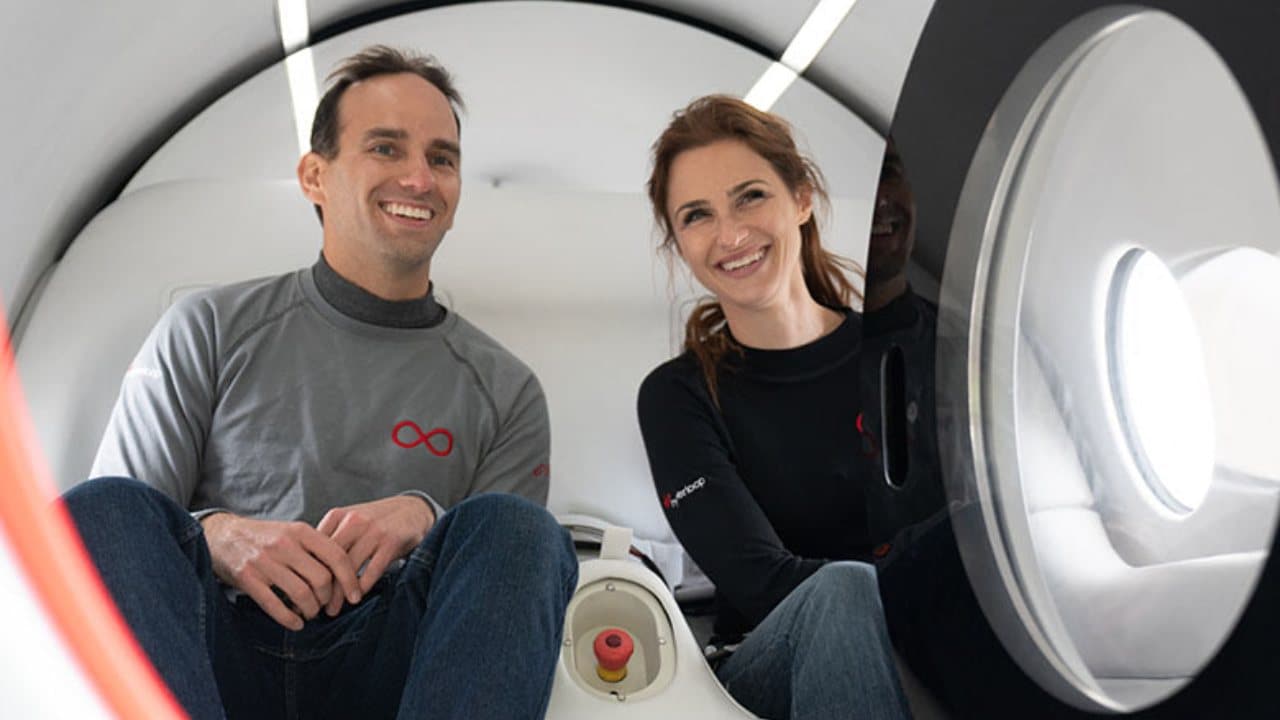
The two virgin hyperloop employees that were the first passengers in the pod. Image credit: Virgin Hyperloop[/caption]But until Sunday the technology, first proposed by eccentric US tech magnate Elon Musk in 2012, had not been tested with people on board.Two Virgin employees made the 500-meter journey in a two-person vehicle in just 15 seconds at a test site in the Nevada desert.Passenger Sara Luchian told the BBC she felt the trip was "exhilarating both psychologically and physically", and reported no discomfort.
Once brought into regular use, the pods will be able to transport up to 28 people at a time, Virgin says, with larger models for moving goods also in development.Virgin's Hyperloop has raised more than $400 million, largely from company CEO Richard Branson and the logistics company DP World, which is owned by the Dubai government. Virgin is one of a number of companies working to develop the technology.But while Branson on Sunday hailed the success of the "groundbreaking" Hyperloop, concerns have dogged developers about just how safe the technology would be.One researcher at Sweden's Royal Institute of Technology argued that the high speeds involved could turn the Hyperloop into a "barf ride."First Published:Nov 10, 2020, 13:03:09 IST
Advertisement
Advertisement

Careless Whispers: Scientists discover that plants can 'talk' to each other using smells
Japanese scientists have recorded a video that shows plants, in certain conditions, communicate with each other using mists that carry smells. The discovery, reveals that plants release a fine mist of airborne compounds, to warn nearby plants of potential dangers
Life on Mars? European Space Agency’s Orbiter discovers ice water deposits at equator
European Space Agency's Mars Express Orbiter has identified massive ice and ice water deposits beneath the surface of Mars. The Mars Express orbiter was also the first to confirmed the presence of ice on Mars in 2004
Microsoft briefly overtakes Apple as the most valuable company, Apple back on top again
At its peak during the session, Microsoft's value reached $2.903 trillion, with a 2% surge. As of writing this article, Apple closed at $2.89 trillion, whereas Microsoft closed at $2.86 trillion
Even NASA is facing a tough time, starts layoffs following major budget cuts
NASA is facing some massive budget cuts, because of which, it has been forced to postpone some upcoming missions. NASA's Jet Propulsion Laboratory has been hit hard by recent federal budget cuts, resulting in the layoff of 100 contractors last week
ISRO, NASA's NISAR satellite to get ready by Jan-end, will monitor Earth's snow-covered regions
The NISAR satellite which has been developed jointly ISRO and NASA, should be ready for launch by the end of January 2024. The collaboration between NASA and ISRO on NISAR is the first time the two agencies have cooperated on hardware development for an Earth-observing mission
Advertisement
Advertisement