


Tiny Cubesats fall silent beyond Mars after proving their new space tech works
The InSight Mars lander's companions WALL-E & EVE were the first CubeSats in deep space.

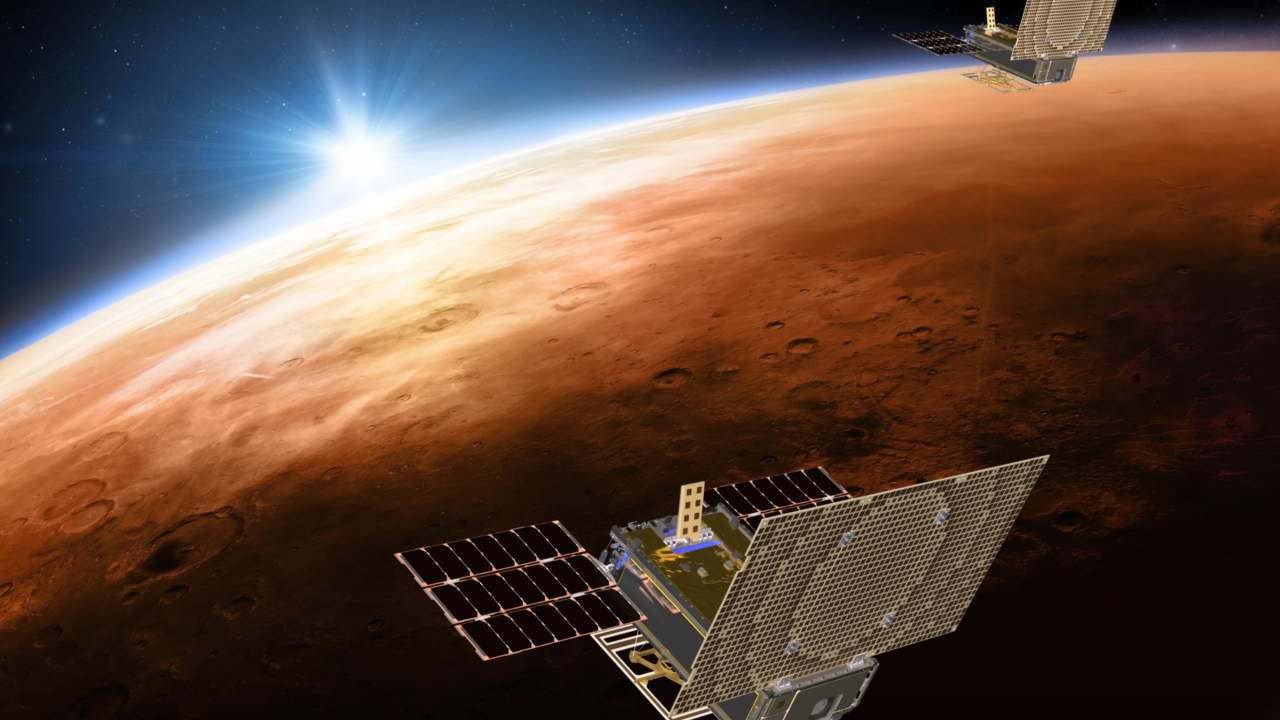
An artistic rendition of the twin Mars Cube One (MarCO) satellites flying over Mars. The MarCOs will be the first CubeSats, a kind of modular, mini-satellite, flown into deep space. They're designed to fly along behind NASA's InSight lander on its cruise to Mars.[/caption]“There’s big potential in these small packages,” program manager John Baker of NASA’s Jet Propulsion Laboratory said in a statement.Chief engineer Andy Klesh noted the mission was about pushing the limits of miniaturized technology.“We’ve put a stake in the ground,” he said. “Future CubeSats might go even farther.”Engineers speculate WALL-E and EVE might be wobbling and unable to point precisely to send messages, or there could be battery recharging issues. In any event, the mini-satellites will remain in an elongated orbit around the sun. They were named after the main characters in the 2008 animated movie.NASA, meanwhile, is still trying to contact the Mars lander Opportunity, silenced last June by a global dust storm that prevented sunlight from reaching its solar panels.Managers consider it a last-ditch effort to reach Opportunity, which recently marked its 15th year on Mars.

Careless Whispers: Scientists discover that plants can 'talk' to each other using smells
Life on Mars? European Space Agency’s Orbiter discovers ice water deposits at equator
Microsoft briefly overtakes Apple as the most valuable company, Apple back on top again
Even NASA is facing a tough time, starts layoffs following major budget cuts
ISRO, NASA's NISAR satellite to get ready by Jan-end, will monitor Earth's snow-covered regions