


Three black holes on a collision course imaged by multiple telescopes in a first
The observation is 'the best evidence yet' of a trio of supermassive black holes in apparently merging galaxies.

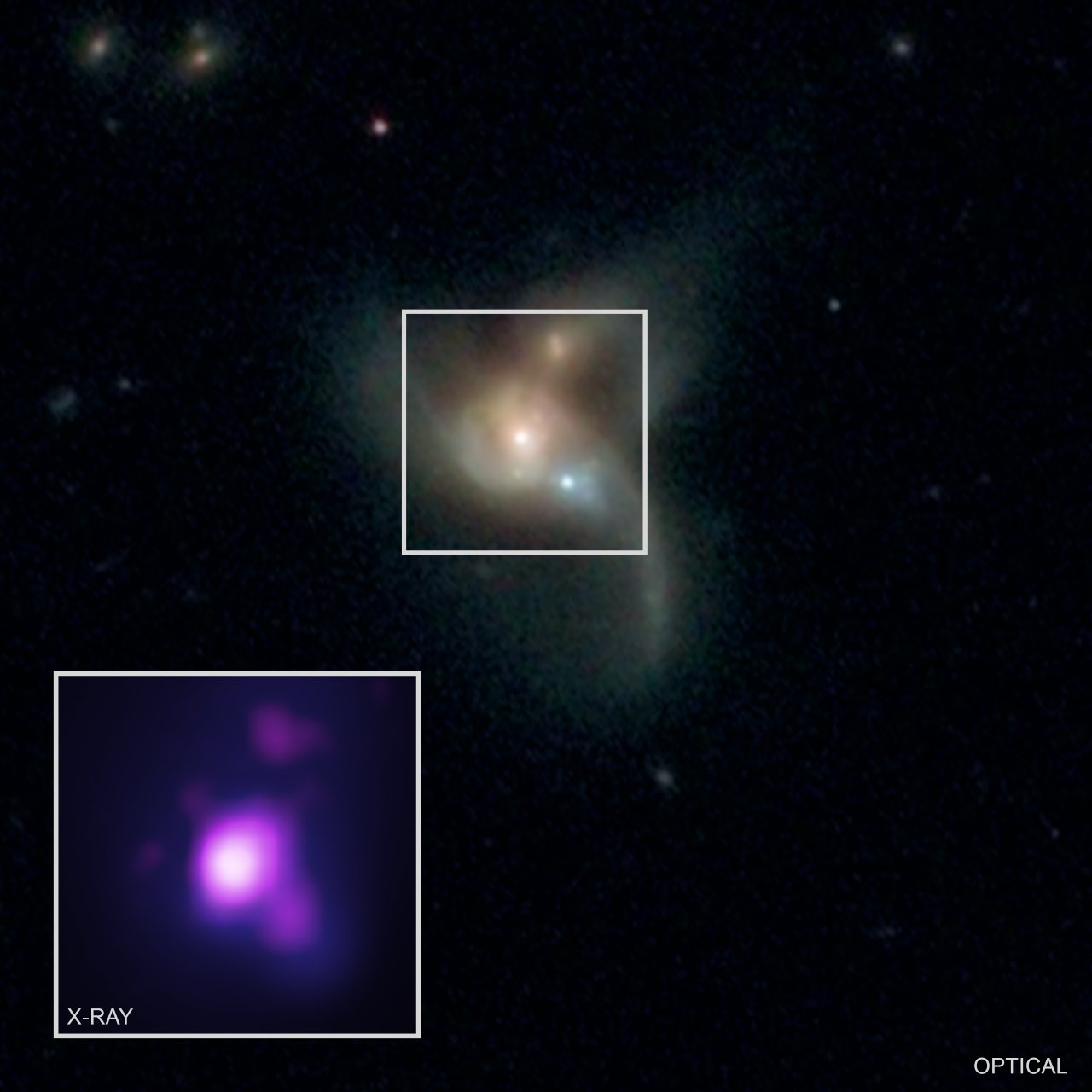
Three black holes colliding, as seen bt the Chandra X-ray Observatory. Image: NASA[/caption]"We were only looking for pairs of black holes at the time, and yet, through our selection technique, we stumbled upon this amazing system," Ryan Pfeifle from George Mason University in Virginia, the first author of the paper, said in a statement. "This is the strongest evidence yet found for such a triple system of actively-feeding supermassive black holes."The system, dubbed SDSS J084905.51+111447.2 (SDSS J0849+1114 for short), is a billion or so light-years away. Combining data from ground- and sky-based telescopes, astronomers spotted the rare black hole trifecta from multiple different observatories. The Sloan Digital Sky Survey (SDSS) telescope, which scans large swaths of the sky in optical light from New Mexico, captured SDSS J0849+1114 in . Citizen scientists participating in a project called Galaxy Zoo helped identify and tag it a system of colliding galaxies.NASA's Wide-field Infrared Survey Explorer (WISE) mission also provided data that revealed an intense glow of the system in an infrared light telescope. The light reaching Earth suggests that in the merger, at least two of the three black holes were feeding rapidly. Astronomers also turned to NASA's Chandra X-Ray telescope and the Large Binocular Telescope (LBT) in Arizona for more details.

Careless Whispers: Scientists discover that plants can 'talk' to each other using smells
Life on Mars? European Space Agency’s Orbiter discovers ice water deposits at equator
Microsoft briefly overtakes Apple as the most valuable company, Apple back on top again
Even NASA is facing a tough time, starts layoffs following major budget cuts
ISRO, NASA's NISAR satellite to get ready by Jan-end, will monitor Earth's snow-covered regions