
Advertisement


Sections
Subsurface lakes on Mars caused by clay not water finds new study

Three news research papers have indicated that the radar signals generated from Mars may have been caused by clay, not water. Initially, it was believed that the signals were coming from water under the structures on the south pole of Mars.The instrument used to measure these signals was present at the Mars Express orbiter of the European Space Agency, ESA. However, three latest studies indicate that clay could be the material causing those radars to catch signals.[caption id="attachment_9859121" align="alignnone" width="1280"]![This image taken by NASA’s Mars Reconnaissance Orbiter shows ice sheets at Mars’ south pole. The spacecraft detected clays nearby this ice; scientists have proposed such clays are the source of radar reflections that have been previously interpreted as liquid water. Image Credits: NASA/JPL-Caltech/University of Arizona/JHU]()
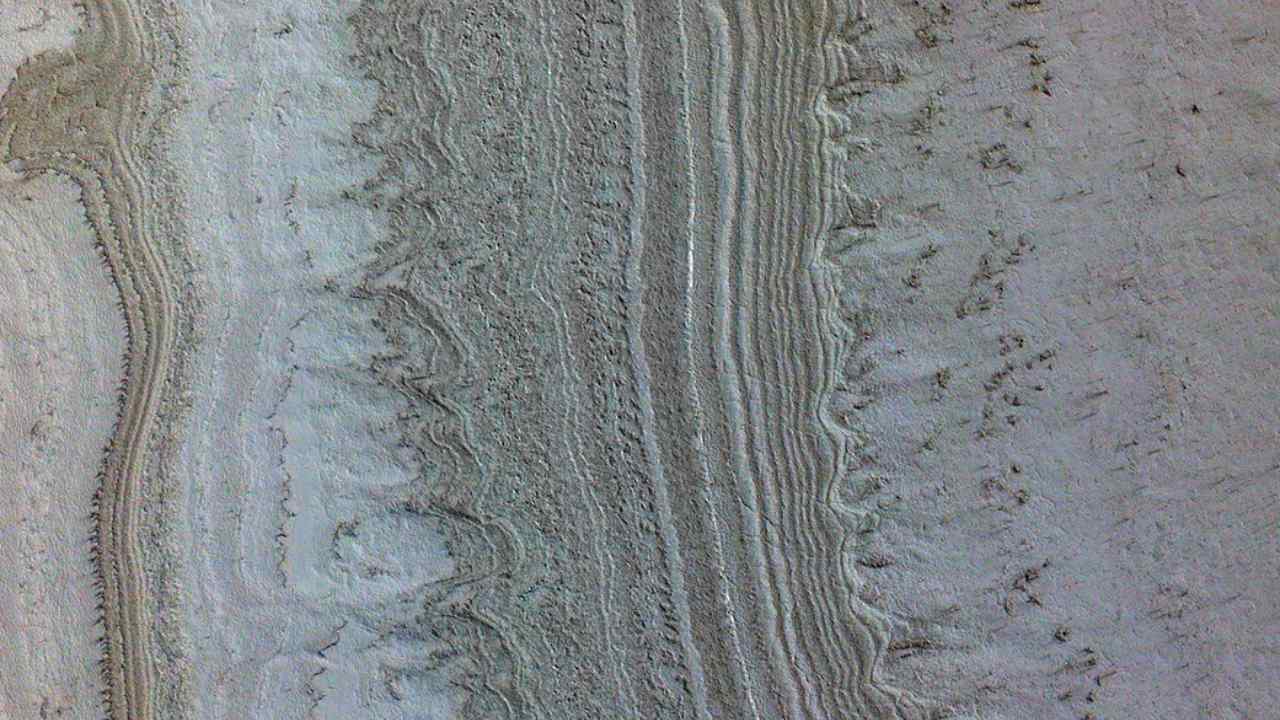
This image taken by NASA’s Mars Reconnaissance Orbiter shows ice sheets at Mars’ south pole. The spacecraft detected clays nearby this ice; scientists have proposed such clays are the source of radar reflections that have been previously interpreted as liquid water. Image Credits: NASA/JPL-Caltech/University of Arizona/JHU[/caption]Scientist Isaac Smith from York University has proposed that the underground structure is actually a group of clays called Smectites. He also measured the properties of clay in a lab.So far, scientists have believed that there were subsurface lakes below the ice cap at the south pole of Mars.
Jeffrey Plaut of Jet Propulsion Laboratory, National Aeronautics and Space Administration (NASA) along with Aditya Khuller, who was interning at JPL and is a doctoral student at the Arizona State University, use the data of Mars Advanced Radar for Subsurface and Ionospheric Sounding (MARSIS). They analysed 44,000 radar echoes across 15 years.Smith discovered that the response generated by the frozen clay samples matched the observations made by the MARSIS radar.Meanwhile, the agency has also shared the latest pictures of Mars. The first one of the three images of the red planet show layered rock formation within Jiji Crater. The second picture is of the polar dune field during northern spring. The third and the last picture is of ice sheets.Posting on its Instagram account, NASA shared it with the caption that you have got a mail from Mars. The post has been liked over 10 lakh times.First Published:Aug 02, 2021, 18:43:12 IST
Advertisement
Advertisement

Careless Whispers: Scientists discover that plants can 'talk' to each other using smells
Japanese scientists have recorded a video that shows plants, in certain conditions, communicate with each other using mists that carry smells. The discovery, reveals that plants release a fine mist of airborne compounds, to warn nearby plants of potential dangers
Life on Mars? European Space Agency’s Orbiter discovers ice water deposits at equator
European Space Agency's Mars Express Orbiter has identified massive ice and ice water deposits beneath the surface of Mars. The Mars Express orbiter was also the first to confirmed the presence of ice on Mars in 2004
Microsoft briefly overtakes Apple as the most valuable company, Apple back on top again
At its peak during the session, Microsoft's value reached $2.903 trillion, with a 2% surge. As of writing this article, Apple closed at $2.89 trillion, whereas Microsoft closed at $2.86 trillion
Even NASA is facing a tough time, starts layoffs following major budget cuts
NASA is facing some massive budget cuts, because of which, it has been forced to postpone some upcoming missions. NASA's Jet Propulsion Laboratory has been hit hard by recent federal budget cuts, resulting in the layoff of 100 contractors last week
ISRO, NASA's NISAR satellite to get ready by Jan-end, will monitor Earth's snow-covered regions
The NISAR satellite which has been developed jointly ISRO and NASA, should be ready for launch by the end of January 2024. The collaboration between NASA and ISRO on NISAR is the first time the two agencies have cooperated on hardware development for an Earth-observing mission
Advertisement
Advertisement