
Advertisement


Sections
SpaceX's Starship rocket passes fifth high-altitude flight test with flying colours
In four previous tests, the rockets launched successfully but some issues during landing or after touch down resulted in spectacular explosions.

A prototype of a spacecraft that SpaceX hopes one day to send to the moon and Mars touched down in one piece on a landing pad in South Texas on Wednesday. It was the fifth high-altitude flight test of Starship, a vehicle that in several earlier test flights exploded either during or after landing.“We are down, the Starship has landed,” said John Insprucker, a SpaceX engineer, during a live video stream of the SN15 launch.[caption id="attachment_9380501" align="alignnone" width="1280"]![SpaceX's Starship rocket is fired up for launch test. Image credit: SpaceX]()
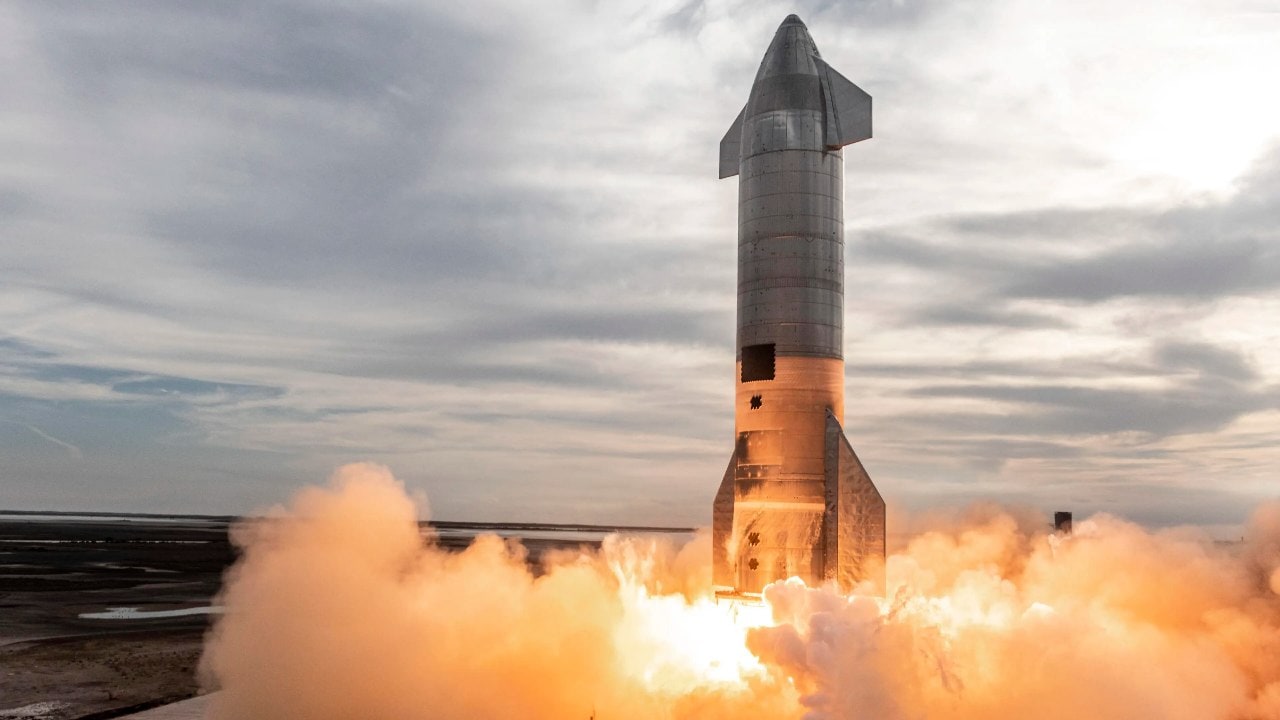
SpaceX's Starship rocket is fired up for launch test. Image credit: SpaceX[/caption]Flames continued to emerge from the base of the rocket after it landed, a result of the fuel used by the rocket, Insprucker said. Shortly after SpaceX concluded its official video feed, Elon Musk, the founder of the private space company, wrote a tweet calling the landing a success in the jargon of rocket engineering: "Starship landing nominal!"
A future model of the vehicle is central to Musk’s goal of one day carrying humans far beyond Earth’s orbit. NASA also recently awarded SpaceX a contract to build a version of Starship that would carry astronauts to the moon’s surface later this decade.In four previous tests, conducted since December, the rockets launched successfully and, after reaching an altitude of several miles, demonstrated controlled belly-flops back toward the ground. But each time, problems during landing or after the rocket touched down resulted in spectacular explosions.Wednesday’s flight was free of any such excitement. The vehicle, powered by its three engines, raced into the cloudy skies over Boca Chica, adjacent to the Gulf of Mexico. It travelled for four minutes to an altitude of about 6 miles, powering down engines and hovering for a time before beginning its trip back toward Earth’s surface.During the return to the landing pad, it flipped over into a horizontal orientation to begin its descent. As it neared the surface, it reactivated its engines and brought itself back into a vertical orientation, slowing its approach to the ground in a cloud of smoke. As the vapor cleared, the spacecraft stood upright, plumes continuing to vent from its sides.SpaceX takes a fail-fast, fix-fast approach, using the tests to identify shortcomings of design and making adjustments on subsequent flights. An announcement NASA made last month is certain to bring more attention to Starship’s progress and setbacks.A few weeks ago, NASA awarded a contract to SpaceX for $2.9 billion to use Starship to take astronauts from lunar orbit to the surface of the moon. The contract is part of the Artemis program, and NASA had been expected to choose more than one company to build a moon lander, mirroring the approach the space agency has used for hiring companies to take cargo and now astronauts to the International Space Station.After the announcement, NASA’s decision was challenged by the two other companies that were competing for the contract: Blue Origin, the private company founded by Jeff Bezos, the chief executive of Amazon; and Dynetics, a defence contractor in Huntsville, Alabama. NASA has now instructed SpaceX to halt work on the lunar Starship until the Government Accountability Office makes a decision on the protests. The challenge does not affect SpaceX’s work on the Starship models currently being tested in Texas.Musk’s company has become successful in the launch business, and it is now one of the world’s most valuable privately held companies. Its Falcon 9 rockets have become a dominant workhorse for sending satellites into orbit. It routinely transports cargo and astronauts to the International Space Station. In the last month, it has launched four astronauts to the space station for NASA and later brought home another crew in a nighttime splashdown on Saturday.However, many are sceptical of Musk’s assertion that the company is just a few years from sending a Starship to Mars, noting that he has repeatedly set timelines for SpaceX that proved far too optimistic.In 2019, when he provided an update on the development of Starship, he said that a high-altitude test would occur within months and that orbital flights could occur early in 2020.Instead, several catastrophic failures happened because of faulty welding. When the propellant tanks stopped rupturing, two of the prototypes made short successful flights last year. Those earlier Starship prototypes resembled spray paint cans with their labels removed, rising nearly 500 feet using a single rocket engine before setting back down at the Texas test site.Although it has lifted off the ground many times, Starship is a long way from being ready for a trip to orbit. But SpaceX already has its eyes on future tests that will send subsequent Starship prototypes to much greater altitudes. In March, Musk shared a picture of a prototype of the large booster stage that will be needed for a trip to space. It is over 200 feet tall.That prototype will not itself take flight, but Musk said the company’s goal was for a second model to launch by July.Kenneth Chang and Michael Roston c.2021 The New York Times CompanyFirst Published:May 06, 2021, 18:16:49 IST
Advertisement
Advertisement

Careless Whispers: Scientists discover that plants can 'talk' to each other using smells
Japanese scientists have recorded a video that shows plants, in certain conditions, communicate with each other using mists that carry smells. The discovery, reveals that plants release a fine mist of airborne compounds, to warn nearby plants of potential dangers
Life on Mars? European Space Agency’s Orbiter discovers ice water deposits at equator
European Space Agency's Mars Express Orbiter has identified massive ice and ice water deposits beneath the surface of Mars. The Mars Express orbiter was also the first to confirmed the presence of ice on Mars in 2004
Microsoft briefly overtakes Apple as the most valuable company, Apple back on top again
At its peak during the session, Microsoft's value reached $2.903 trillion, with a 2% surge. As of writing this article, Apple closed at $2.89 trillion, whereas Microsoft closed at $2.86 trillion
Even NASA is facing a tough time, starts layoffs following major budget cuts
NASA is facing some massive budget cuts, because of which, it has been forced to postpone some upcoming missions. NASA's Jet Propulsion Laboratory has been hit hard by recent federal budget cuts, resulting in the layoff of 100 contractors last week
ISRO, NASA's NISAR satellite to get ready by Jan-end, will monitor Earth's snow-covered regions
The NISAR satellite which has been developed jointly ISRO and NASA, should be ready for launch by the end of January 2024. The collaboration between NASA and ISRO on NISAR is the first time the two agencies have cooperated on hardware development for an Earth-observing mission
Advertisement
Advertisement