
Advertisement


Sections
SpaceX launches used Dragon capsule on 18th commercial resupply to space station
The successful launch marked the 18th mission under SpaceX's commercial resupply contract with NASA.

The SpaceX Dragon spacecraft successfully launched its third resupply mission — the eighteenth commercial resupply mission, to the International Space Station. SpaceX used a Falcon 9 rocket to launch a twice-used Dragon capsule carrying 2.5 metric tons of supplies to the orbiting laboratory.The Falcon 9 was scheduled to liftoff from launchpad SLC-40 at the Cape Canaveral Air Force Station, Florida on 24 July in an instantaneous, one-second launch window. This plan was scrubbed due to unseasonably strong winds, predicted showers and thunderstorms around the designated launchpad in Florida.Of all the previous launches under the contract, this is the seventh mission to feature a reused Dragon capsule — and the first time a Dragon capsule has run three prior resupply missions: the CRS-6 mission in April 2015, the CRS-13 mission in December 2017 and now, the CRS-18 mission.[caption id="attachment_7060451" align="alignnone" width="1280"]![]() A slightly-modified Falcon 9 lifts off on CRS-18 resupply mission to the ISS. Image: SpaceX[/caption]CRS-18 was the first time a twice-used Dragon has flown to the space station, but it may not be the last. Each of the next two resupplies — the CRS-19 mission planned for and CRS-20 planned for — will also be on Dragon capsules that have been similarly twice-used. Each Dragon cargo spacecraft is certified to fly three times before it needs to be retired, SpaceX officials told Space.com. SpaceX currently has a fleet of 13 Dragon capsules, each of which is scheduled for a flight approximately every year and a half.[caption id="attachment_7060461" align="alignnone" width="1280"]
A slightly-modified Falcon 9 lifts off on CRS-18 resupply mission to the ISS. Image: SpaceX[/caption]CRS-18 was the first time a twice-used Dragon has flown to the space station, but it may not be the last. Each of the next two resupplies — the CRS-19 mission planned for and CRS-20 planned for — will also be on Dragon capsules that have been similarly twice-used. Each Dragon cargo spacecraft is certified to fly three times before it needs to be retired, SpaceX officials told Space.com. SpaceX currently has a fleet of 13 Dragon capsules, each of which is scheduled for a flight approximately every year and a half.[caption id="attachment_7060461" align="alignnone" width="1280"]![SpaceX Dragon with depictions of two space station logos for two successful resupply missions prior. Image: SpaceX]() SpaceX Dragon with depictions of two space station logos for two successful resupply missions prior. Image: SpaceX[/caption]The Falcon 9's first stage was modified slightly in an experimental feature to study and test the thermal properties of the Falcon 9's second-stage propellant tank. The Falcon 9 also looked a little different from previous versions, with a gray stripe just above the black 'interstage' that connects the rocket's two stages.The CRS-18 mission was chosen to test out the new addition to Falcon 9 because SpaceX has carried out second-stage burn tests on earlier CRS missions and has a good baseline to compare the new modification to. Depending on how the tests go, the Falcon 9 could retain the gray stripe as a permanent addition, Space.com said.The last SpaceX resupply mission to the ISS was nearly a month ago on 25 June, with the third flight of the Falcon Heavy rocket carrying a rideshare sponsored by the US Air Force.
SpaceX Dragon with depictions of two space station logos for two successful resupply missions prior. Image: SpaceX[/caption]The Falcon 9's first stage was modified slightly in an experimental feature to study and test the thermal properties of the Falcon 9's second-stage propellant tank. The Falcon 9 also looked a little different from previous versions, with a gray stripe just above the black 'interstage' that connects the rocket's two stages.The CRS-18 mission was chosen to test out the new addition to Falcon 9 because SpaceX has carried out second-stage burn tests on earlier CRS missions and has a good baseline to compare the new modification to. Depending on how the tests go, the Falcon 9 could retain the gray stripe as a permanent addition, Space.com said.The last SpaceX resupply mission to the ISS was nearly a month ago on 25 June, with the third flight of the Falcon Heavy rocket carrying a rideshare sponsored by the US Air Force.
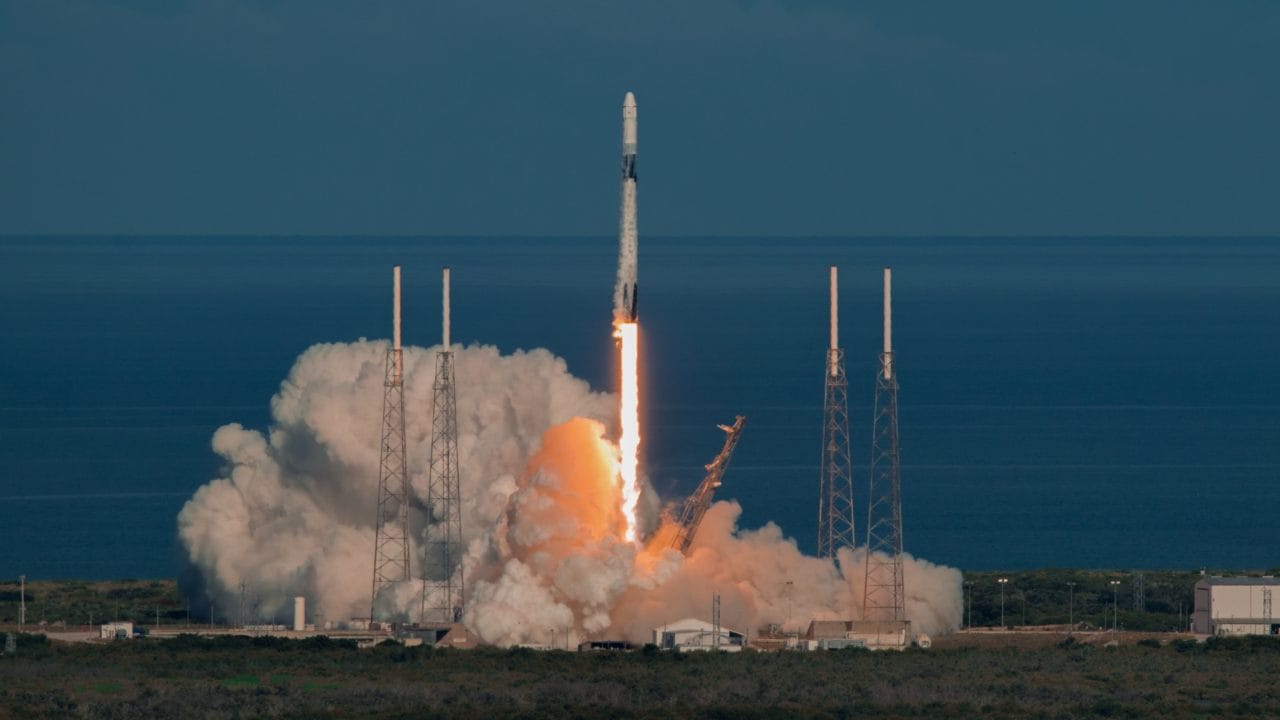 A slightly-modified Falcon 9 lifts off on CRS-18 resupply mission to the ISS. Image: SpaceX[/caption]CRS-18 was the first time a twice-used Dragon has flown to the space station, but it may not be the last. Each of the next two resupplies — the CRS-19 mission planned for and CRS-20 planned for — will also be on Dragon capsules that have been similarly twice-used. Each Dragon cargo spacecraft is certified to fly three times before it needs to be retired, SpaceX officials told Space.com. SpaceX currently has a fleet of 13 Dragon capsules, each of which is scheduled for a flight approximately every year and a half.[caption id="attachment_7060461" align="alignnone" width="1280"]
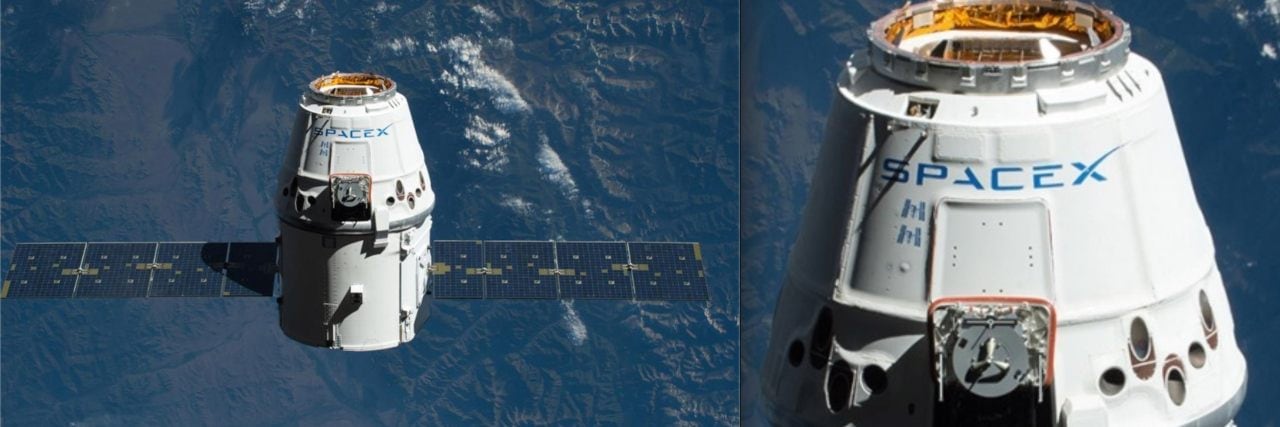 SpaceX Dragon with depictions of two space station logos for two successful resupply missions prior. Image: SpaceX[/caption]The Falcon 9's first stage was modified slightly in an experimental feature to study and test the thermal properties of the Falcon 9's second-stage propellant tank. The Falcon 9 also looked a little different from previous versions, with a gray stripe just above the black 'interstage' that connects the rocket's two stages.
First Published:Jul 26, 2019, 11:21:08 IST
Advertisement
Advertisement

Careless Whispers: Scientists discover that plants can 'talk' to each other using smells
Japanese scientists have recorded a video that shows plants, in certain conditions, communicate with each other using mists that carry smells. The discovery, reveals that plants release a fine mist of airborne compounds, to warn nearby plants of potential dangers
Life on Mars? European Space Agency’s Orbiter discovers ice water deposits at equator
European Space Agency's Mars Express Orbiter has identified massive ice and ice water deposits beneath the surface of Mars. The Mars Express orbiter was also the first to confirmed the presence of ice on Mars in 2004
Microsoft briefly overtakes Apple as the most valuable company, Apple back on top again
At its peak during the session, Microsoft's value reached $2.903 trillion, with a 2% surge. As of writing this article, Apple closed at $2.89 trillion, whereas Microsoft closed at $2.86 trillion
Even NASA is facing a tough time, starts layoffs following major budget cuts
NASA is facing some massive budget cuts, because of which, it has been forced to postpone some upcoming missions. NASA's Jet Propulsion Laboratory has been hit hard by recent federal budget cuts, resulting in the layoff of 100 contractors last week
ISRO, NASA's NISAR satellite to get ready by Jan-end, will monitor Earth's snow-covered regions
The NISAR satellite which has been developed jointly ISRO and NASA, should be ready for launch by the end of January 2024. The collaboration between NASA and ISRO on NISAR is the first time the two agencies have cooperated on hardware development for an Earth-observing mission
Advertisement
Advertisement