
Advertisement


Sections
SpaceX Falcon 9's failed landing may hide a silver lining in its readiness, safety
The rocket targets a water landing if it loses control, a senior SpaceX engineer explained.

SpaceX saw its first ever failed attempt at landing its reusable Falcon 9 booster, which was expected to land at the Cape Canaveral Landing Zone after launching the Dragon capsule in an resupply mission to the International Space Station (ISS) on 5 December.The rocket’s titanium ‘grid fins’– the large directional fins that guide the rocket during its landing after re-entry – stalled after what was apparently a mechanical failure. The Falcon 9 booster didn't land anywhere close to land, making a gentle splash into the Atlantic waters off the Florida coast instead.The rocket can be seen spiralling out of control and missing its mark by quite a distance, but completely in control as it reaches the water. It lolled in the water for a few hours before a ship came to tow the massive Falcon 9 back to shore.[caption id="attachment_5696171" align="alignnone" width="1280"]![SpaceX Falcon 9 booster being towed back to shore. Image courtesy: Twitter/Restrantek]() SpaceX Falcon 9 booster being towed back to shore. Image courtesy: Twitter/Restrantek[/caption]To anyone that isn’t a SpaceX engineer or rocket scientist, it may look like the landing was a total bust, a mistake.In the seconds between the rocket's reentry into the atmosphere and landing burns (where the thrusters are fired to control the rocket's movements), the booster began to spin and hit transonic speeds. While that sounds and looks bad, those with enough rocketry know-how might appreciate what may have been a success in the failure.By triggering a programmed safety sequence after the grid fin began to malfunction, the rocket guided itself well away from its designated landing zone and prevented what could have been a far more damaging touchdown.[caption id="attachment_5696301" align="alignnone" width="1280"]
SpaceX Falcon 9 booster being towed back to shore. Image courtesy: Twitter/Restrantek[/caption]To anyone that isn’t a SpaceX engineer or rocket scientist, it may look like the landing was a total bust, a mistake.In the seconds between the rocket's reentry into the atmosphere and landing burns (where the thrusters are fired to control the rocket's movements), the booster began to spin and hit transonic speeds. While that sounds and looks bad, those with enough rocketry know-how might appreciate what may have been a success in the failure.By triggering a programmed safety sequence after the grid fin began to malfunction, the rocket guided itself well away from its designated landing zone and prevented what could have been a far more damaging touchdown.[caption id="attachment_5696301" align="alignnone" width="1280"]![Falcon 9 tilting before water splash. Image credit: Twitter/MarcusCole]() Falcon 9 tilting before water splash. Image credit: Twitter/MarcusCole[/caption]"It actually targets a landing spot in the water if it loses control," explained Hans Koenigsmann, SpaceX's vice president of build and flight reliability during the post-launch press conference. "It's trying to stay away from land…trying to stay safe."From the below video of the rocket, it can be seen making a near-vertical landing on the water surface before it tips over and falls sideways.While there’s no doubt about the rocket’s failure to land, the incident did succeed in bringing out an important element in the rocket’s design: how ready it is in the event that something goes very wrong. Elon Musk explained in a tweet that it appeared the rocket was undamaged and still transmitting data, and expressed what he saw was the problem with the landing. Koenigsmann echoed Musk’s thoughts during the post-launch briefing, saying, "I’m pretty sure it is going to result in potentially adding a backup to supply the grid fins with hydraulic power." SpaceX still is conducting diagnostic tests to pinpoint any other issues that may have added to the mishap and working on a plan to prevent faulty future landings. The mission was otherwise a success: Falcon 9 launched the Dragon capsule loaded with 5600 pounds of supplies to the ISS. 650 of those pounds were science experiments alone, there was also holiday cargo like candied yams, turkey and Christmas cookies for the astronauts currently manning the space station, NASA said in a statement.
Falcon 9 tilting before water splash. Image credit: Twitter/MarcusCole[/caption]"It actually targets a landing spot in the water if it loses control," explained Hans Koenigsmann, SpaceX's vice president of build and flight reliability during the post-launch press conference. "It's trying to stay away from land…trying to stay safe."From the below video of the rocket, it can be seen making a near-vertical landing on the water surface before it tips over and falls sideways.While there’s no doubt about the rocket’s failure to land, the incident did succeed in bringing out an important element in the rocket’s design: how ready it is in the event that something goes very wrong. Elon Musk explained in a tweet that it appeared the rocket was undamaged and still transmitting data, and expressed what he saw was the problem with the landing. Koenigsmann echoed Musk’s thoughts during the post-launch briefing, saying, "I’m pretty sure it is going to result in potentially adding a backup to supply the grid fins with hydraulic power." SpaceX still is conducting diagnostic tests to pinpoint any other issues that may have added to the mishap and working on a plan to prevent faulty future landings. The mission was otherwise a success: Falcon 9 launched the Dragon capsule loaded with 5600 pounds of supplies to the ISS. 650 of those pounds were science experiments alone, there was also holiday cargo like candied yams, turkey and Christmas cookies for the astronauts currently manning the space station, NASA said in a statement.
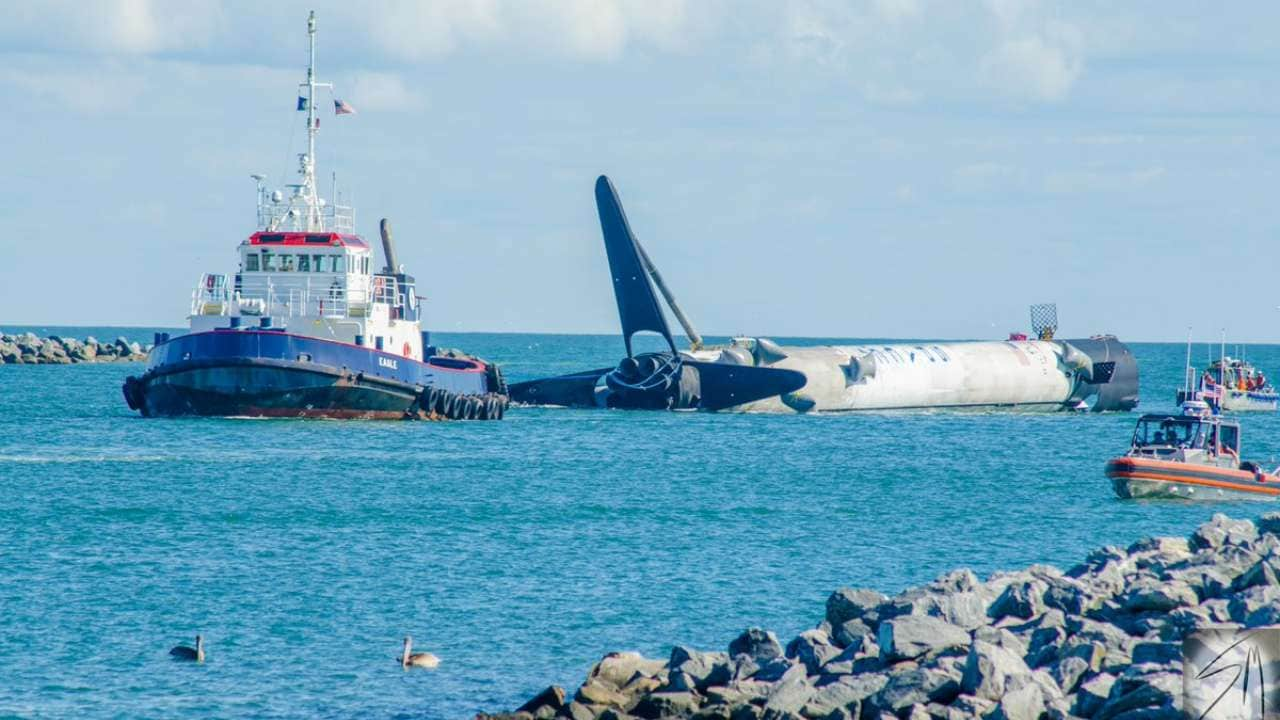 SpaceX Falcon 9 booster being towed back to shore. Image courtesy: Twitter/Restrantek[/caption]To anyone that isn’t a SpaceX engineer or rocket scientist, it may look like the landing was a total bust, a mistake.In the seconds between the rocket's reentry into the atmosphere and landing burns (where the thrusters are fired to control the rocket's movements), the booster began to spin and hit transonic speeds. While that sounds and looks bad, those with enough rocketry know-how might appreciate what may have been a success in the failure.By triggering a programmed safety sequence after the grid fin began to malfunction, the rocket guided itself well away from its designated landing zone and prevented what could have been a far more damaging touchdown.[caption id="attachment_5696301" align="alignnone" width="1280"]
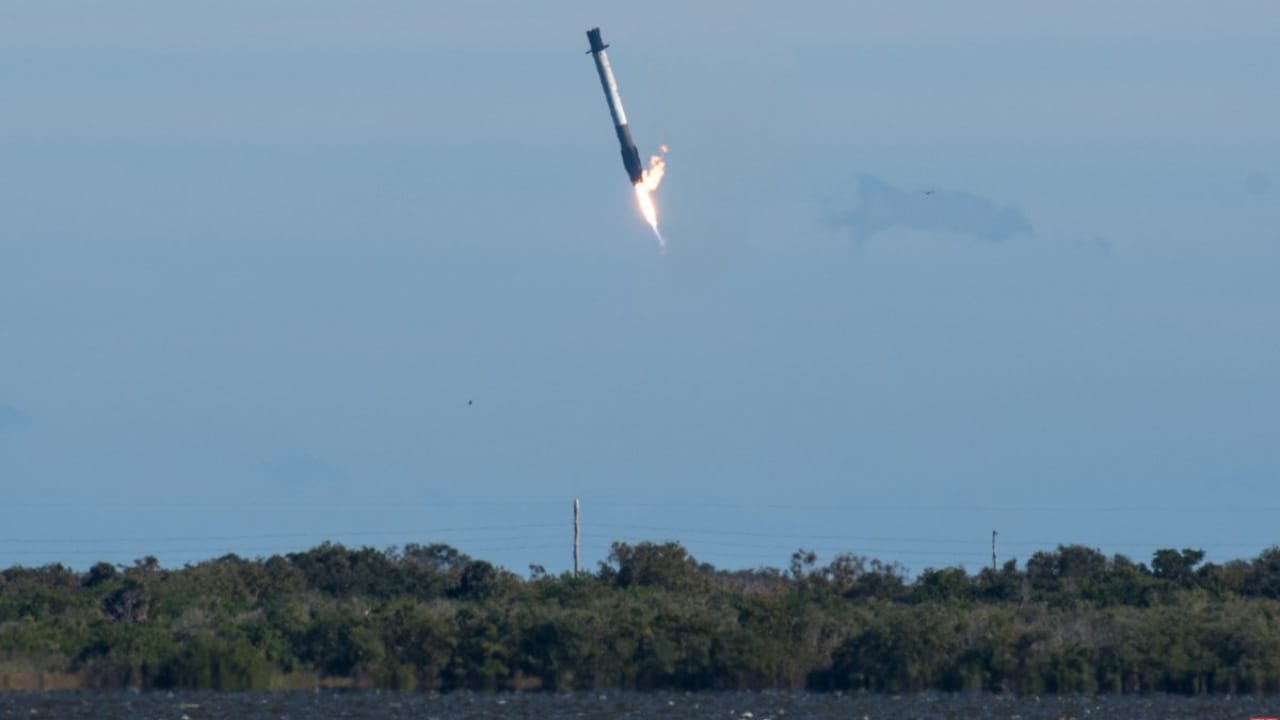 Falcon 9 tilting before water splash. Image credit: Twitter/MarcusCole[/caption]"It actually targets a landing spot in the water if it loses control," explained Hans Koenigsmann, SpaceX's vice president of build and flight reliability during the post-launch press conference. "It's trying to stay away from land…trying to stay safe."From the below video of the rocket, it can be seen making a near-vertical landing on the water surface before it tips over and falls sideways.While there’s no doubt about the rocket’s failure to land, the incident did succeed in bringing out an important element in the rocket’s design: how ready it is in the event that something goes very wrong. Elon Musk explained in a tweet that it appeared the rocket was undamaged and still transmitting data, and expressed what he saw was the problem with the landing. Koenigsmann echoed Musk’s thoughts during the post-launch briefing, saying, "I’m pretty sure it is going to result in potentially adding a backup to supply the grid fins with hydraulic power." SpaceX still is conducting diagnostic tests to pinpoint any other issues that may have added to the mishap and working on a plan to prevent faulty future landings. The mission was otherwise a success: Falcon 9 launched the Dragon capsule loaded with 5600 pounds of supplies to the ISS. 650 of those pounds were science experiments alone, there was also holiday cargo like candied yams, turkey and Christmas cookies for the astronauts currently manning the space station, NASA said in a statement.
 First Published:Dec 08, 2018, 15:50:46 IST
Advertisement
Advertisement

Careless Whispers: Scientists discover that plants can 'talk' to each other using smells
Japanese scientists have recorded a video that shows plants, in certain conditions, communicate with each other using mists that carry smells. The discovery, reveals that plants release a fine mist of airborne compounds, to warn nearby plants of potential dangers
Life on Mars? European Space Agency’s Orbiter discovers ice water deposits at equator
European Space Agency's Mars Express Orbiter has identified massive ice and ice water deposits beneath the surface of Mars. The Mars Express orbiter was also the first to confirmed the presence of ice on Mars in 2004
Microsoft briefly overtakes Apple as the most valuable company, Apple back on top again
At its peak during the session, Microsoft's value reached $2.903 trillion, with a 2% surge. As of writing this article, Apple closed at $2.89 trillion, whereas Microsoft closed at $2.86 trillion
Even NASA is facing a tough time, starts layoffs following major budget cuts
NASA is facing some massive budget cuts, because of which, it has been forced to postpone some upcoming missions. NASA's Jet Propulsion Laboratory has been hit hard by recent federal budget cuts, resulting in the layoff of 100 contractors last week
ISRO, NASA's NISAR satellite to get ready by Jan-end, will monitor Earth's snow-covered regions
The NISAR satellite which has been developed jointly ISRO and NASA, should be ready for launch by the end of January 2024. The collaboration between NASA and ISRO on NISAR is the first time the two agencies have cooperated on hardware development for an Earth-observing mission
Advertisement
Advertisement