


Scientists detect mammoth collision of 'impossible' black holes for first time
It is thought that black holes are the vacuum cleaners of the Universe, sucking in everything in their paths.

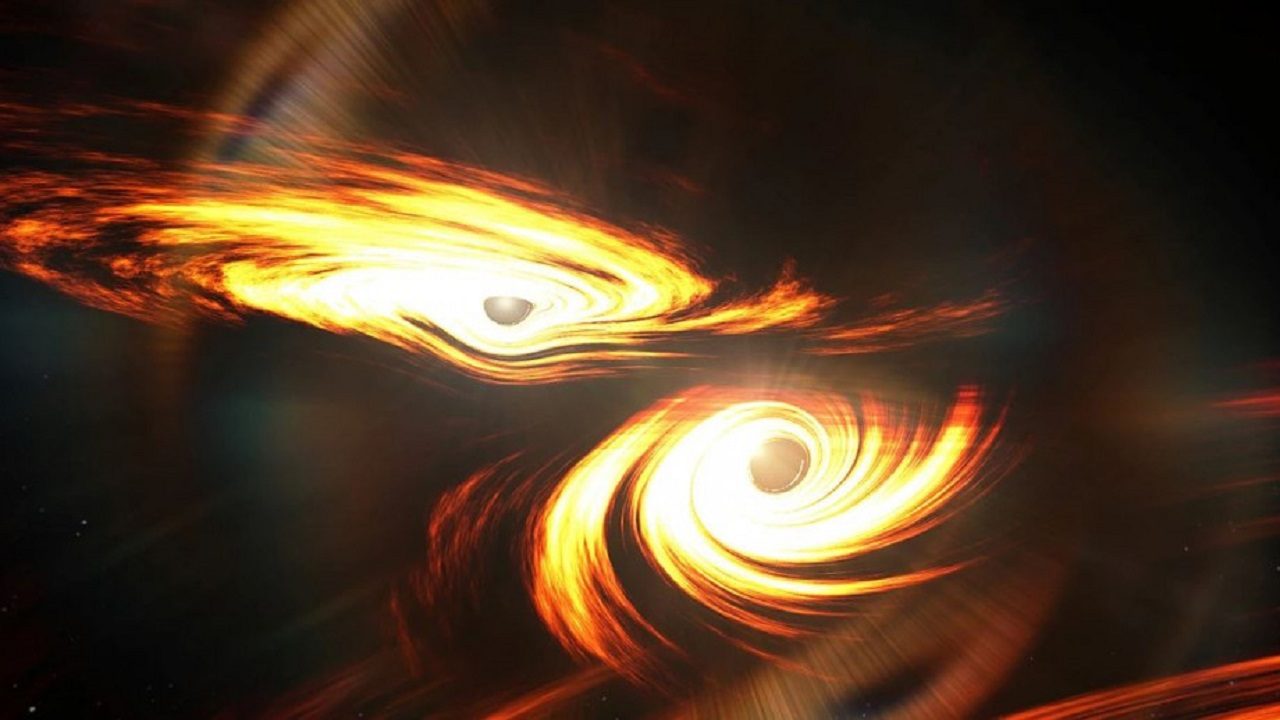
Artist impression of binary black holes about to colide. Image credit: ANU/ARC centre of excellence for gravtiational wave discovery[/caption]However, according to study authors, the larger of the two black holes falls in a forbidden range that is called the upper black hole mass gap and should be 'impossible'.Speaking about it, co-author of the publication from ANU, Professor Susan Scott said it is thought that black holes are the vacuum cleaners of the Universe, sucking in everything in their paths. She went on to add, "They also suck in other black holes and it is possible to produce bigger and bigger black holes by the ongoing collisions of earlier generations of black holes. The heavier `impossible' black hole in our detected collision may have been produced in this way."According to study authors, both the black holes merged when the Universe was roughly half of its present age. This led them to form an even larger black hole which was 142 times the mass of the sin and by far the largest black hole ever observed through gravitational-wave observations."The ‘impossible’ black hole formed by the collision lies in the black hole desert between 100 and 1,000 times the mass of the Sun," Professor Scott said.She added that they are very excited to have achieved the first direct observation of an IMBH in this mass range."We also saw how it formed, confirming that IMBHs can be produced through the merger of two smaller black holes," Professor Scott said.The ANU statement added that another recent study by scientists using Caltech's Zwicky Transient Facility may have spotted a light flare from the collision as well.Study authors say this is surprising as black holes and their mergers are dark to telescopes. They think that the newly formed black hole may have received a kick from the collision and shot off in a new direction, surging through the disk of gas surrounding the supermassive black hole and lighting up.

Careless Whispers: Scientists discover that plants can 'talk' to each other using smells
Life on Mars? European Space Agency’s Orbiter discovers ice water deposits at equator
Microsoft briefly overtakes Apple as the most valuable company, Apple back on top again
Even NASA is facing a tough time, starts layoffs following major budget cuts
ISRO, NASA's NISAR satellite to get ready by Jan-end, will monitor Earth's snow-covered regions