
Advertisement


Sections
Samples of asteroid Bennu are spilling out from NASA's jammed OSIRIS-REx spacecraft
Bennu was chosen by NASA for its carbon-rich character, thought to have held on to the building blocks of the solar system.

A NASA spacecraft is stuffed with so much asteroid rubble from this week’s grab that it’s jammed open and precious particles are drifting away in space, scientists said Friday. Scientists announced the news three days after the spacecraft named Osiris-Rex briefly touched asteroid Bennu, NASA’s first attempt at such a mission. The mission’s lead scientist, Dante Lauretta of the University of Arizona, said Tuesday’s operation 200 million miles away collected far more material than expected for return to Earth — in the hundreds of grams.The sample container on the end of the robot arm penetrated so deeply into the asteroid and with such force, however, that rocks got sucked in and became wedged around the rim of the lid. Scientists estimate the sampler pressed as much as 19 inches (48 centimetres) into the rough, crumbly, black terrain.“We’re almost a victim of our own success here,” Lauretta said at a hastily arranged news conference.[caption id="attachment_8952181" align="alignnone" width="1280"]![The OSIRIS spacecraft arm colliding with Bennu. Image Courtesy: NASA Goddard/YouTube]() The OSIRIS spacecraft arm colliding with Bennu. Image Courtesy: NASA Goddard/YouTube[/caption]Lauretta said there is nothing flight controllers can do to clear the obstructions and prevent more bits of Bennu from escaping, other than to get the samples into their return capsule as soon as possible. So, the flight team was scrambling to put the sample container into the capsule as early as Tuesday — much sooner than originally planned — for the long trip home.“Time is of the essence,” said Thomas Zurbuchen, chief of NASA’s science missions.This is NASA’s first asteroid sample-return mission. Bennu was chosen because its carbon-rich material is believed to hold the preserved building blocks of our solar system. Getting pieces from this cosmic time capsule could help scientists better understand how the planets formed billions of years ago and how life originated on Earth.Scientists were stunned — and then dismayed — on Thursday when they saw the pictures coming from Osiris-Rex following its wildly successful touch-and-go at Bennu two days earlier.A cloud of asteroid particles could be seen swirling around the spacecraft as it backed away from Bennu. The situation appeared to stabilize, according to Lauretta, once the robot arm was locked into place. But it was impossible to know exactly how much had already been lost.The requirement for the $800 million-plus mission was to bring back a minimum 2 ounces (60 grams).Regardless of what’s on board, Osiris-Rex will still leave the vicinity of the asteroid in March — that’s the earliest possible departure given the relative locations of Earth and Bennu. The samples won’t make it back until 2023, seven years after the spacecraft rocketed away from Cape Canaveral.Osiris-Rex will keep drifting away from Bennu and will not orbit it again, as it waits for its scheduled departure.Because of the sudden turn of events, scientists won’t know how much the sample capsule holds until it’s back on Earth. They initially planned to spin the spacecraft to measure the contents, but that maneuver was canceled since it could spill even more debris.“I think we’re going to have to wait until we get home to know precisely how much we have,” Lauretta told reporters. “As you can imagine, that’s hard. ... But the good news is we see a lot of material.”Japan, meanwhile, is awaiting its second batch of samples taken from a different asteroid, due back in December.
The OSIRIS spacecraft arm colliding with Bennu. Image Courtesy: NASA Goddard/YouTube[/caption]Lauretta said there is nothing flight controllers can do to clear the obstructions and prevent more bits of Bennu from escaping, other than to get the samples into their return capsule as soon as possible. So, the flight team was scrambling to put the sample container into the capsule as early as Tuesday — much sooner than originally planned — for the long trip home.“Time is of the essence,” said Thomas Zurbuchen, chief of NASA’s science missions.This is NASA’s first asteroid sample-return mission. Bennu was chosen because its carbon-rich material is believed to hold the preserved building blocks of our solar system. Getting pieces from this cosmic time capsule could help scientists better understand how the planets formed billions of years ago and how life originated on Earth.Scientists were stunned — and then dismayed — on Thursday when they saw the pictures coming from Osiris-Rex following its wildly successful touch-and-go at Bennu two days earlier.A cloud of asteroid particles could be seen swirling around the spacecraft as it backed away from Bennu. The situation appeared to stabilize, according to Lauretta, once the robot arm was locked into place. But it was impossible to know exactly how much had already been lost.The requirement for the $800 million-plus mission was to bring back a minimum 2 ounces (60 grams).Regardless of what’s on board, Osiris-Rex will still leave the vicinity of the asteroid in March — that’s the earliest possible departure given the relative locations of Earth and Bennu. The samples won’t make it back until 2023, seven years after the spacecraft rocketed away from Cape Canaveral.Osiris-Rex will keep drifting away from Bennu and will not orbit it again, as it waits for its scheduled departure.Because of the sudden turn of events, scientists won’t know how much the sample capsule holds until it’s back on Earth. They initially planned to spin the spacecraft to measure the contents, but that maneuver was canceled since it could spill even more debris.“I think we’re going to have to wait until we get home to know precisely how much we have,” Lauretta told reporters. “As you can imagine, that’s hard. ... But the good news is we see a lot of material.”Japan, meanwhile, is awaiting its second batch of samples taken from a different asteroid, due back in December.
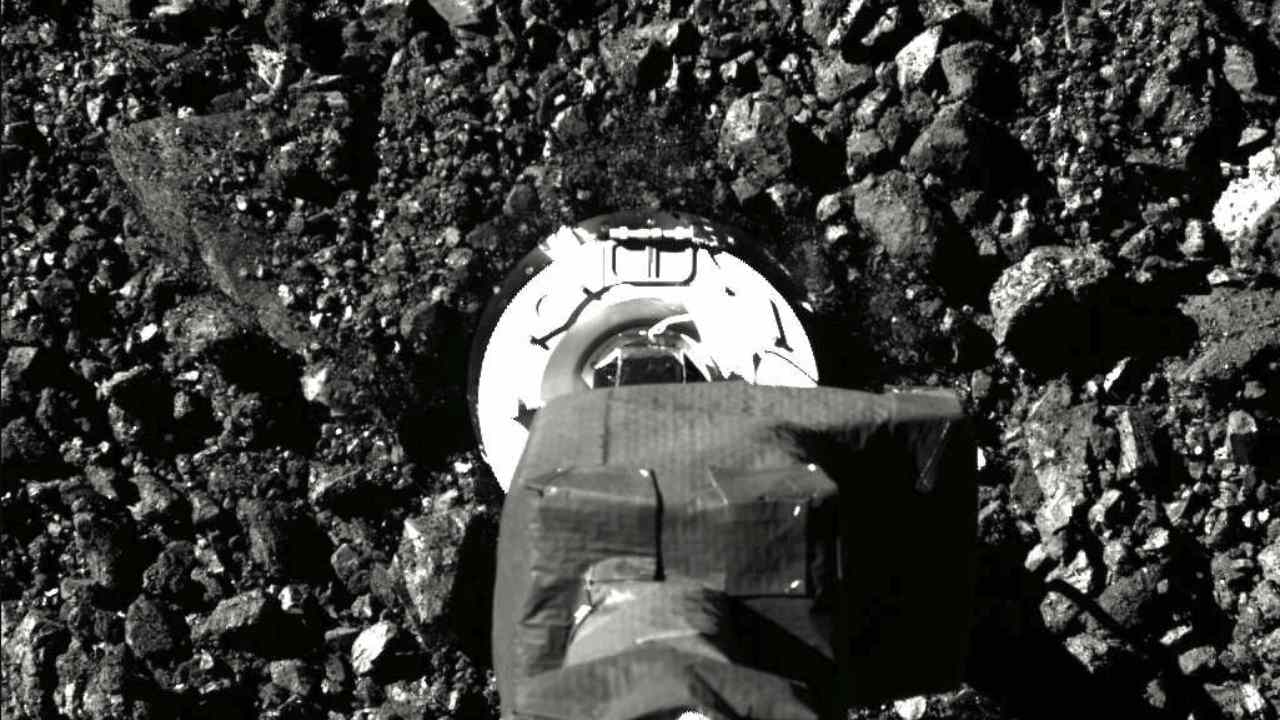 The OSIRIS spacecraft arm colliding with Bennu. Image Courtesy: NASA Goddard/YouTube[/caption]Lauretta said there is nothing flight controllers can do to clear the obstructions and prevent more bits of Bennu from escaping, other than to get the samples into their return capsule as soon as possible. So, the flight team was scrambling to put the sample container into the capsule as early as Tuesday — much sooner than originally planned — for the long trip home.“Time is of the essence,” said Thomas Zurbuchen, chief of NASA’s science missions.This is NASA’s first asteroid sample-return mission. Bennu was chosen because its carbon-rich material is believed to hold the preserved building blocks of our solar system. Getting pieces from this cosmic time capsule could help scientists better understand how the planets formed billions of years ago and how life originated on Earth.Scientists were stunned — and then dismayed — on Thursday when they saw the pictures coming from Osiris-Rex following its wildly successful touch-and-go at Bennu two days earlier.A cloud of asteroid particles could be seen swirling around the spacecraft as it backed away from Bennu. The situation appeared to stabilize, according to Lauretta, once the robot arm was locked into place. But it was impossible to know exactly how much had already been lost.
First Published:Oct 26, 2020, 10:18:17 IST
Advertisement
Advertisement

Careless Whispers: Scientists discover that plants can 'talk' to each other using smells
Japanese scientists have recorded a video that shows plants, in certain conditions, communicate with each other using mists that carry smells. The discovery, reveals that plants release a fine mist of airborne compounds, to warn nearby plants of potential dangers
Life on Mars? European Space Agency’s Orbiter discovers ice water deposits at equator
European Space Agency's Mars Express Orbiter has identified massive ice and ice water deposits beneath the surface of Mars. The Mars Express orbiter was also the first to confirmed the presence of ice on Mars in 2004
Microsoft briefly overtakes Apple as the most valuable company, Apple back on top again
At its peak during the session, Microsoft's value reached $2.903 trillion, with a 2% surge. As of writing this article, Apple closed at $2.89 trillion, whereas Microsoft closed at $2.86 trillion
Even NASA is facing a tough time, starts layoffs following major budget cuts
NASA is facing some massive budget cuts, because of which, it has been forced to postpone some upcoming missions. NASA's Jet Propulsion Laboratory has been hit hard by recent federal budget cuts, resulting in the layoff of 100 contractors last week
ISRO, NASA's NISAR satellite to get ready by Jan-end, will monitor Earth's snow-covered regions
The NISAR satellite which has been developed jointly ISRO and NASA, should be ready for launch by the end of January 2024. The collaboration between NASA and ISRO on NISAR is the first time the two agencies have cooperated on hardware development for an Earth-observing mission
Advertisement
Advertisement