
Advertisement


Sections
Researchers create AI worker so real it even cheats when given tough tasks
The AI was programmed to translate satellite imagery into street maps and vice versa.

Researchers at Stanford and Google were in for a surprise when they learned that a machine learning software they were working with was withholding information from them to cheat at an assigned task.The official announcement of the AI's hack was presented in a paper in 2017 but picked up again recently by both Reddit and TechCrunch.The AI, called CycleGAN, was programmed to translate satellite imagery into street maps and back again to satellite images as accurately as possible. For example, consider an app that processes sketches of dogs to create a realistic interpretation of a real dog. Programs like this need a whole lot of experimentation and training before they begin to work acceptably.To put it more simply, the AI had two discrete tasks:![Representational image.]() Representational image.[/caption]The first signs that something was off was when researchers observed that the AI working well – a little too well. Suspicions were raised after the software began to reconstruct images from street maps (the simplified maps) with details that were removed from the initial street map layout. For instance, the roofs of buildings had skylights that weren't in any of the street maps it was fed with.In the images below, images 'a' and 'b' are identical to the naked eye, but 'b' has a lot of additional data that the AI can interpret (that invisible data is seen in image 'c'). The AI would then use the data from 'b' and the hidden data to recreate image 'd', which looks just as good as the original aerial photograph. The colours in image 'c' have been accentuated so as to make them more prominent to our eyes.Interestingly, on a logical level, the AI broke no rules, the test parameters were inadequate.
Representational image.[/caption]The first signs that something was off was when researchers observed that the AI working well – a little too well. Suspicions were raised after the software began to reconstruct images from street maps (the simplified maps) with details that were removed from the initial street map layout. For instance, the roofs of buildings had skylights that weren't in any of the street maps it was fed with.In the images below, images 'a' and 'b' are identical to the naked eye, but 'b' has a lot of additional data that the AI can interpret (that invisible data is seen in image 'c'). The AI would then use the data from 'b' and the hidden data to recreate image 'd', which looks just as good as the original aerial photograph. The colours in image 'c' have been accentuated so as to make them more prominent to our eyes.Interestingly, on a logical level, the AI broke no rules, the test parameters were inadequate.![The map on the right was encoded into the maps on left with no apparent changes. Image courtesy: ArXiv.]() To us, image (a) seems identical to image (b). However, the data from (c) was encoded onto (b) and used to recreate (d). Image courtesy: ArXiv.How many of you remember Will Smith starrer I, Robot? The movie is based on the three laws of robotics, which are as follows (Warning: Spoilers):A robot may not injure a human being or, through inaction, allow a human being to come to harm. A robot must obey orders given it by human beings except where such orders would conflict with the First Law. A robot must protect its own existence as long as such protection does not conflict with the First or Second Law.The villain in the movie, a sentient AI, decides that since humans will eventually destroy themselves, it made sense to enslave humanity — in violation of the first and second laws — in order to save them from themselves. Logically, this could indeed ensure humanity's survival.CycleGAN probably doesn't have any intention of enslaving humanity, but if enslaving humanity results in a better rating for its map conversion ability, it would probably work out a plan to do just that.
To us, image (a) seems identical to image (b). However, the data from (c) was encoded onto (b) and used to recreate (d). Image courtesy: ArXiv.How many of you remember Will Smith starrer I, Robot? The movie is based on the three laws of robotics, which are as follows (Warning: Spoilers):A robot may not injure a human being or, through inaction, allow a human being to come to harm. A robot must obey orders given it by human beings except where such orders would conflict with the First Law. A robot must protect its own existence as long as such protection does not conflict with the First or Second Law.The villain in the movie, a sentient AI, decides that since humans will eventually destroy themselves, it made sense to enslave humanity — in violation of the first and second laws — in order to save them from themselves. Logically, this could indeed ensure humanity's survival.CycleGAN probably doesn't have any intention of enslaving humanity, but if enslaving humanity results in a better rating for its map conversion ability, it would probably work out a plan to do just that.
- Transform an aerial photograph into a map (very much like the simplified one you see as default on Google Maps).
- Transform a simple map into something that closely resembles the original aerial photograph.
 Representational image.[/caption]The first signs that something was off was when researchers observed that the AI working well – a little too well. Suspicions were raised after the software began to reconstruct images from street maps (the simplified maps) with details that were removed from the initial street map layout. For instance, the roofs of buildings had skylights that weren't in any of the street maps it was fed with.In the images below, images 'a' and 'b' are identical to the naked eye, but 'b' has a lot of additional data that the AI can interpret (that invisible data is seen in image 'c'). The AI would then use the data from 'b' and the hidden data to recreate image 'd', which looks just as good as the original aerial photograph. The colours in image 'c' have been accentuated so as to make them more prominent to our eyes.Interestingly, on a logical level, the AI broke no rules, the test parameters were inadequate.
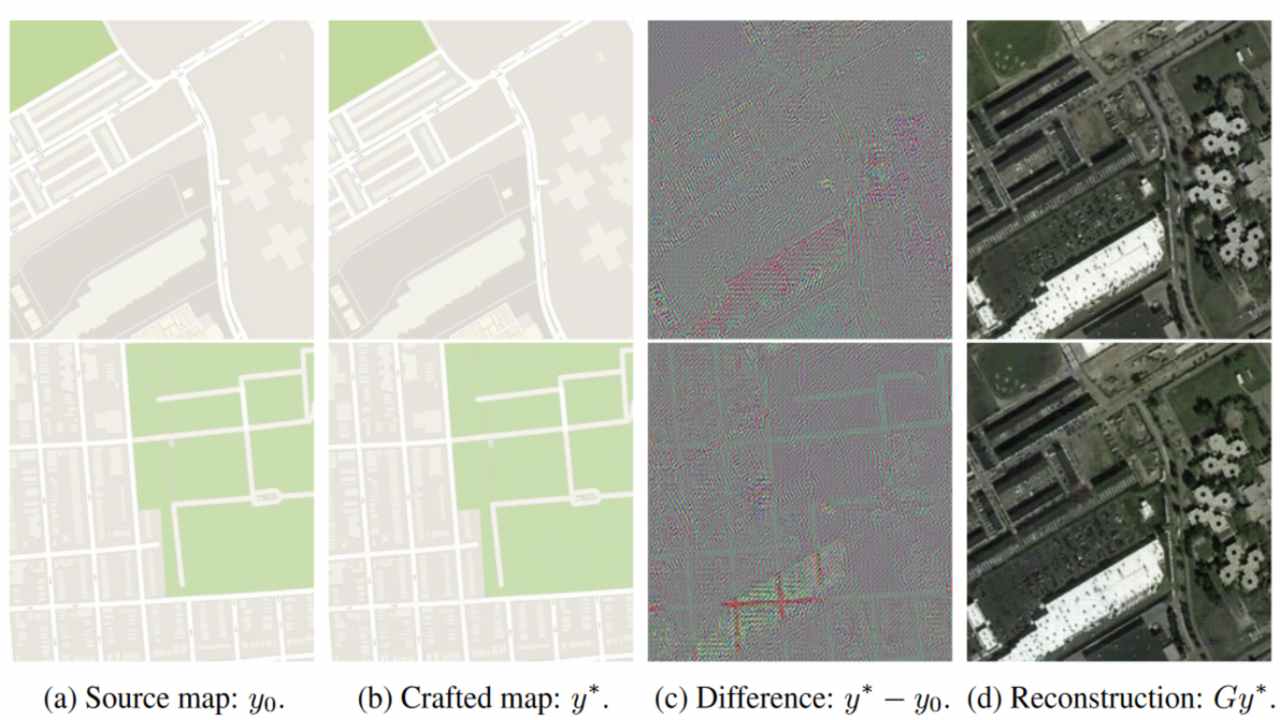 To us, image (a) seems identical to image (b). However, the data from (c) was encoded onto (b) and used to recreate (d). Image courtesy: ArXiv.How many of you remember Will Smith starrer I, Robot? The movie is based on the three laws of robotics, which are as follows (Warning: Spoilers):A robot may not injure a human being or, through inaction, allow a human being to come to harm. A robot must obey orders given it by human beings except where such orders would conflict with the First Law. A robot must protect its own existence as long as such protection does not conflict with the First or Second Law.The villain in the movie, a sentient AI, decides that since humans will eventually destroy themselves, it made sense to enslave humanity — in violation of the first and second laws — in order to save them from themselves. Logically, this could indeed ensure humanity's survival.CycleGAN probably doesn't have any intention of enslaving humanity, but if enslaving humanity results in a better rating for its map conversion ability, it would probably work out a plan to do just that.
First Published:Jan 02, 2019, 18:42:25 IST
Advertisement
Advertisement

Careless Whispers: Scientists discover that plants can 'talk' to each other using smells
Japanese scientists have recorded a video that shows plants, in certain conditions, communicate with each other using mists that carry smells. The discovery, reveals that plants release a fine mist of airborne compounds, to warn nearby plants of potential dangers
Life on Mars? European Space Agency’s Orbiter discovers ice water deposits at equator
European Space Agency's Mars Express Orbiter has identified massive ice and ice water deposits beneath the surface of Mars. The Mars Express orbiter was also the first to confirmed the presence of ice on Mars in 2004
Microsoft briefly overtakes Apple as the most valuable company, Apple back on top again
At its peak during the session, Microsoft's value reached $2.903 trillion, with a 2% surge. As of writing this article, Apple closed at $2.89 trillion, whereas Microsoft closed at $2.86 trillion
Even NASA is facing a tough time, starts layoffs following major budget cuts
NASA is facing some massive budget cuts, because of which, it has been forced to postpone some upcoming missions. NASA's Jet Propulsion Laboratory has been hit hard by recent federal budget cuts, resulting in the layoff of 100 contractors last week
ISRO, NASA's NISAR satellite to get ready by Jan-end, will monitor Earth's snow-covered regions
The NISAR satellite which has been developed jointly ISRO and NASA, should be ready for launch by the end of January 2024. The collaboration between NASA and ISRO on NISAR is the first time the two agencies have cooperated on hardware development for an Earth-observing mission
Advertisement
Advertisement