


Pac-Man-like behaviour could explain how massive, spinning black holes merge
Researchers are hoping to find signs of large, spinning black holes that can help in the hunt for gravitational waves.

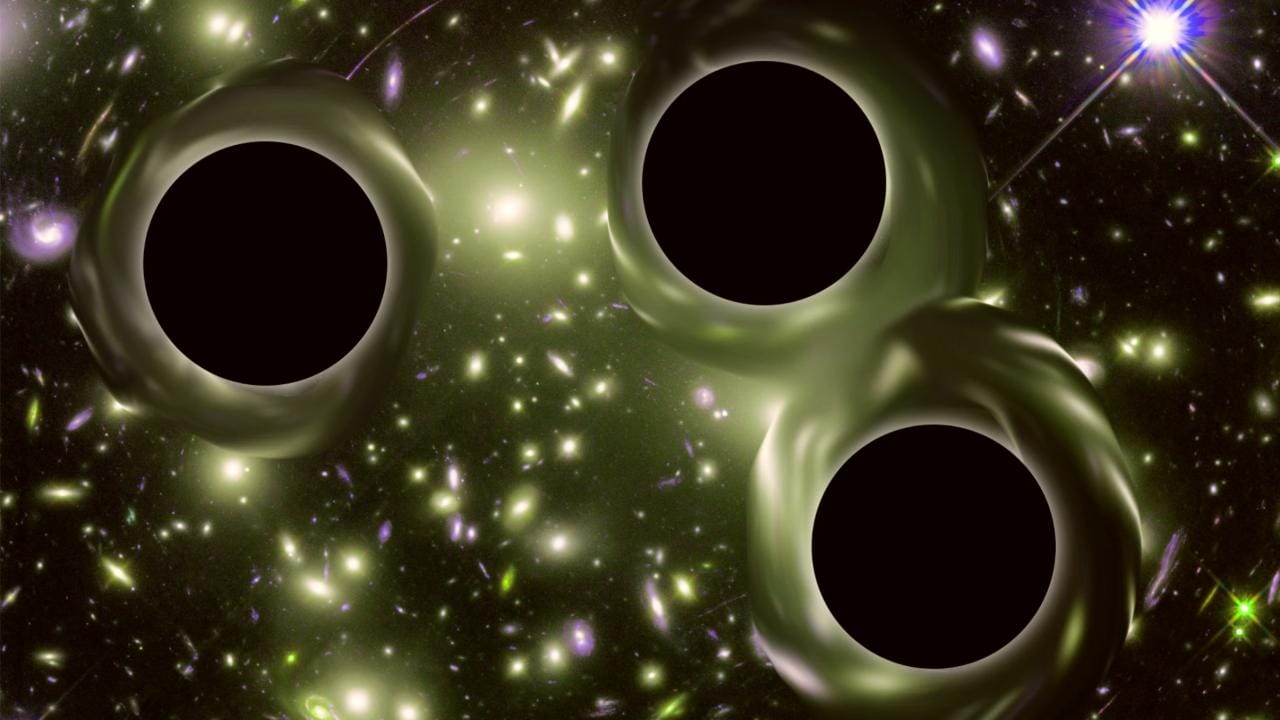
Concept artwork of 3 black holes in a merger. Image: Flickr NASA Goddard Jordan Pearson[/caption]According to the researchers, gas, stars, dust, and black holes may get caught in a region surrounding supermassive black holes known as an accretion disk. As black holes circle around in the accretion disk, they may eventually collide and merge to form a bigger black hole, which may continue to devour smaller black holes, becoming increasingly large in a "Pac-Man-like" behaviour, according to study co-author Richard O’Shaughnessy from Rochester Institute of Technology."It offers a natural way to explain high mass, high spin binary black hole mergers and to produce binaries in parts of parameter space that the other models cannot populate. There is no way to get certain types of black holes out of these other formation channels," O'Shaughnessy said.The researchers hope to find signatures of large, spinning black holes that could help confirm their models as labs across the world continue to hunt for gravitational waves."This could be a unique way of probing the physics around these supermassive black holes in a way that could not be probed in any other way," said O’Shaughnessy. "It offers unique insight into how the centres of galaxies grow, which is of course essential to understanding how galaxies as a whole grow, which explains most of the structure in the universe," he said

Careless Whispers: Scientists discover that plants can 'talk' to each other using smells
Life on Mars? European Space Agency’s Orbiter discovers ice water deposits at equator
Microsoft briefly overtakes Apple as the most valuable company, Apple back on top again
Even NASA is facing a tough time, starts layoffs following major budget cuts
ISRO, NASA's NISAR satellite to get ready by Jan-end, will monitor Earth's snow-covered regions