


Ozone layer is recovering, thanks to climate change treaty signed over 30 years ago, finds study
Earth’s ozone layer, responsible for protecting the planet from Sun’s ultraviolet rays, has been healing and might even fully recover, a recent study has revealed

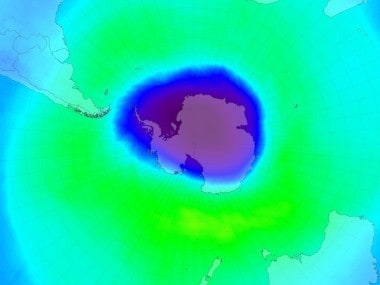
A 2019 image of the slowly-shrinking ozone hole over the Antarctic. Image Courtesy: NOAA[/caption]Without the presence of the ozone-concentrated layer in the stratosphere, almost nothing would be able to survive on the planet.Major depletion of the layer was attributed to the human use of chlorofluorocarbons or CFCs. The international treaty was adopted to ban the use of CFCs.Antara Banerjee, who is the lead author of the study, spoke to The Independent regarding their findings. She is a CIRES Visiting Fellow at the University of Colorado Boulder and works at the National Oceanic and Atmospheric Administration (NOAA).The depleting ozone layer had impacted the air currents that flow towards both the North and South Pole. “The movement of these jet streams was found to have stopped since 2000 and might even be reversing,” she said.CFCsAround the same time, Antara said the “CFCs from spray cans and refrigerants started to decline”.She said this shows that climate change actions do work and “we can reverse the damage that we’ve already done to our planet”.Now, her team hopes that if humans keep following the protocol, the ozone hole might recover fully though the recovery at different regions would happen at a different pace.

Careless Whispers: Scientists discover that plants can 'talk' to each other using smells
Life on Mars? European Space Agency’s Orbiter discovers ice water deposits at equator
Microsoft briefly overtakes Apple as the most valuable company, Apple back on top again
Even NASA is facing a tough time, starts layoffs following major budget cuts
ISRO, NASA's NISAR satellite to get ready by Jan-end, will monitor Earth's snow-covered regions