


Ozone-depleting substances caused half of Arctic warming, sea ice loss from 1955 to 2005
The ozone-depleting substances have also caused about a third of all the global warming from 1955 to 2005.

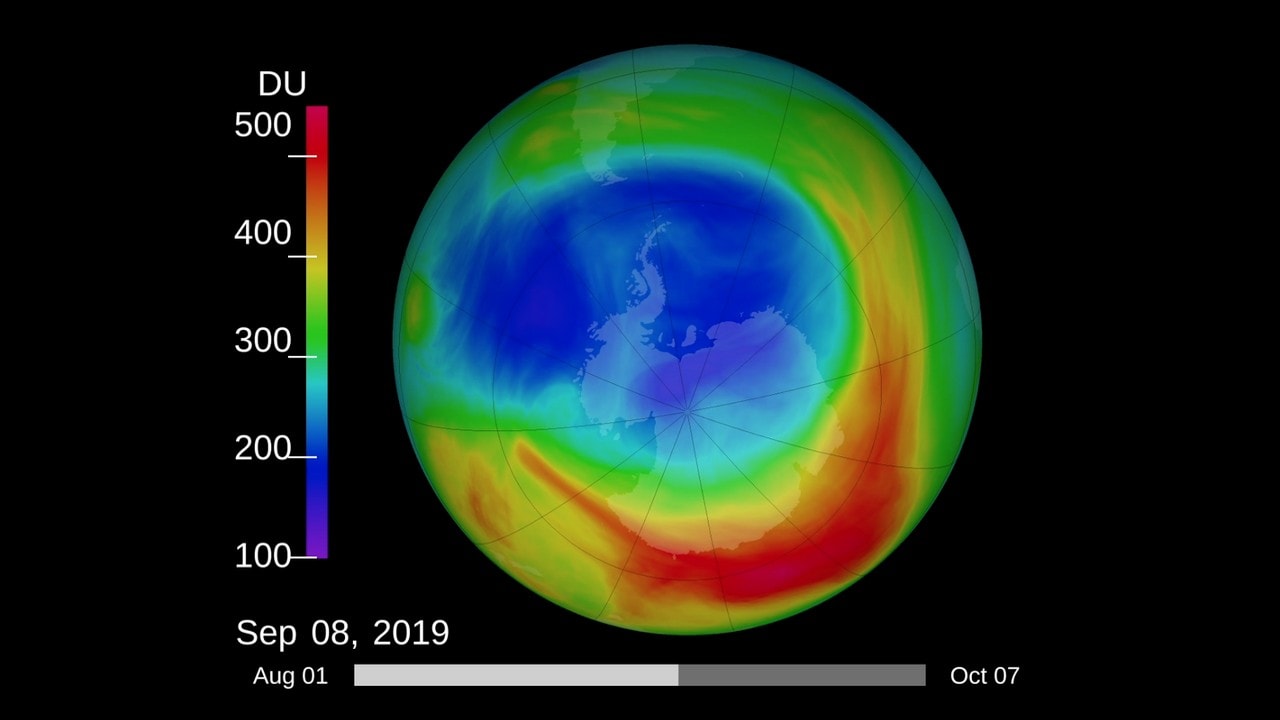
The 2019 ozone hole reached a peak extent of 6.3 million square miles on Sept. 8, 2019, the lowest maximum observed in 40 years of record. This NASA visualization depicts ozone concentrations on Sept. 8 in Dobson Units, the standard measure for stratospheric ozone. Credit: Katy Mersmann/NASA Goddard[/caption]Ozone-depleting substances or ODS were developed in the 1920s and '30s and became popularly used as refrigerants, solvents and propellants. They are entirely manmade, and so did not exist in the atmosphere before this time. In the 1980s a hole in Earth's stratospheric ozone layer, which filters much of the harmful ultraviolet radiation from the sun, was discovered over Antarctica. Scientists quickly attributed it to ODS.The world sprang into action, finalising a global agreement to phase out ODS. The Montreal Protocol, as it is called, was signed in 1987 and entered into force in 1989. Due to the swift international reaction, atmospheric concentrations of most ODS peaked in the late 20th century and have been declining since. However, for at least 50 years, the climate impacts of ODS were extensive, as the new study reveals.Scientists at Columbia's School of Engineering and Applied Science and the Lamont-Doherty Earth Observatory used climate models to understand the effects of ODS on Arctic climate. According to Lamont-Doherty researcher Michael Previdi, "We showed that ODS has affected the Arctic climate in a substantial way."The scientists reached their conclusion using two very different climate models that are widely employed by the scientific community, both developed at the US National Center for Atmospheric Research.The results highlight the importance of the Montreal Protocol, which has been signed by nearly 200 countries, say the authors.According to Lorenzo Polvani, lead author of the study and a professor in Columbia's Department of Applied Physics and Applied Mathematics, "Climate mitigation is in action as we speak because these substances are decreasing in the atmosphere, thanks to the Montreal Protocol, in the coming decades, they will contribute less and less to global warming. It's a good-news story.

Careless Whispers: Scientists discover that plants can 'talk' to each other using smells
Life on Mars? European Space Agency’s Orbiter discovers ice water deposits at equator
Microsoft briefly overtakes Apple as the most valuable company, Apple back on top again
Even NASA is facing a tough time, starts layoffs following major budget cuts
ISRO, NASA's NISAR satellite to get ready by Jan-end, will monitor Earth's snow-covered regions