


Oumuamua leaves the solar system and its scientists with more questions than answers
'Oumuamua brought to light that space rocks are likely a spectrum rather than a binary: Researchers.

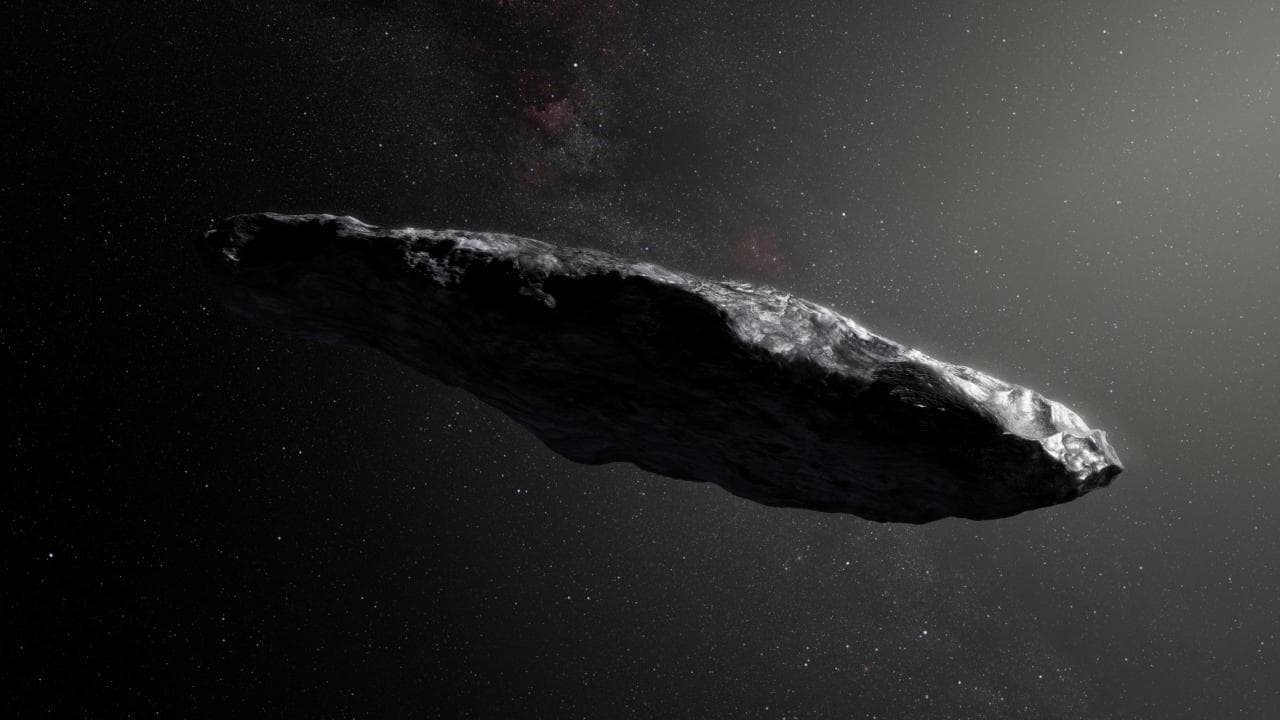
This artist’s impression shows the first interstellar asteroid, `Oumuamua as it passes through the solar system after its discovery in October 2017. Reuters[/caption]It was being accelerated by jets of gas released from within it as it passed by our Sun.A new study now argues that the same forces that would have given 'Oumuamua a tail (like a comet), and caused it to accelerate (due to outgassing) would have also caused it to spin. It would have spun apart and broken up into smaller rocks because of the way the comet moved and behaved — which the study says is very unlike a comet.“There’s very strong and unequivocal evidence on both sides,” Dr Roman Rafikov, author of the study, said to Quanta. “If it’s an asteroid, then it’s really unusual, with exotic scenarios for its formation.”The rock is a messenger, but a messenger from a dead star, the study says.Rafikov theorises in a previous study that when a star dies and forms what is known as a 'white dwarf', it rips planets apart and causes shards (like 'Oumuamua) to be flung in different directions.The one fact brought to light by 'Oumuamua according to many astronomers including Dr Michele Bannister from the Queen’s University, Belfast, is that space rocks need not be a binary — either comet or asteroid.“What I hope 'Oumuamua brings home is that planetary systems grow and evolve.. they create trillions of little planetesimals throughout the galaxy, and some of those will come and visit us every once and a while,” Bannister said to Quanta.“Our planetesimals are no doubt visiting other stars.”

Careless Whispers: Scientists discover that plants can 'talk' to each other using smells
Life on Mars? European Space Agency’s Orbiter discovers ice water deposits at equator
Microsoft briefly overtakes Apple as the most valuable company, Apple back on top again
Even NASA is facing a tough time, starts layoffs following major budget cuts
ISRO, NASA's NISAR satellite to get ready by Jan-end, will monitor Earth's snow-covered regions