


One year in, NASA's Parker Probe returns clues to long-held mysteries about solar wind, sun's atmosphere
One of Parker's interesting findings is that strong waves of charged particles from the Sun flips the direction of its magnetic field periodically.


Parker has made several close approaches, and will continue to weave in and out of the sun's corona over it's remaining 6 years on the job. Image courtesy: NASA Goddard[/caption]
Blazing hot bubble
The sun is essentially a big ball of hydrogen and helium, and for something that we see every day, it remains a complex ball of mystery.One puzzle that scientists have been pondering for decades: Why is the solar atmosphere superhot?The surface of the sun — what we see as a yellow disk in the sky — is about 10,000 degrees Fahrenheit. That is toasty, but cool compared with what lies above, in the thin atmosphere known as the corona.There, the temperatures jump by a factor of 300 or more, to millions of degrees. The corona also accelerates the solar wind — the million-kmph stream of particles that fly outward from the sun.Justin C Kasper, a professor of space sciences and engineering at the University of Michigan and the principal investigator of one of the solar probe’s four instruments, said scientists said they had a hunch that the vibrating of the sun’s magnetic fields — like the plucking of a guitar string — was critical to heating the corona. So they were curious about what the vibrations would look like closer to the sun.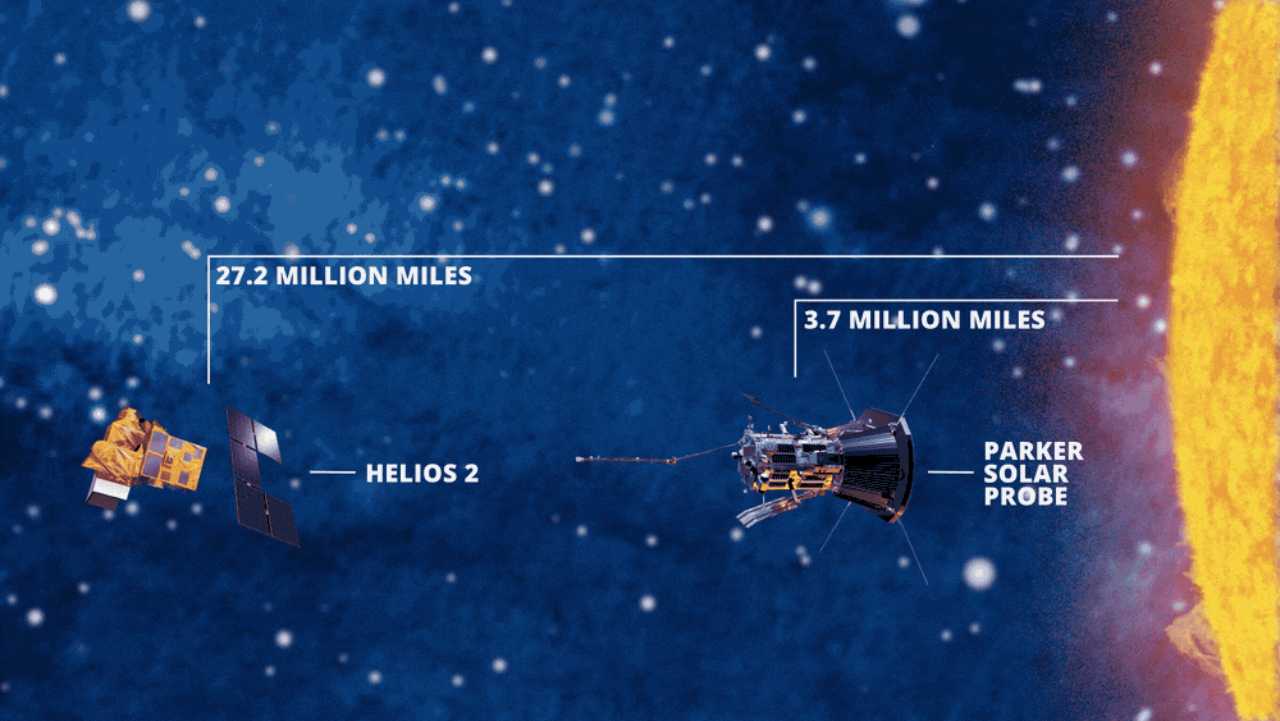
Parker probe has gotten even closer to the Sun than Helios 2 did in 1976. Illustration: Steve Alvey/Michigan Engineer[/caption]
Where the wind blows
With the closer view of the sun, scientists also now have a better idea of where the solar wind originates.Most of the solar wind measurements to date have been in the neighborhood of Earth, more than 90 million miles from the sun.Stuart Bale, a physicist at the University of California, Berkeley, who leads an instrument that measures the electric and magnetic fields in the solar wind, said trying to study solar winds from Earth is like observing the waterfall halfway down.“The water is always flowing past us,” he said. “It is very turbulent, chaotic, unstructured. And we want to know what is the source of the waterfall, what’s at the top. Is there an iceberg melting up there? Is there a sprinkler system? A lake?”By the time the solar wind reaches Earth, clues about its origin have been jumbled and become difficult to discern.“We want to know the source of the water, what’s at the top,” Bale said.
When solar wind collides with Earth's magnetic field. Image courtesy: NOAA/National Geophysical Data Cantre[/caption]He said that data from the Parker Solar Probe now shows that the so-called slow solar wind, moving at relatively slow speeds of less than a million mph (in the order of 1.6 million kmph), emerges from what are known as coronal holes — locations associated with sunspots and where hydrogen and helium are colder and less dense — near the sun’s Equator. (Faster solar winds traveling more than a million mph, or faster than 1.6 million kmph, were known to originate from coronal holes near the poles.)
Star dust
The spacecraft has also been putting together a picture of the cloud of dust surrounding the sun and the corona — bits shed from comets and asteroids that have passed. The dust was thinner closer to the sun, matching the expectations for a long-theorized dust-free zone around the star.As the Parker Solar Probe gets closer — repeated flybys of Venus in the coming years will eventually nudge it to a trajectory that will take it within 4 million miles of the sun — it is likely to confirm that observation and reveal new mysteries.[caption id="attachment_5307151" align="alignnone" width="1280"]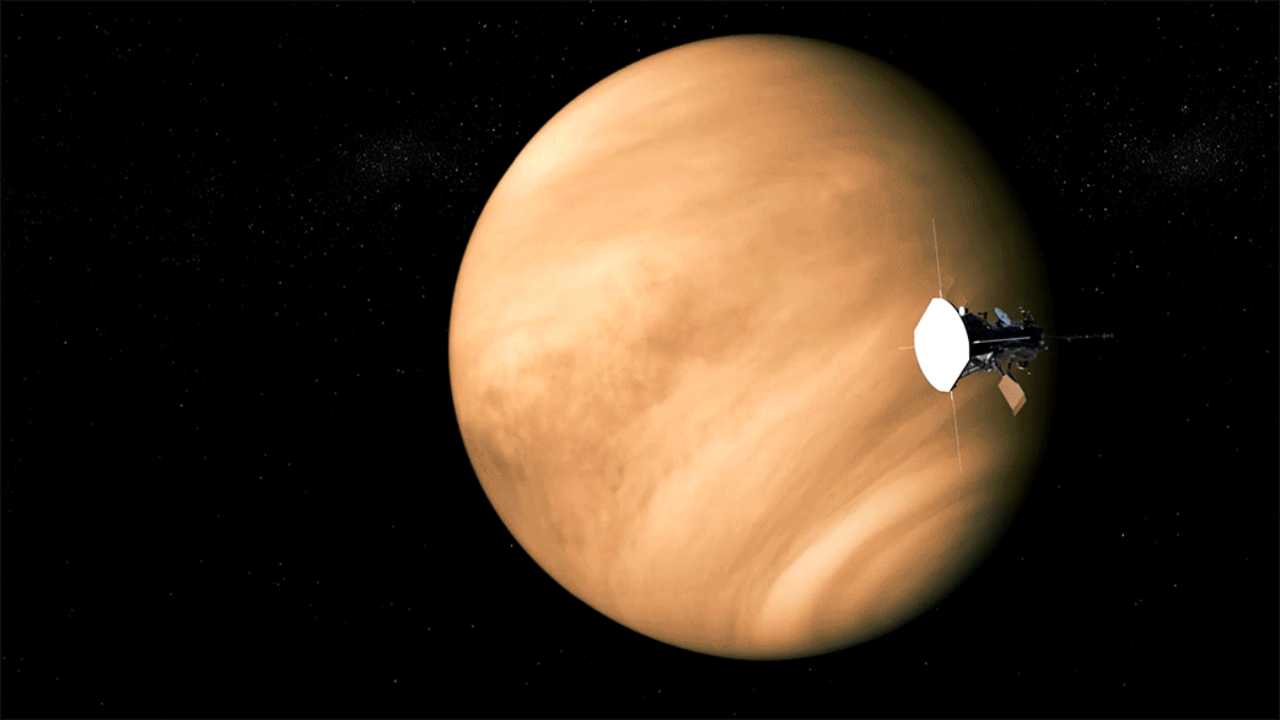
An illustration of the Parker probe at the start of its seven revolutions of Venus, in a gravity assist en route the Sun. Image courtesy: NASA[/caption]“It’s a bit early to say whether these discoveries actually overturn existing models,” Daniel Verscharen, a space scientist at University College London who wrote a commentary accompanying the Nature papers, said in an email. “They definitely show that there is a lot more happening close to the sun and that it’s absolutely worth going there to explore further.”A European Space Agency mission, Solar Orbiter, is set to launch in February. While it will not get as close to the sun as the Parker Solar Probe, it will carry instruments that will provide different views and provide more clues on solving the mystery of the solar wind.Eugene N Parker, a retired University of Chicago astrophysicist whom the spacecraft is named after, predicted the existence of the solar wind in 1958. "It was humbling to see the probe’s launch and watch it disappear into the night sky," Parker, now 92, said in a statement provided by the university."But now that data is finally coming in and being analyzed, things are getting really exciting."Kenneth Chang. c.2019 The New York Times Company

Careless Whispers: Scientists discover that plants can 'talk' to each other using smells
Life on Mars? European Space Agency’s Orbiter discovers ice water deposits at equator
Microsoft briefly overtakes Apple as the most valuable company, Apple back on top again
Even NASA is facing a tough time, starts layoffs following major budget cuts
ISRO, NASA's NISAR satellite to get ready by Jan-end, will monitor Earth's snow-covered regions