


Newly discovered Earth-like rogue planet might be smallest free floating world
Of the many rogue planets found, they are mostly massive in size, often ranging from two to 40 times the mass of Jupiter.

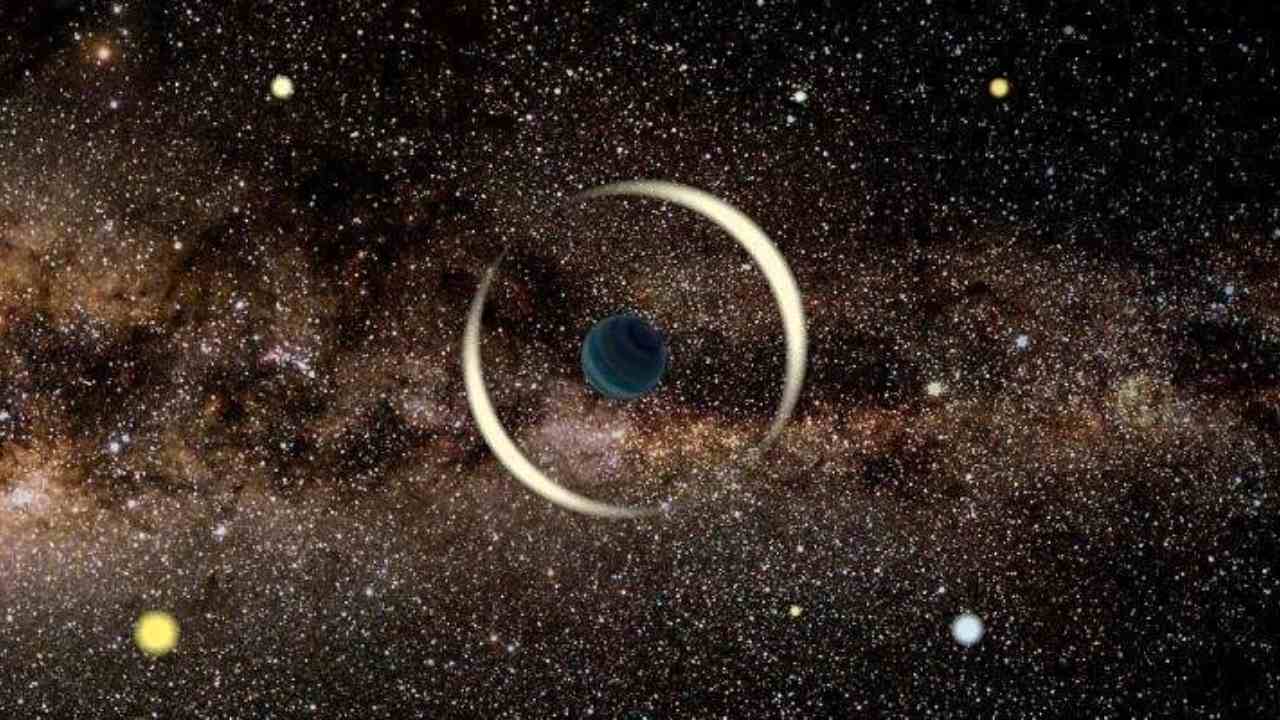
An artist's impression of a gravitational microlensing event by a free-floating planet. Image Credit: Jan Skowron / Astronomical Observatory, University of Warsaw[/caption]Of the many rogue planets found till now, most are massive in size, often ranging from two to 40 times the mass of Jupiter (it is important to remember here that Jupiter is equivalent to about 300 Earths). So with the discovery of the recent free world, scientists are looking at the possibility of the wide existence of small rogue planets.Lead study author Przemek Mroz, a postdoctoral scholar at the California Institute of Technology, told Live Science in an email that the odds of “detecting such a low-mass object are extremely low”. So this means that either they “were very lucky, or such objects are very common in the Milky Way”. he goes on to say that they might be “as common as stars.”Experts use light coming from a star to detect the various exoplanets. So it is very difficult to spot a world without a star. Moreover, for a planet which is in between Earth and Mars in terms of mass, detecting it is way harder. To hunt the world, scientists used "gravitational microlensing," which involves watching foreground objects pass in front of distant background stars. As part of the project, the team was using a 1.3-meter telescope at Las Campanas Observatory in Chile to monitor millions of stars near the Milky Way's centre on every clear night.The new study was published online on 29 October in Astrophysical Journal Letters.

Careless Whispers: Scientists discover that plants can 'talk' to each other using smells
Life on Mars? European Space Agency’s Orbiter discovers ice water deposits at equator
Microsoft briefly overtakes Apple as the most valuable company, Apple back on top again
Even NASA is facing a tough time, starts layoffs following major budget cuts
ISRO, NASA's NISAR satellite to get ready by Jan-end, will monitor Earth's snow-covered regions