
Advertisement


Sections
National Science Day: C V Raman's Nobel-winning discovery celebrated each 28 Feb
For discovering the Raman Effect, C V Raman became the first Indian & Asian to win a Nobel Prize.

Yes, there are some that look forward to the month of February for other reasons than Valentine's Day and the shortest month in the year.28 February also brings a day to commemorate an important discovery made by the legendary Indian physicist C V Raman.Educated entirely in India, C V Raman's expertise were acoustic vibrations — sounds of string instruments like the violin, the veena and two signature Indian percussion instruments — the tabla and mridangam.Raman made his first trip to London in 1921 to collaborate on a study with two internationally famous British scientists — J J Thomson and Lord Rutherford.[caption id="attachment_6168111" align="alignnone" width="1280"]![Dr C V Raman. Image courtesy: RRI]() Dr C V Raman. Image courtesy: RRI[/caption]His return journey to India — a fifteen-day voyage by ship, would be a historic one. Raman was struck by a question while cruising the deep blue Mediterranean waters: Why does the sea appear blue?At the time, there was one explanation for it already, but one that Raman wasn't convinced by. Lord Rayleigh, a British scientist who made countless contributions to theoretical and experimental physics, explained that the colour of sea simply reflected the colour of the sky.Raman outlined his thoughts on why he didn't agree with Rayleigh's theory and posted a letter to the journal Nature once his ship docked in the Bombay harbor.He spent the next six years solidifying his theory and shared it with the world in a 1928 paper.[caption id="attachment_6168101" align="alignnone" width="1280"]
Dr C V Raman. Image courtesy: RRI[/caption]His return journey to India — a fifteen-day voyage by ship, would be a historic one. Raman was struck by a question while cruising the deep blue Mediterranean waters: Why does the sea appear blue?At the time, there was one explanation for it already, but one that Raman wasn't convinced by. Lord Rayleigh, a British scientist who made countless contributions to theoretical and experimental physics, explained that the colour of sea simply reflected the colour of the sky.Raman outlined his thoughts on why he didn't agree with Rayleigh's theory and posted a letter to the journal Nature once his ship docked in the Bombay harbor.He spent the next six years solidifying his theory and shared it with the world in a 1928 paper.[caption id="attachment_6168101" align="alignnone" width="1280"]![Blue seas and blue skies.]() Blue seas and blue skies.[/caption]Raman showed conclusively — and for the first time — that the colour of the sea was blue because sunlight was scattered by water molecules. Ironically, it was the same exact argument Rayleigh had used to explain the sky's colour. The sea's blue, however, was because sunlight was split into its spectrum of colours by molecules in the air.The only colour reflected by the water, that reaches our eyes is blue.C V Raman was awarded the Nobel Prize in Physics in 1930 for this discovery, making him the first Indian and the first Asian to win the prestigious award.For the past 32 years, every 28 February has been celebrated as a remembrance of Raman's contribution to science and the Indian scientific community.Every Science Day has had a theme over the years. Last year's was 'Science and Technology for a Sustainable Future'. The theme for this year's Science Day is 'Science for the People and the People for Science'.
Blue seas and blue skies.[/caption]Raman showed conclusively — and for the first time — that the colour of the sea was blue because sunlight was scattered by water molecules. Ironically, it was the same exact argument Rayleigh had used to explain the sky's colour. The sea's blue, however, was because sunlight was split into its spectrum of colours by molecules in the air.The only colour reflected by the water, that reaches our eyes is blue.C V Raman was awarded the Nobel Prize in Physics in 1930 for this discovery, making him the first Indian and the first Asian to win the prestigious award.For the past 32 years, every 28 February has been celebrated as a remembrance of Raman's contribution to science and the Indian scientific community.Every Science Day has had a theme over the years. Last year's was 'Science and Technology for a Sustainable Future'. The theme for this year's Science Day is 'Science for the People and the People for Science'.
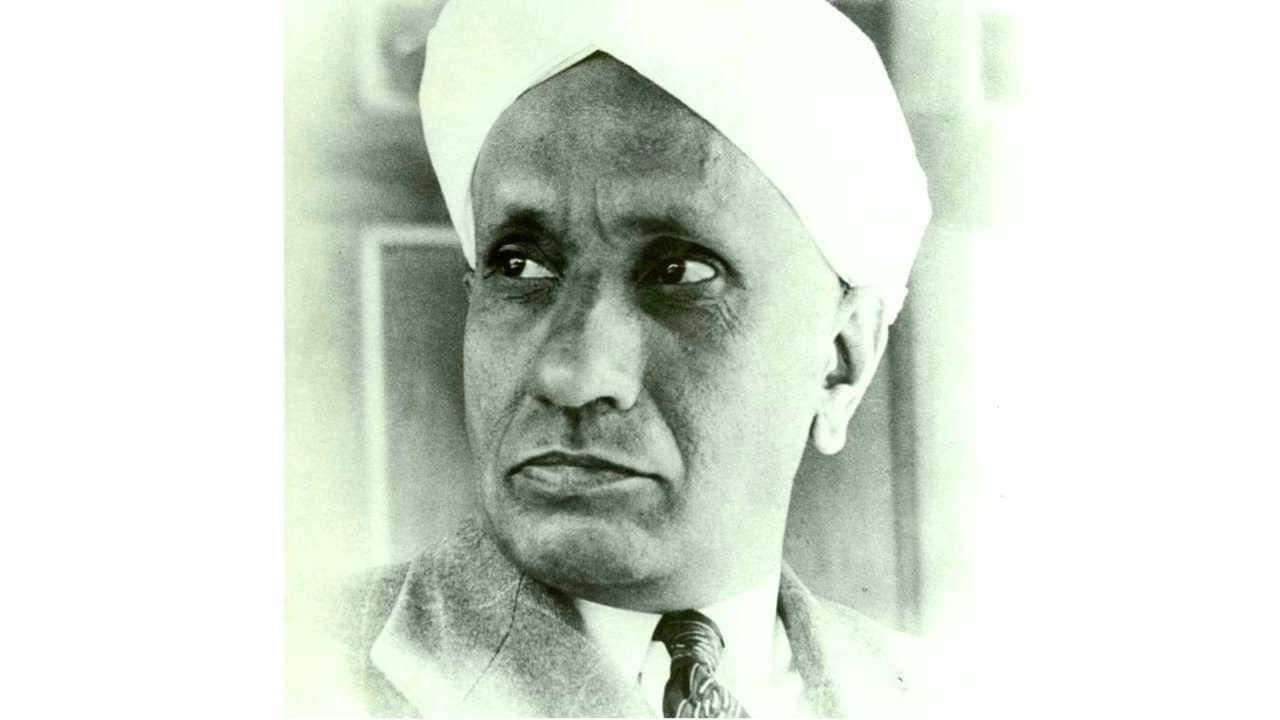 Dr C V Raman. Image courtesy: RRI[/caption]His return journey to India — a fifteen-day voyage by ship, would be a historic one. Raman was struck by a question while cruising the deep blue Mediterranean waters: Why does the sea appear blue?At the time, there was one explanation for it already, but one that Raman wasn't convinced by. Lord Rayleigh, a British scientist who made countless contributions to theoretical and experimental physics, explained that the colour of sea simply reflected the colour of the sky.Raman outlined his thoughts on why he didn't agree with Rayleigh's theory and posted a letter to the journal Nature once his ship docked in the Bombay harbor.He spent the next six years solidifying his theory and shared it with the world in a 1928 paper.[caption id="attachment_6168101" align="alignnone" width="1280"]
 Blue seas and blue skies.[/caption]Raman showed conclusively — and for the first time — that the colour of the sea was blue because sunlight was scattered by water molecules. Ironically, it was the same exact argument Rayleigh had used to explain the sky's colour. The sea's blue, however, was because sunlight was split into its spectrum of colours by molecules in the air.The only colour reflected by the water, that reaches our eyes is blue.C V Raman was awarded the Nobel Prize in Physics in 1930 for this discovery, making him the first Indian and the first Asian to win the prestigious award.For the past 32 years, every 28 February has been celebrated as a remembrance of Raman's contribution to science and the Indian scientific community.Every Science Day has had a theme over the years. Last year's was 'Science and Technology for a Sustainable Future'. The theme for this year's Science Day is 'Science for the People and the People for Science'.
First Published:Feb 28, 2019, 09:28:34 IST
Advertisement
Advertisement

Careless Whispers: Scientists discover that plants can 'talk' to each other using smells
Japanese scientists have recorded a video that shows plants, in certain conditions, communicate with each other using mists that carry smells. The discovery, reveals that plants release a fine mist of airborne compounds, to warn nearby plants of potential dangers
Life on Mars? European Space Agency’s Orbiter discovers ice water deposits at equator
European Space Agency's Mars Express Orbiter has identified massive ice and ice water deposits beneath the surface of Mars. The Mars Express orbiter was also the first to confirmed the presence of ice on Mars in 2004
Microsoft briefly overtakes Apple as the most valuable company, Apple back on top again
At its peak during the session, Microsoft's value reached $2.903 trillion, with a 2% surge. As of writing this article, Apple closed at $2.89 trillion, whereas Microsoft closed at $2.86 trillion
Even NASA is facing a tough time, starts layoffs following major budget cuts
NASA is facing some massive budget cuts, because of which, it has been forced to postpone some upcoming missions. NASA's Jet Propulsion Laboratory has been hit hard by recent federal budget cuts, resulting in the layoff of 100 contractors last week
ISRO, NASA's NISAR satellite to get ready by Jan-end, will monitor Earth's snow-covered regions
The NISAR satellite which has been developed jointly ISRO and NASA, should be ready for launch by the end of January 2024. The collaboration between NASA and ISRO on NISAR is the first time the two agencies have cooperated on hardware development for an Earth-observing mission
Advertisement
Advertisement