


NASA's new missions to study the Sun and understand the effects on space weather
The Sun's particles known as solar wind creates a dynamic system of radiation called space weather.

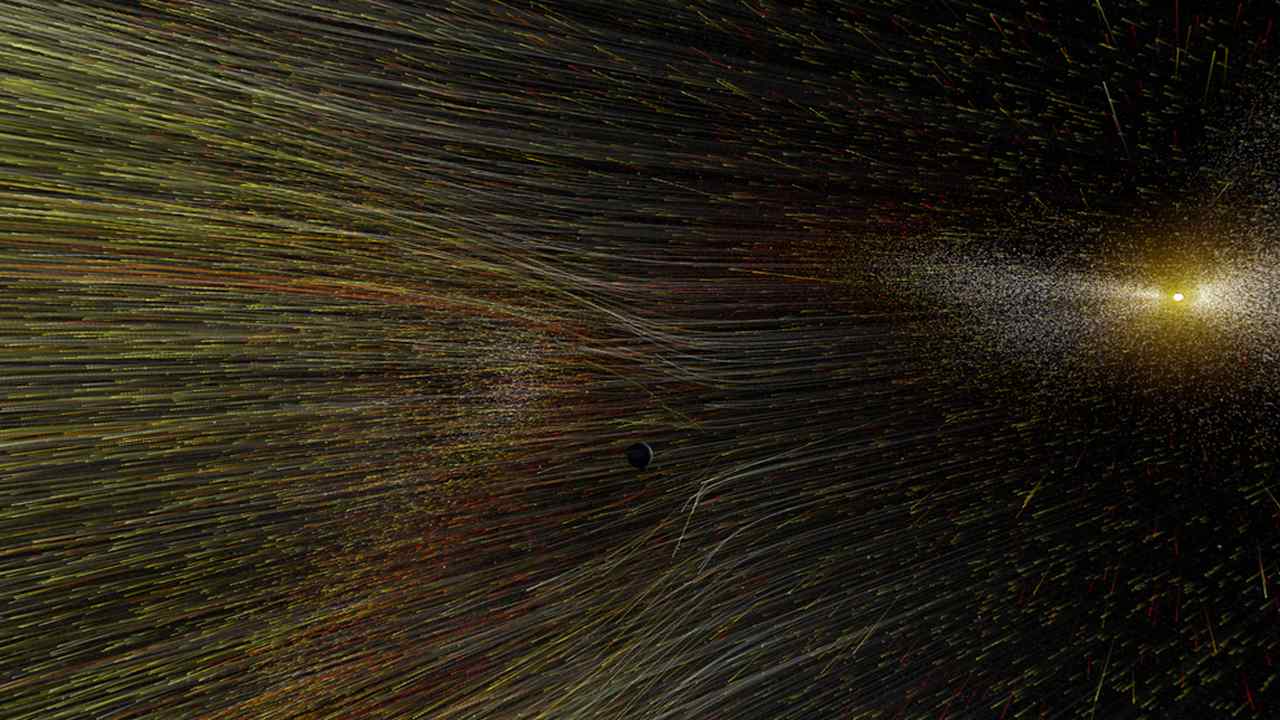
A constant outflow of solar material streams out from the Sun depicted in an artist's rendering. Image credits: NASA[/caption]The more we understand what drives space weather and its interaction with the Earth and lunar systems, the more we can mitigate its effects — including safeguarding astronauts and technology crucial to NASA's Artemis programme to the Moon.The launch date for the two missions is "no later than August 2022," NASA said in a statement. "We carefully selected these two missions not only because of the high-class science they can do in their own right, but because they will work well together with the other heliophysics spacecraft advancing NASA's mission to protect astronauts, space technology and life down here on Earth," said Thomas Zurbuchen, associate administrator for the Science Mission Directorate at NASA headquarters here. "These missions will do big science, but they're also special because they come in small packages, which means that we can launch them together and get more research for the price of a single launch," Zurbuchen said.The Polarimeter to Unify the Corona and Heliosphere, or PUNCH, the mission will focus directly on the Sun's outer atmosphere, the corona, and how it generates the solar wind, according to NASA. Composed of four suitcase-sized satellites, PUNCH will image and track the solar wind as it leaves the Sun. The spacecraft also will track coronal mass ejections — large eruptions of solar material that can drive large space weather events near Earth — to better understand their evolution and develop new techniques for predicting such eruptions.
The second mission is Tandem Reconnection and Cusp Electrodynamics Reconnaissance Satellites, or TRACERS. It will observe particles and fields at the Earth's northern magnetic cusp region — the region encircling Earth's pole, where our planet's magnetic field lines curve down towards Earth.The field lines guide particles from the boundary between Earth's magnetic field and interplanetary space down into the atmosphere. In the cusp area, with its easy access to our boundary with interplanetary space, TRACERS will study how magnetic fields around Earth interact with those from the Sun.TRACERS will be the first space mission to explore this process in the cusp with two spacecraft, providing observations of how processes change over both space and time. TRACERS' unique measurements will help with NASA's mission to safeguard our technology and astronauts in space, NASA said.Together, these missions will investigate how the star we live with drives radiation in space, it said.
Careless Whispers: Scientists discover that plants can 'talk' to each other using smells
Life on Mars? European Space Agency’s Orbiter discovers ice water deposits at equator
Microsoft briefly overtakes Apple as the most valuable company, Apple back on top again
Even NASA is facing a tough time, starts layoffs following major budget cuts
ISRO, NASA's NISAR satellite to get ready by Jan-end, will monitor Earth's snow-covered regions