


NASA's Juno spacecraft snaps Jupiter moon Ganymede for the first time in 21 years
The spacecraft will conduct its flyby to get a closer look at Ganymede on 7 June at 11:05 pm IST.

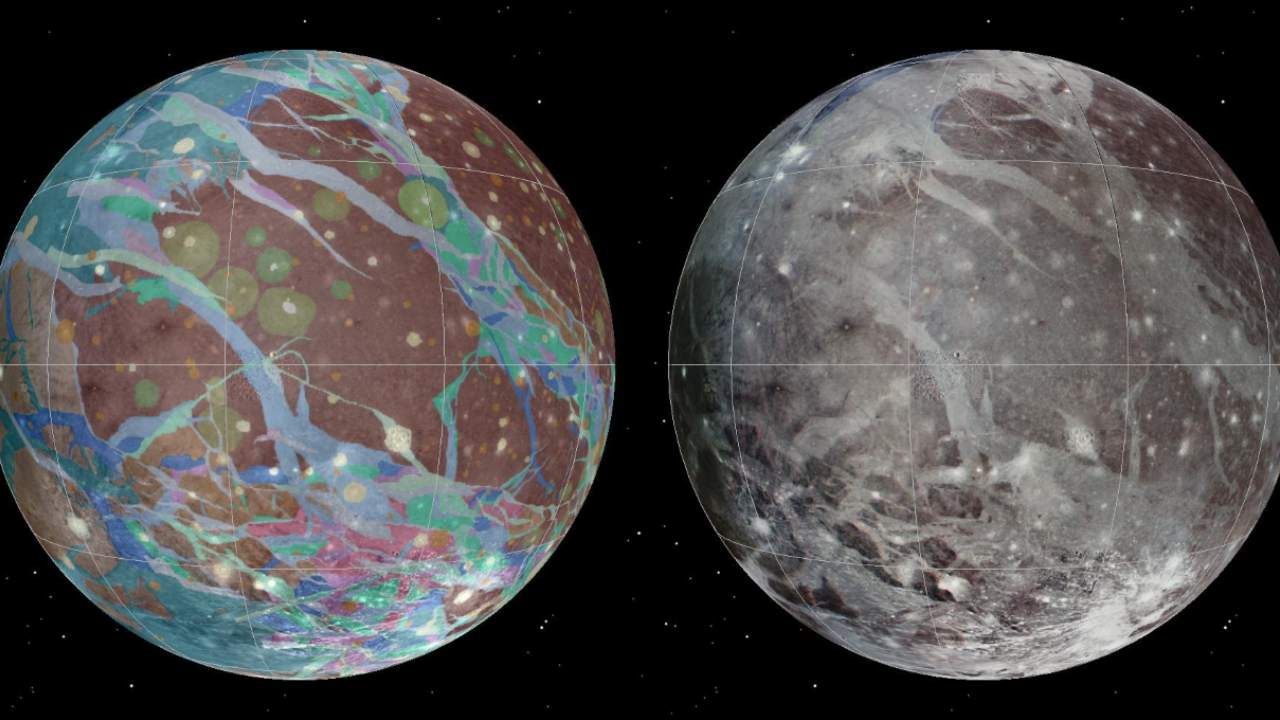
Left to right: The mosaic and geologic maps of Jupiter’s moon Ganymede were assembled incorporating the best available imagery from NASA’s Voyager 1 and 2 spacecraft and NASA’s Galileo spacecraft. Credit: USGS Astrogeology Science Center/Wheaton/NASA/JPL-Caltech[/caption]As mentioned in a blog by NASA’s Jet Propulsion Laboratory (JPL), Juno will get closer to Ganymede on 7 June at 11:05 pm IST (1:35 pm EDT).It further mentions that with the help of the Juno spacecraft, researchers will get an insight into the ionosphere, ice shell, composition, and magnetosphere of Jupiter’s moon. Italian astronomer Galileo Galilei discovered Ganymede in 1610 when he also discovered three other biggest moons of Jupiter.Scott Bolton, principal investigator of Juno from San Antonio’s Southwest Research Institute said that there will be special equipment on Juno that will make the researchers see Ganymede in a way that has never been possible before. Bolton added that by flying so close to Jupiter's moon, they will help the next generation of missions including the JUpiter ICy moons Explorer [JUICE] by the European Space Agency (ESA) and Europa Clipper by NASA.The navigation camera in the Stellar Reference Unit (SRU) of Juno will not only help the spacecraft to follow its path but also be used to collect images to investigate the high-energy radiation environment in Ganymede.Three hours before the Juno spacecraft will make its closest approach, its equipment is going to start collecting data.In order to get details about its water-ice crust, Ultraviolet Spectrograph (UVS), Microwave Radiometer’s (MWR), and Jovian Infrared Auroral Mapper (JIRAM) instruments will be used for the purpose. A radio occultation experiment will also be performed with the help of signals received from the X-band and Ka-band radio wavelengths of Juno. This experiment will investigate Ganymede’s ionosphere.“This is the closest any spacecraft has come to this mammoth moon in a generation,” Bolton said. “We are going to take our time before we draw any scientific conclusions, but until then we can simply marvel at this celestial wonder – the only moon in our solar system bigger than the planet Mercury.”NASA released Juno’s first two pictures Tuesday, highlighting Ganymede’s craters and long, narrow features possibly related to tectonic faults. One shows the moon’s far side, opposite the sun.With inputs from The Associated Press

Careless Whispers: Scientists discover that plants can 'talk' to each other using smells
Life on Mars? European Space Agency’s Orbiter discovers ice water deposits at equator
Microsoft briefly overtakes Apple as the most valuable company, Apple back on top again
Even NASA is facing a tough time, starts layoffs following major budget cuts
ISRO, NASA's NISAR satellite to get ready by Jan-end, will monitor Earth's snow-covered regions