


NASA's Juno spacecraft sends new images of volcanic plume on Jupiter's moon Io
Four of Juno's cameras captured images of Jovian moon Io, the most volcanic body in our solar system.

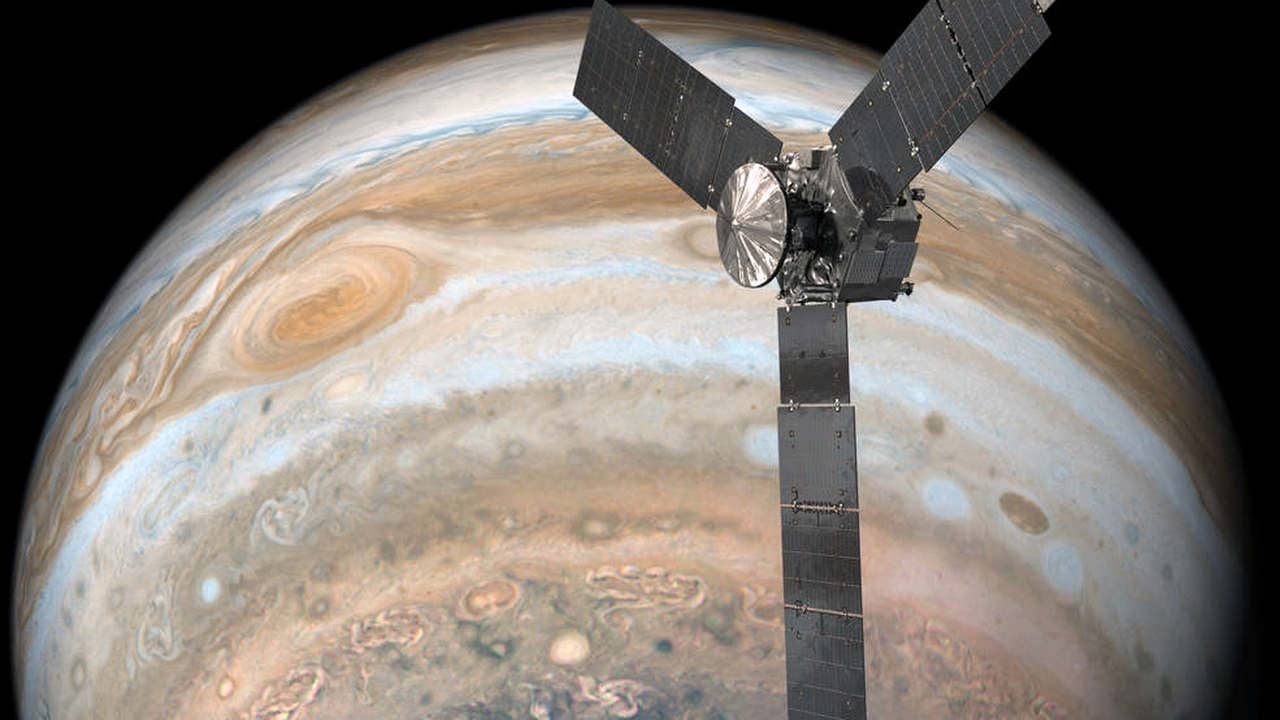
Juno Jupiter mission. Image: NASA[/caption]“This is quite a New Year's present showing us that Juno has the ability to clearly see plumes,” said Bolton, associate vice president of Southwest Research Institute's Space Science and Engineering Division.The images show the moon half-illuminated with a bright spot seen just beyond the terminator, the day-night boundary.“The ground is already in shadow, but the height of the plume allows it to reflect sunlight, much like the way mountaintops or clouds on the Earth continue to be lit after the sun has set,” said Candice Hansen-Koharcheck, the JunoCam lead from the Planetary Science Institute.After Io had passed into the darkness of total eclipse behind Jupiter, sunlight reflecting off nearby moon Europa helped to illuminate Io and its plume. SRU images released by SwRI depict Io softly illuminated by moonlight from Europa.The brightest feature on Io in the image is thought to be a penetrating radiation signature, a reminder of this satellite’s role in feeding Jupiter’s radiation belts, while other features show the glow of activity from several volcanoes.The images can lead to new insights into the gas giant’s interactions with its five moons, causing phenomena such as Io’s volcanic activity or freezing of the moon’s atmosphere during eclipse, added Bolton.Io’s volcanoes were discovered by NASA’s Voyager spacecraft in 1979. Io’s gravitational interaction with Jupiter drives the moon’s volcanoes, which emit umbrella-like plumes of SO2 gas and produce extensive basaltic lava fieldsThe recent Io images were captured at the halfway point of the mission, which is scheduled to complete a map of Jupiter in July 2021. Launched in 2011, Juno arrived at Jupiter in 2016. The spacecraft orbits Jupiter every 53 days, studying its auroras, atmosphere and magnetosphere. The solar-powered Juno features eight scientific instruments designed to study Jupiter’s interior structure, atmosphere and magnetosphere.

Careless Whispers: Scientists discover that plants can 'talk' to each other using smells
Life on Mars? European Space Agency’s Orbiter discovers ice water deposits at equator
Microsoft briefly overtakes Apple as the most valuable company, Apple back on top again
Even NASA is facing a tough time, starts layoffs following major budget cuts
ISRO, NASA's NISAR satellite to get ready by Jan-end, will monitor Earth's snow-covered regions