
Advertisement


Sections
NASA's InSight flexes its robotic arm sending us newest images of Mars' surface
The images will help mission members determine where to set InSight's seismometer and heat flow probe.

After the successful touchdown of NASA's InSight on Mars last week, new images from the lander show its robotic arm is ready to do some lifting.[caption id="attachment_5645051" align="alignnone" width="1280"]![A replica of the Mars InSight lander at NASA's Jet Propulsion Laboratory in California. Image courtesy: NASA]()
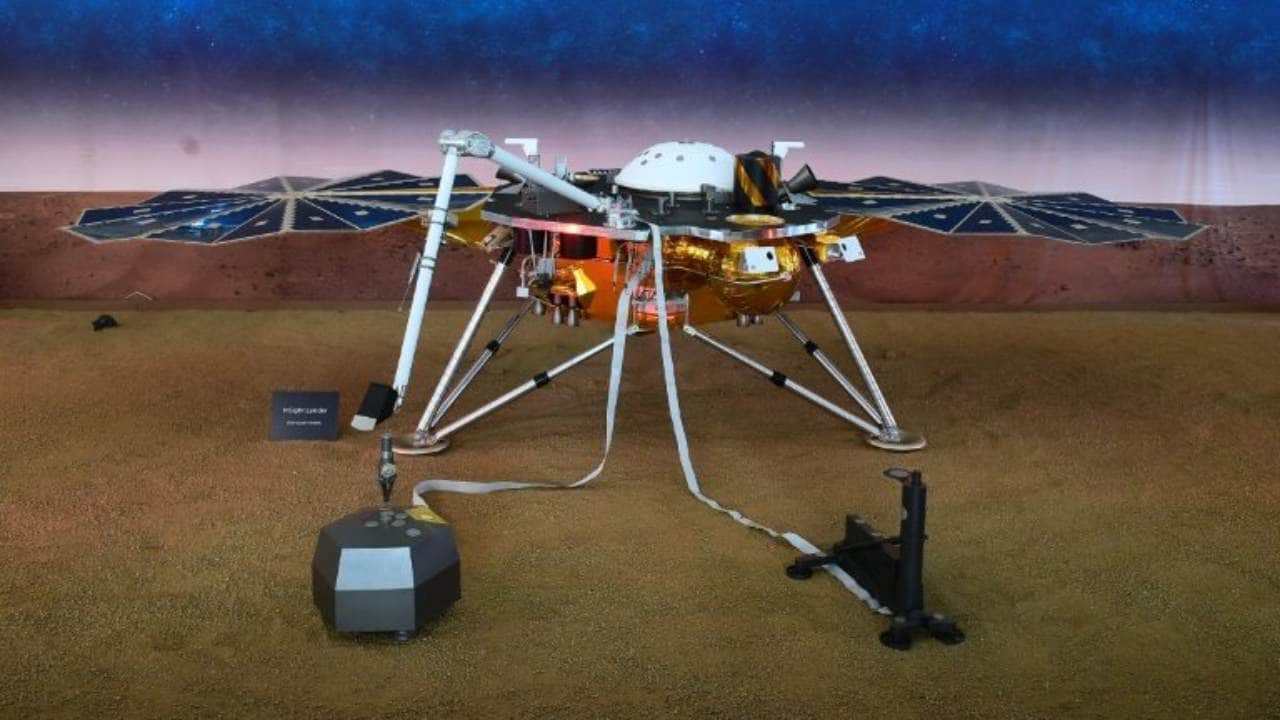
A replica of the Mars InSight lander at NASA's Jet Propulsion Laboratory in California. Image courtesy: NASA[/caption]With a reach of nearly 6 feet (2 metres), the arm will be used to pick up science instruments from the lander's deck, gently setting them on the Martian surface at Elysium Planitia, the lava plain where InSight touched down on 26 November.But first, the arm will use its Instrument Deployment Camera, located on its elbow, to take photos of the terrain in front of the lander, the space agency said in a statement on Thursday.
These images will help mission team members determine where to set InSight's seismometer and heat flow probe — the only instruments ever to be robotically placed on the surface of another planet, it added. "Today we can see the first glimpses of our workspace," said Bruce Banerdt, the mission's principal investigator at NASA's Jet Propulsion Laboratory (JPL) in Pasadena, California. "By early next week, we'll be imaging it in finer detail and creating a full mosaic." Another camera, called the Instrument Context Camera, is located under the lander's deck. It will also offer views of the workspace, though the view won't be as pretty."We had a protective cover on the Instrument Context Camera, but somehow dust still managed to get onto the lens," said JPL's Tom Hoffman, InSight project manager."While this is unfortunate, it will not affect the role of the camera, which is to take images of the area in front of the lander where our instruments will eventually be placed."Over the past week and a half, mission engineers have been testing those instruments and spacecraft systems, ensuring they were in working order.More images from InSight's arm were scheduled to come down this past weekend. However, imaging was momentarily interrupted, resuming the following day.Spacecraft engineers had already factored extra time into their estimates for instrument deployment to account for likely delays caused by faults. The mission's primary mission is scheduled for two Earth years, or one Mars year.First Published:Dec 07, 2018, 14:28:11 IST
Advertisement
Advertisement

Careless Whispers: Scientists discover that plants can 'talk' to each other using smells
Japanese scientists have recorded a video that shows plants, in certain conditions, communicate with each other using mists that carry smells. The discovery, reveals that plants release a fine mist of airborne compounds, to warn nearby plants of potential dangers
Life on Mars? European Space Agency’s Orbiter discovers ice water deposits at equator
European Space Agency's Mars Express Orbiter has identified massive ice and ice water deposits beneath the surface of Mars. The Mars Express orbiter was also the first to confirmed the presence of ice on Mars in 2004
Microsoft briefly overtakes Apple as the most valuable company, Apple back on top again
At its peak during the session, Microsoft's value reached $2.903 trillion, with a 2% surge. As of writing this article, Apple closed at $2.89 trillion, whereas Microsoft closed at $2.86 trillion
Even NASA is facing a tough time, starts layoffs following major budget cuts
NASA is facing some massive budget cuts, because of which, it has been forced to postpone some upcoming missions. NASA's Jet Propulsion Laboratory has been hit hard by recent federal budget cuts, resulting in the layoff of 100 contractors last week
ISRO, NASA's NISAR satellite to get ready by Jan-end, will monitor Earth's snow-covered regions
The NISAR satellite which has been developed jointly ISRO and NASA, should be ready for launch by the end of January 2024. The collaboration between NASA and ISRO on NISAR is the first time the two agencies have cooperated on hardware development for an Earth-observing mission
Advertisement
Advertisement