


NASA's Hubble telescope captures Saturn changing its colours according to the seasons
Saturn’s seasonal change is similar to Earth’s as they orbit the Sun on their tilted axis and the northern and the southern hemisphere receive sunlight.

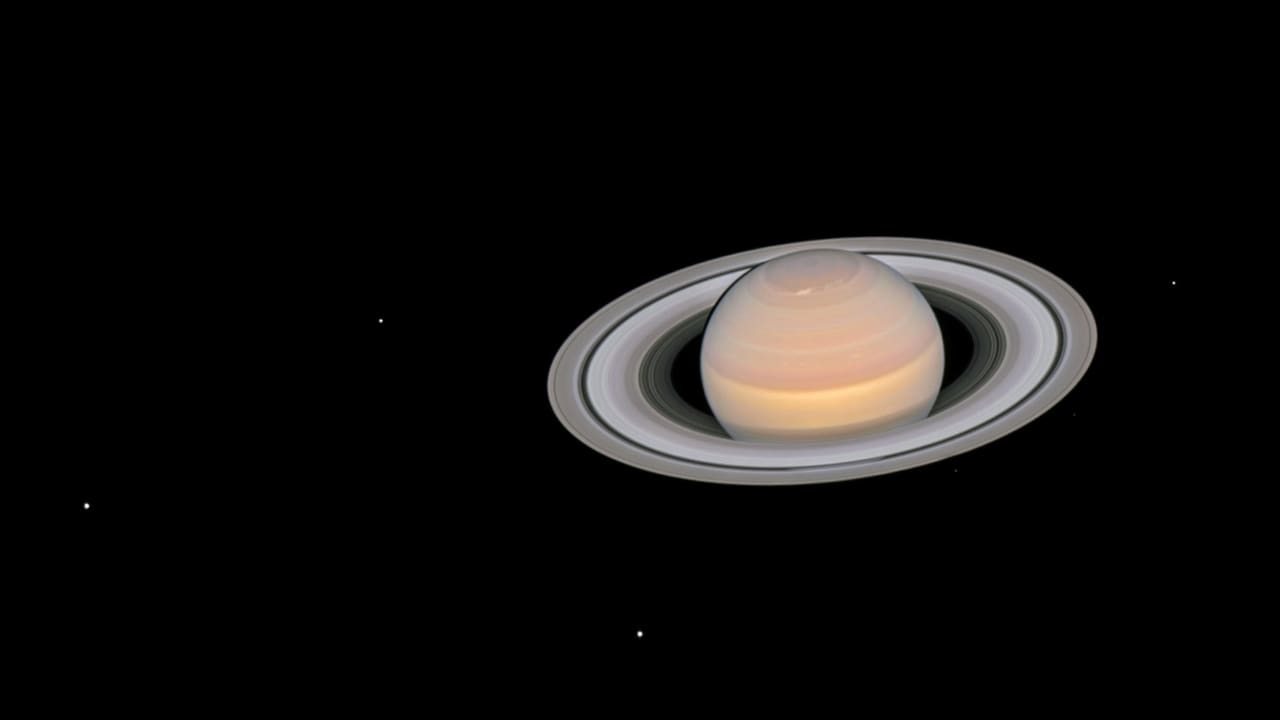
A 2018 composite image of the ringed planet Saturn is pictured with six of its 82 known moons. From left to right, the moons visible in this image are Dione, Enceladus, Tethys, Janus, Epimetheus, and Mimas. Image credit: ESA/Hubble[/caption]From 2018 to 2020, the equatorial region of the planet got 5-10 percent brighter due to a wind speed that measured 1000 miles per hour. Between 2004 and 2009, NASA’s Cassini spacecraft had measured a wind speed of 800 miles per hour.The reason why such a transition takes place once in every seven years is that the planet takes 29 Earth years to complete a revolution around the Sun and each season takes at least 7 Earth years to change.Saturn’s seasonal change is similar to that of Earth’s. The two planets orbit the Sun on their own tilted axis owing to which the northern and the southern hemisphere receive their share of sunlight. Scientists believe that this difference leads to variations in the climate on the ringed planet.According to The Weather Channel, NASA’s Sea-viewing Wide Field-of-view Sensor (SeaWiFS), NOAA Visible Infrared Imaging Radiometer Suite, and the Moderate Resolution Imaging Spectroradiometer have observed similar colour change on Earth owing to periodic seasonal changes.Being the second-largest planet in the solar system, Saturn is over nine times as wide as Earth. It has got 50 moons that make beautiful celestial formations in the night sky.

Careless Whispers: Scientists discover that plants can 'talk' to each other using smells
Life on Mars? European Space Agency’s Orbiter discovers ice water deposits at equator
Microsoft briefly overtakes Apple as the most valuable company, Apple back on top again
Even NASA is facing a tough time, starts layoffs following major budget cuts
ISRO, NASA's NISAR satellite to get ready by Jan-end, will monitor Earth's snow-covered regions