
Advertisement


Sections
NASA's Hubble catches a pair of Neptune's moons in a truly bizarre 'dance of avoidance'
Naiad and Thalassa are two of Neptune's innermost moons that exist pretty close to each other.

The eighth planet in the solar system, Neptune, has 14 moons and they all rotate around the planet at their own pace. Recently, scientists at NASA’s Jet Propulsion Laboratory (JPL) discovered that two of the ice giant’s moons — Naiad and Thalassa — are locked in a 'dance of avoidance'.These two Neptunian satellites are fairly close to one other — some 1,850 kilometres apart. When they pass each other, they are around 3,540 kilometres apart.[caption id="attachment_7669271" align="alignnone" width="1280"]![Two of Neptune's moons are caught in an odd dance of avoidance. Image: NASA]() Two of Neptune's moons are caught in an odd dance of avoidance. Image: NASA[/caption]Naiad moves a lot quicker than Thalassa and dances around the other moon in an effort to avoid a head-on collision. They do not collide into each other because Naiad’s orbit is tilted at about 5 degrees. Naiad takes seven hours to complete one rotation around Neptune while Thalassa completes it in seven and a half hours.If you were to live on Thalassa, you would see Naiad go up and down in a zigzag pattern, passing by twice from above and then twice from below. While scientists do not know how the two moons came to perfect this routine, they do have a few working theories.The first possibility is that an original satellite system was disrupted when Neptune captured its giant moon Triton, which led to the inner moons and rings forming from the leftover debris. [Neptunes has a total of six rings.][caption id="attachment_7669111" align="alignnone" width="1280"]
Two of Neptune's moons are caught in an odd dance of avoidance. Image: NASA[/caption]Naiad moves a lot quicker than Thalassa and dances around the other moon in an effort to avoid a head-on collision. They do not collide into each other because Naiad’s orbit is tilted at about 5 degrees. Naiad takes seven hours to complete one rotation around Neptune while Thalassa completes it in seven and a half hours.If you were to live on Thalassa, you would see Naiad go up and down in a zigzag pattern, passing by twice from above and then twice from below. While scientists do not know how the two moons came to perfect this routine, they do have a few working theories.The first possibility is that an original satellite system was disrupted when Neptune captured its giant moon Triton, which led to the inner moons and rings forming from the leftover debris. [Neptunes has a total of six rings.][caption id="attachment_7669111" align="alignnone" width="1280"]![Relative sizes of a few of Neptune’s moons, including Hippocamp. Image credit: Mark Showalter/SETI Institute]() Relative sizes of a few of Neptune’s moons, including Hippocamp. Image credit: Mark Showalter/SETI Institute[/caption]"We suspect that Naiad was kicked into its tilted orbit by an earlier interaction with one of Neptune's other inner moons," said Marina Brozović, an expert in solar system dynamics at JPL in a press release. "Only later, after its orbital tilt was established, could Naiad settle into this unusual resonance with Thalassa.""Naiad and Thalassa have probably been locked together in this configuration for a very long time, because it makes their orbits more stable. They maintain peace by never getting too close," Mark Showalter, a planetary astronomer at the SETI Institute and a co-author of the new paper said in a press release.Data collected between 1981 and 2016 from NASA’s Hubble telescope and Voyager 2 (the only spacecraft to visit Neptune first hand on its way out of the solar system)and other space telescopes on Earth helped in the discovery of this unusual orbital pattern. The study also said that the moons are largely made up of water ice.The study and its findings were published in the journal Icarus.
Relative sizes of a few of Neptune’s moons, including Hippocamp. Image credit: Mark Showalter/SETI Institute[/caption]"We suspect that Naiad was kicked into its tilted orbit by an earlier interaction with one of Neptune's other inner moons," said Marina Brozović, an expert in solar system dynamics at JPL in a press release. "Only later, after its orbital tilt was established, could Naiad settle into this unusual resonance with Thalassa.""Naiad and Thalassa have probably been locked together in this configuration for a very long time, because it makes their orbits more stable. They maintain peace by never getting too close," Mark Showalter, a planetary astronomer at the SETI Institute and a co-author of the new paper said in a press release.Data collected between 1981 and 2016 from NASA’s Hubble telescope and Voyager 2 (the only spacecraft to visit Neptune first hand on its way out of the solar system)and other space telescopes on Earth helped in the discovery of this unusual orbital pattern. The study also said that the moons are largely made up of water ice.The study and its findings were published in the journal Icarus.
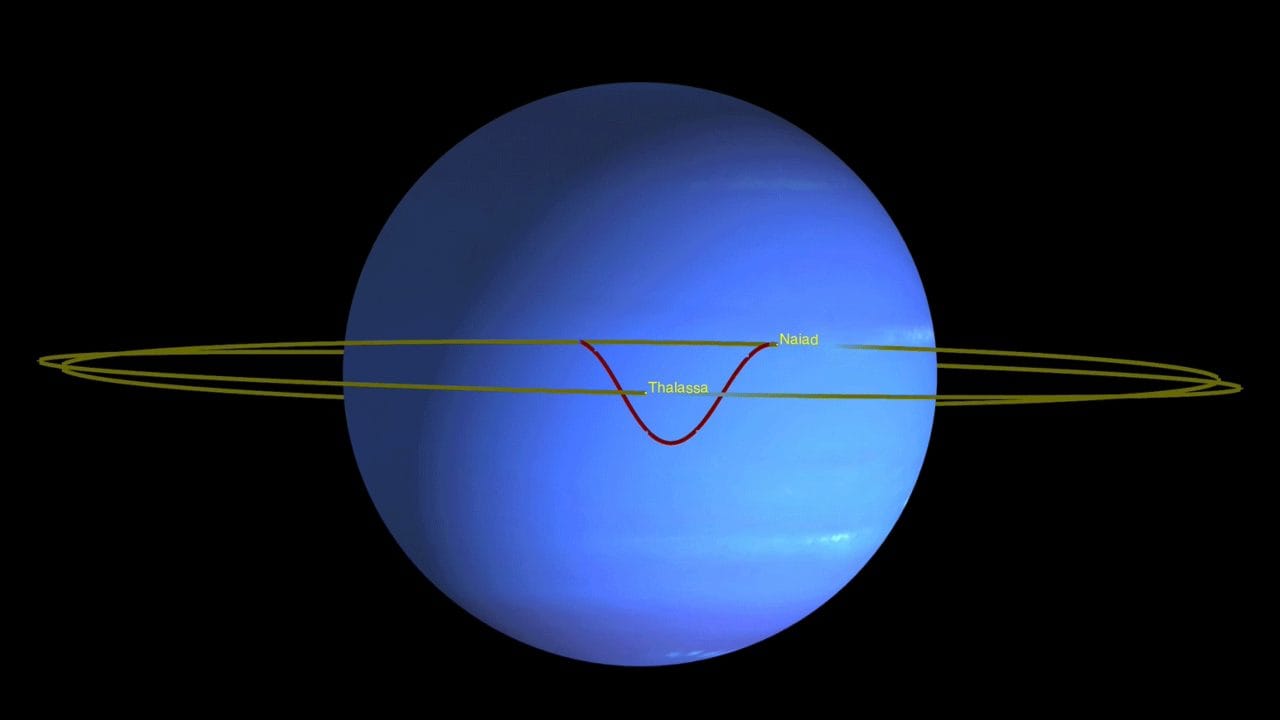 Two of Neptune's moons are caught in an odd dance of avoidance. Image: NASA[/caption]Naiad moves a lot quicker than Thalassa and dances around the other moon in an effort to avoid a head-on collision. They do not collide into each other because Naiad’s orbit is tilted at about 5 degrees. Naiad takes seven hours to complete one rotation around Neptune while Thalassa completes it in seven and a half hours.If you were to live on Thalassa, you would see Naiad go up and down in a zigzag pattern, passing by twice from above and then twice from below. While scientists do not know how the two moons came to perfect this routine, they do have a few working theories.The first possibility is that an original satellite system was disrupted when Neptune captured its giant moon Triton, which led to the inner moons and rings forming from the leftover debris. [Neptunes has a total of six rings.][caption id="attachment_7669111" align="alignnone" width="1280"]
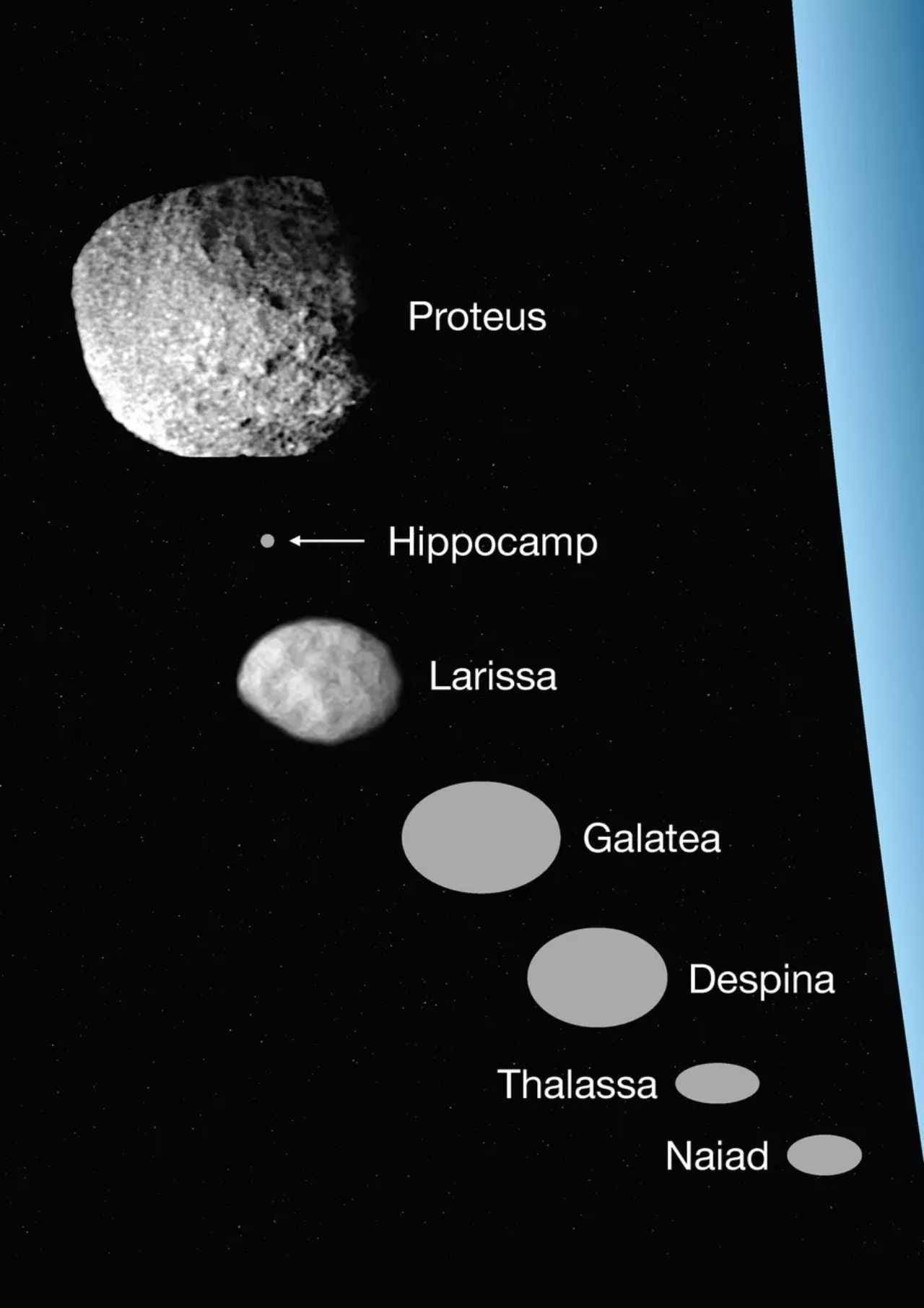 Relative sizes of a few of Neptune’s moons, including Hippocamp. Image credit: Mark Showalter/SETI Institute[/caption]"We suspect that Naiad was kicked into its tilted orbit by an earlier interaction with one of Neptune's other inner moons," said Marina Brozović, an expert in solar system dynamics at JPL in a press release. "Only later, after its orbital tilt was established, could Naiad settle into this unusual resonance with Thalassa.""Naiad and Thalassa have probably been locked together in this configuration for a very long time, because it makes their orbits more stable. They maintain peace by never getting too close," Mark Showalter, a planetary astronomer at the SETI Institute and a co-author of the new paper said in a press release.
First Published:Nov 18, 2019, 17:05:44 IST
Advertisement
Advertisement

Careless Whispers: Scientists discover that plants can 'talk' to each other using smells
Japanese scientists have recorded a video that shows plants, in certain conditions, communicate with each other using mists that carry smells. The discovery, reveals that plants release a fine mist of airborne compounds, to warn nearby plants of potential dangers
Life on Mars? European Space Agency’s Orbiter discovers ice water deposits at equator
European Space Agency's Mars Express Orbiter has identified massive ice and ice water deposits beneath the surface of Mars. The Mars Express orbiter was also the first to confirmed the presence of ice on Mars in 2004
Microsoft briefly overtakes Apple as the most valuable company, Apple back on top again
At its peak during the session, Microsoft's value reached $2.903 trillion, with a 2% surge. As of writing this article, Apple closed at $2.89 trillion, whereas Microsoft closed at $2.86 trillion
Even NASA is facing a tough time, starts layoffs following major budget cuts
NASA is facing some massive budget cuts, because of which, it has been forced to postpone some upcoming missions. NASA's Jet Propulsion Laboratory has been hit hard by recent federal budget cuts, resulting in the layoff of 100 contractors last week
ISRO, NASA's NISAR satellite to get ready by Jan-end, will monitor Earth's snow-covered regions
The NISAR satellite which has been developed jointly ISRO and NASA, should be ready for launch by the end of January 2024. The collaboration between NASA and ISRO on NISAR is the first time the two agencies have cooperated on hardware development for an Earth-observing mission
Advertisement
Advertisement