


NASA's Fermi spots pulsar zipping through space at 4 million kilometres an hour
Pulsars are super dense, rapidly spinning neutron stars left behind when a massive star explodes.

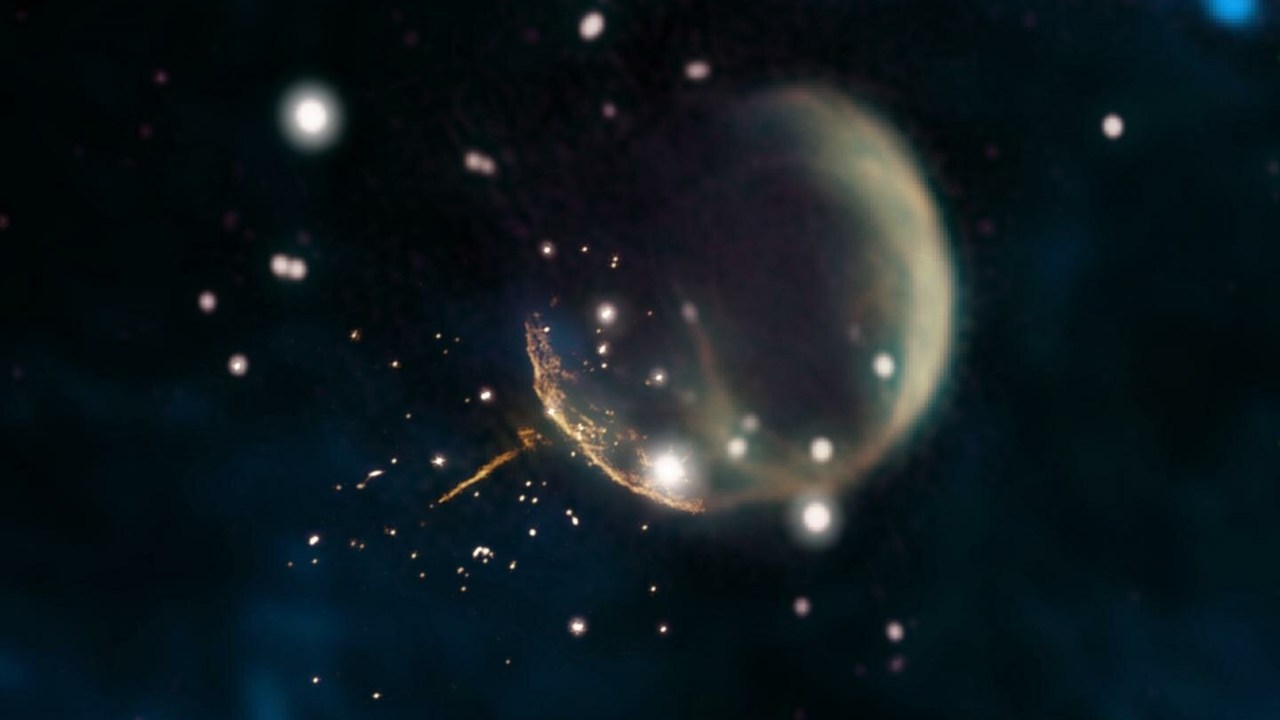
Fermi Satellite clocks 'cannonball' pulsar speeding through space. Image courtesy: NASA Fermi[/caption]J0002 is speeding through space five times faster than the average pulsar, and faster than 99 percent of those with measured speeds. It will eventually escape our galaxy, researchers said.At first, the supernova's expanding debris would have moved outward faster than J0002, but over thousands of years, the shell's interaction with interstellar gas produced a drag that gradually slowed this motion.Meanwhile, the pulsar, behaving more like a cannonball, steadily raced through the remnant, escaping it about 5,000 years after the explosion.Exactly how the pulsar was accelerated to such high speed during the supernova explosion remains unclear, and further study of J0002 will help shed light on the process.One possible mechanism involves instabilities in the collapsing star forming a region of dense, slow-moving matter that survives long enough to serve as a "gravitational tugboat," accelerating the nascent neutron star toward it.

Careless Whispers: Scientists discover that plants can 'talk' to each other using smells
Life on Mars? European Space Agency’s Orbiter discovers ice water deposits at equator
Microsoft briefly overtakes Apple as the most valuable company, Apple back on top again
Even NASA is facing a tough time, starts layoffs following major budget cuts
ISRO, NASA's NISAR satellite to get ready by Jan-end, will monitor Earth's snow-covered regions