
Advertisement


Sections
NASA's Dawn spacecraft to run out of fuel, remain in dwarf planet Ceres's orbit
Dawn will lose its ability to communicate with Earth, but will remain in a silent orbit around Ceres.

After 11 years of gathering breathtaking imagery, and performing unprecedented feats of spacecraft engineering, Dawn – NASA's space probe for the asteroid belt – is drawing to a close due to lack of a key fuel, the US space agency said.Launched from Cape Canaveral Air Force Station in September 2007, Dawn was majorly tasked to study two of the three known protoplanets of the asteroid belt Vesta and Ceres, which when combined, make up 45 percent of the mass of the main asteroid belt.The spacecraft is likely to run out of a fuel known as hydrazine, which keeps it oriented and in communication with Earth – between September and October.[caption id="attachment_5144441" align="alignnone" width="1280"]![An artistic representation of NASA's Dawn spacecraft arriving at dwarf planet Ceres, the biggest object in the asteroid belt. Image courtesy: NASA/JPL]() An artistic representation of NASA's Dawn spacecraft arriving at dwarf planet Ceres, the biggest object in the asteroid belt. Image courtesy: NASA/JPL[/caption]When that happens, Dawn will lose its ability to communicate with Earth, but will remain in a silent orbit around Ceres for decades, NASA said in a statement late on Thursday."Not only did this spacecraft unlock scientific secrets at these two small but significant worlds, it was also the first spacecraft to visit and orbit bodies at two extraterrestrial destinations during its mission," Lori Glaze, acting director of the Planetary Science Division at Headquarters in Washington, said.From 2011 to 2012, the spacecraft swept over Vesta, capturing images of craters, canyons and even mountains of this planet-like world.Then in 2015, Dawn's cameras spotted a cryovolcano and mysterious bright spots on Ceres, which scientists later found might be salt deposits produced by the exposure of briny liquid from Ceres' interior."Dawn has shown us alien worlds that, for two centuries, were just pinpoints of light amidst the stars. And it has produced these richly detailed, intimate portraits and revealed exotic, mysterious landscapes unlike anything we've ever seen," said Marc Rayman, Dawn's mission director and chief engineer at NASA's Jet Propulsion Laboratory, in California.[caption id="attachment_4158819" align="alignnone" width="1280"]
An artistic representation of NASA's Dawn spacecraft arriving at dwarf planet Ceres, the biggest object in the asteroid belt. Image courtesy: NASA/JPL[/caption]When that happens, Dawn will lose its ability to communicate with Earth, but will remain in a silent orbit around Ceres for decades, NASA said in a statement late on Thursday."Not only did this spacecraft unlock scientific secrets at these two small but significant worlds, it was also the first spacecraft to visit and orbit bodies at two extraterrestrial destinations during its mission," Lori Glaze, acting director of the Planetary Science Division at Headquarters in Washington, said.From 2011 to 2012, the spacecraft swept over Vesta, capturing images of craters, canyons and even mountains of this planet-like world.Then in 2015, Dawn's cameras spotted a cryovolcano and mysterious bright spots on Ceres, which scientists later found might be salt deposits produced by the exposure of briny liquid from Ceres' interior."Dawn has shown us alien worlds that, for two centuries, were just pinpoints of light amidst the stars. And it has produced these richly detailed, intimate portraits and revealed exotic, mysterious landscapes unlike anything we've ever seen," said Marc Rayman, Dawn's mission director and chief engineer at NASA's Jet Propulsion Laboratory, in California.[caption id="attachment_4158819" align="alignnone" width="1280"]![An image captured by Dawn spacecraft of Ceres's surface. Image courtesy: NASA/JPL]() An image captured by Dawn spacecraft of part of dwarf planet Ceres's surface in its northern hemisphere. Image courtesy: NASA/JPL[/caption]It has continued to gather high-resolution images, gamma ray and neutron spectra, infrared spectra and gravity data at Ceres.Nearly once a day, Dawn will swoop over Ceres about 35 kilometers from its surface – only about three times the altitude of a passenger jet – gathering valuable data until it expends the last of the hydrazine that feeds thrusters controlling its orientation.Engineers have designed Dawn's final orbit – around Ceres, which has no atmosphere – to ensure it will not crash for at least 20 years, and likely decades longer, NASA said.According to Rayman, Dawn's is "an inert, celestial monument to human creativity and ingenuity."
An image captured by Dawn spacecraft of part of dwarf planet Ceres's surface in its northern hemisphere. Image courtesy: NASA/JPL[/caption]It has continued to gather high-resolution images, gamma ray and neutron spectra, infrared spectra and gravity data at Ceres.Nearly once a day, Dawn will swoop over Ceres about 35 kilometers from its surface – only about three times the altitude of a passenger jet – gathering valuable data until it expends the last of the hydrazine that feeds thrusters controlling its orientation.Engineers have designed Dawn's final orbit – around Ceres, which has no atmosphere – to ensure it will not crash for at least 20 years, and likely decades longer, NASA said.According to Rayman, Dawn's is "an inert, celestial monument to human creativity and ingenuity."
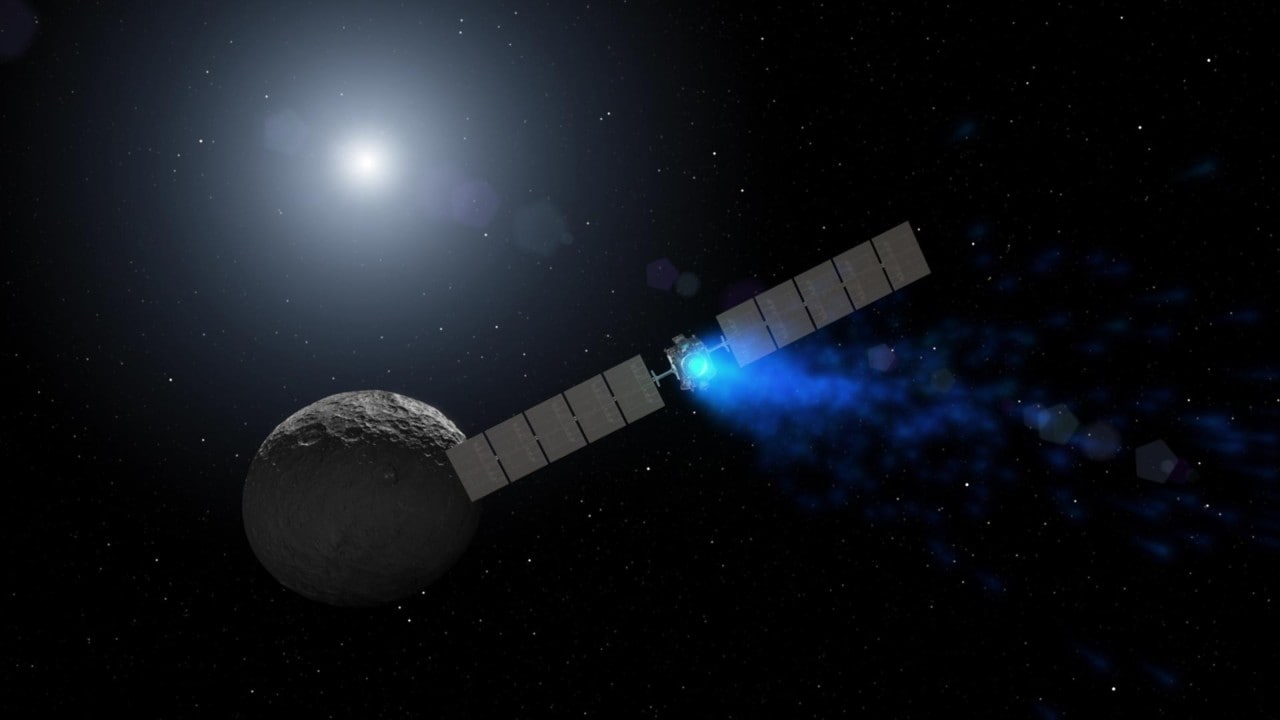 An artistic representation of NASA's Dawn spacecraft arriving at dwarf planet Ceres, the biggest object in the asteroid belt. Image courtesy: NASA/JPL[/caption]When that happens, Dawn will lose its ability to communicate with Earth, but will remain in a silent orbit around Ceres for decades, NASA said in a statement late on Thursday."Not only did this spacecraft unlock scientific secrets at these two small but significant worlds, it was also the first spacecraft to visit and orbit bodies at two extraterrestrial destinations during its mission," Lori Glaze, acting director of the Planetary Science Division at Headquarters in Washington, said.
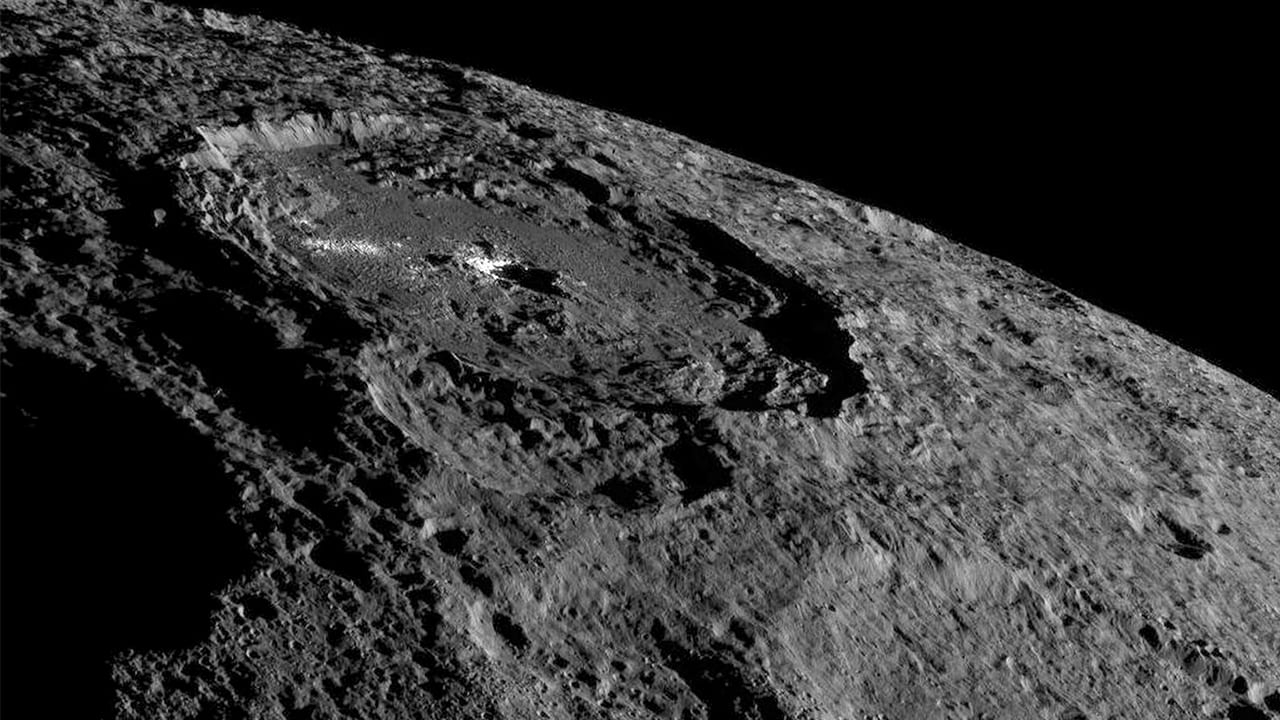 An image captured by Dawn spacecraft of part of dwarf planet Ceres's surface in its northern hemisphere. Image courtesy: NASA/JPL[/caption]It has continued to gather high-resolution images, gamma ray and neutron spectra, infrared spectra and gravity data at Ceres.Nearly once a day, Dawn will swoop over Ceres about 35 kilometers from its surface – only about three times the altitude of a passenger jet – gathering valuable data until it expends the last of the hydrazine that feeds thrusters controlling its orientation.Engineers have designed Dawn's final orbit – around Ceres, which has no atmosphere – to ensure it will not crash for at least 20 years, and likely decades longer, NASA said.According to Rayman, Dawn's is "an inert, celestial monument to human creativity and ingenuity."
First Published:Sep 08, 2018, 18:22:16 IST
Advertisement
Advertisement

Careless Whispers: Scientists discover that plants can 'talk' to each other using smells
Japanese scientists have recorded a video that shows plants, in certain conditions, communicate with each other using mists that carry smells. The discovery, reveals that plants release a fine mist of airborne compounds, to warn nearby plants of potential dangers
Life on Mars? European Space Agency’s Orbiter discovers ice water deposits at equator
European Space Agency's Mars Express Orbiter has identified massive ice and ice water deposits beneath the surface of Mars. The Mars Express orbiter was also the first to confirmed the presence of ice on Mars in 2004
Microsoft briefly overtakes Apple as the most valuable company, Apple back on top again
At its peak during the session, Microsoft's value reached $2.903 trillion, with a 2% surge. As of writing this article, Apple closed at $2.89 trillion, whereas Microsoft closed at $2.86 trillion
Even NASA is facing a tough time, starts layoffs following major budget cuts
NASA is facing some massive budget cuts, because of which, it has been forced to postpone some upcoming missions. NASA's Jet Propulsion Laboratory has been hit hard by recent federal budget cuts, resulting in the layoff of 100 contractors last week
ISRO, NASA's NISAR satellite to get ready by Jan-end, will monitor Earth's snow-covered regions
The NISAR satellite which has been developed jointly ISRO and NASA, should be ready for launch by the end of January 2024. The collaboration between NASA and ISRO on NISAR is the first time the two agencies have cooperated on hardware development for an Earth-observing mission
Advertisement
Advertisement