


NASA's Curiosity Rover shares selfie from Mars that it captured during its ‘steepest’ climb ever
It was one of the steepest slopes any manmade creation has climbed outside Earth and it took three tries for the rover to climb it.

The Curiosity Rover of the US space agency NASA has sent back a selfie from Mars. The car-sized rover dug a hole near a highland area on Mars, called the ‘Greenheugh Pediment’.
In the 360-degree panorama shot received from Curiosity, the said hole, the pediment atop the hill and the rover itself are visible. The picture released to the public has been stitched together by NASA from 86 images sent by the rover.
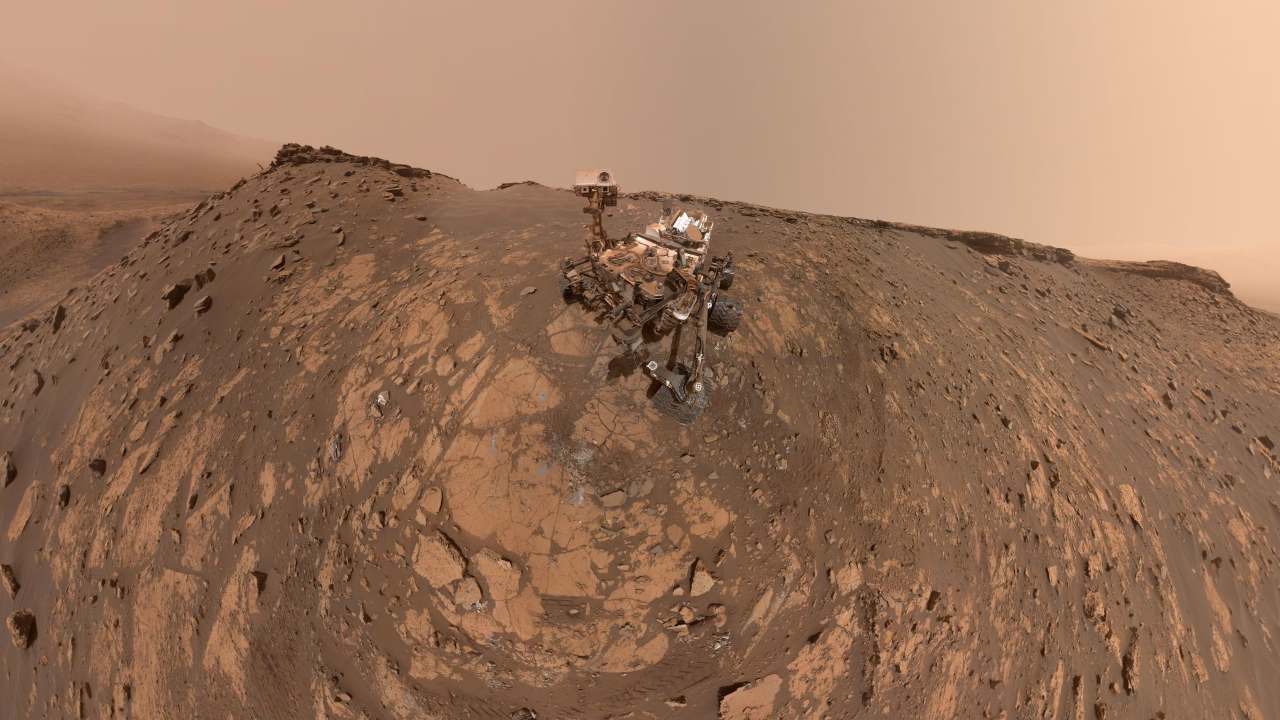
The picture released to the public has been stitched together by NASA from 86 images sent by the rover after Curiosity climbed Greenheugh Pediment slope. Image credit: NASA[/caption]It was also one of the steepest slopes that any manmade creation has managed to reach outside the Earth. It took three tries for the rover to climb the slope and it managed the feat on 6 March.
Owing to the specialised wheel system, Curiosity had hardly any chance of flipping over while climbing on steep slopes. The rover can tilt up to 45 degrees safely. While scaling the ‘Greenheugh Pediment’, it tilted as much as 31 degrees.In order to capture images, Curiosity is enabled with a Mars Hand Lens Camera or MAHLI. This is located at the tip of its arm. Researchers can rotate the tip and use this camera to capture the condition of Curiosity.
As every image clicked by MAHLI covers only a small area, many images from different angles are required to make up a single complete image of the entire rover and its surroundings.
 More from Science
Careless Whispers: Scientists discover that plants can 'talk' to each other using smells
Life on Mars? European Space Agency’s Orbiter discovers ice water deposits at equator
Microsoft briefly overtakes Apple as the most valuable company, Apple back on top again
Even NASA is facing a tough time, starts layoffs following major budget cuts
ISRO, NASA's NISAR satellite to get ready by Jan-end, will monitor Earth's snow-covered regions