


NASA's Cassini help scientists describe methane lakes, landscape on Saturn's Titan
Saturn's moon Titan has a water cycle like Earth but lakes filled with liquid methane

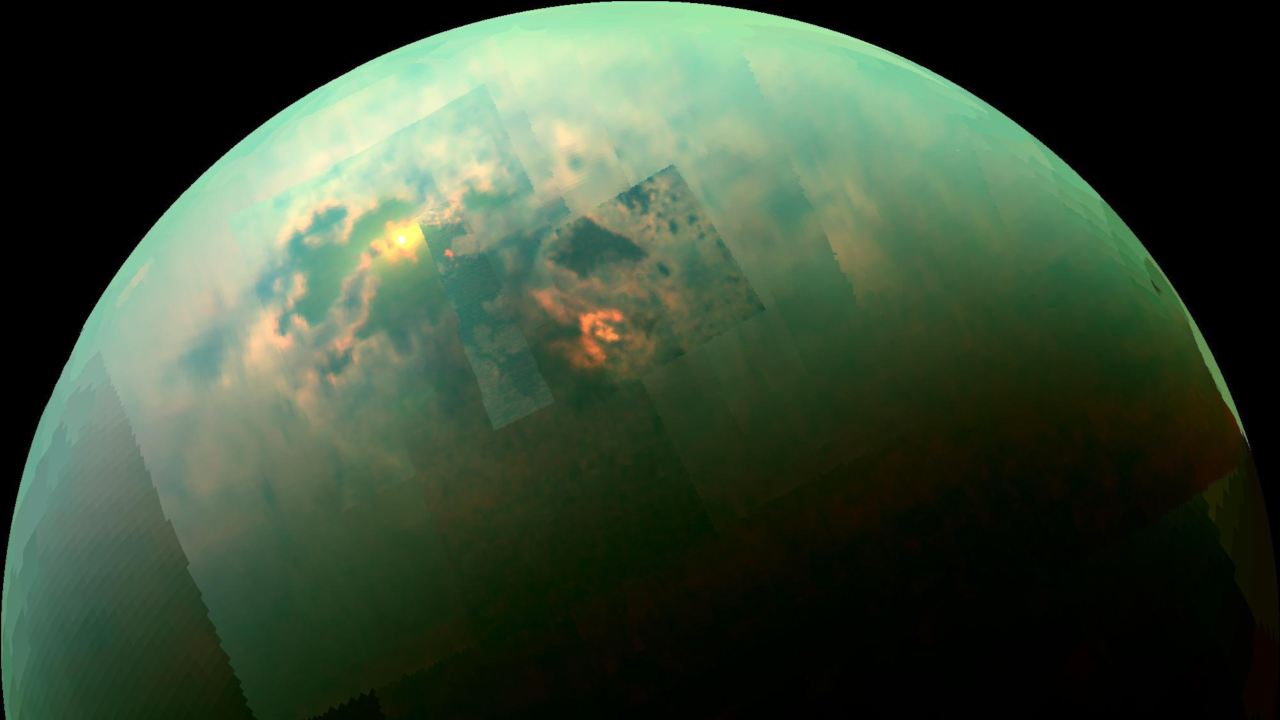
This view captured by Cassini shows the sun glinting off of Titan's north polar seas. image credit: NASA/JPL[/caption]The scientists also described “phantom lakes” that during wintertime appeared to be wide but shallow ponds — perhaps only a few inches (cm) deep but — evaporated or drained into the surface by springtime, a process taking seven years on Titan.The findings represented further evidence about Titan’s hydrological cycle, with liquid hydrocarbons raining down from clouds, flowing across its surface and evaporating back into the sky. This is comparable to Earth’s water cycle.Because of Titan’s complex chemistry and distinctive environments, scientists suspect it potentially could harbour life, in particular in its subsurface ocean of water, but possibly in the surface bodies of liquid hydrocarbons.
“Titan is a very fascinating object in the solar system, and every time we look carefully at the data we find out something new,” California Institute of Technology planetary scientist Marco Mastrogiuseppe said.Titan, with a diameter of 3,200 miles (5,150 km), is the solar system’s second largest moon, behind only Jupiter’s Ganymede. It is bigger than the planet Mercury.“Titan is the most Earth-like body in the solar system. It has lakes, canyons, rivers, dune fields of organic sand particles about the same size as silica sand grains on Earth,” Johns Hopkins University Applied Physics Laboratory planetary scientist Shannon MacKenzie said.
Careless Whispers: Scientists discover that plants can 'talk' to each other using smells
Life on Mars? European Space Agency’s Orbiter discovers ice water deposits at equator
Microsoft briefly overtakes Apple as the most valuable company, Apple back on top again
Even NASA is facing a tough time, starts layoffs following major budget cuts
ISRO, NASA's NISAR satellite to get ready by Jan-end, will monitor Earth's snow-covered regions