


NASA's animated video gives viewers Juno's POV of flying over Jupiter, Ganymede
This video was taken on 7 June 2021 when Juno flew past the icy giant and its moon, closer than any spacecraft had in 20 years.

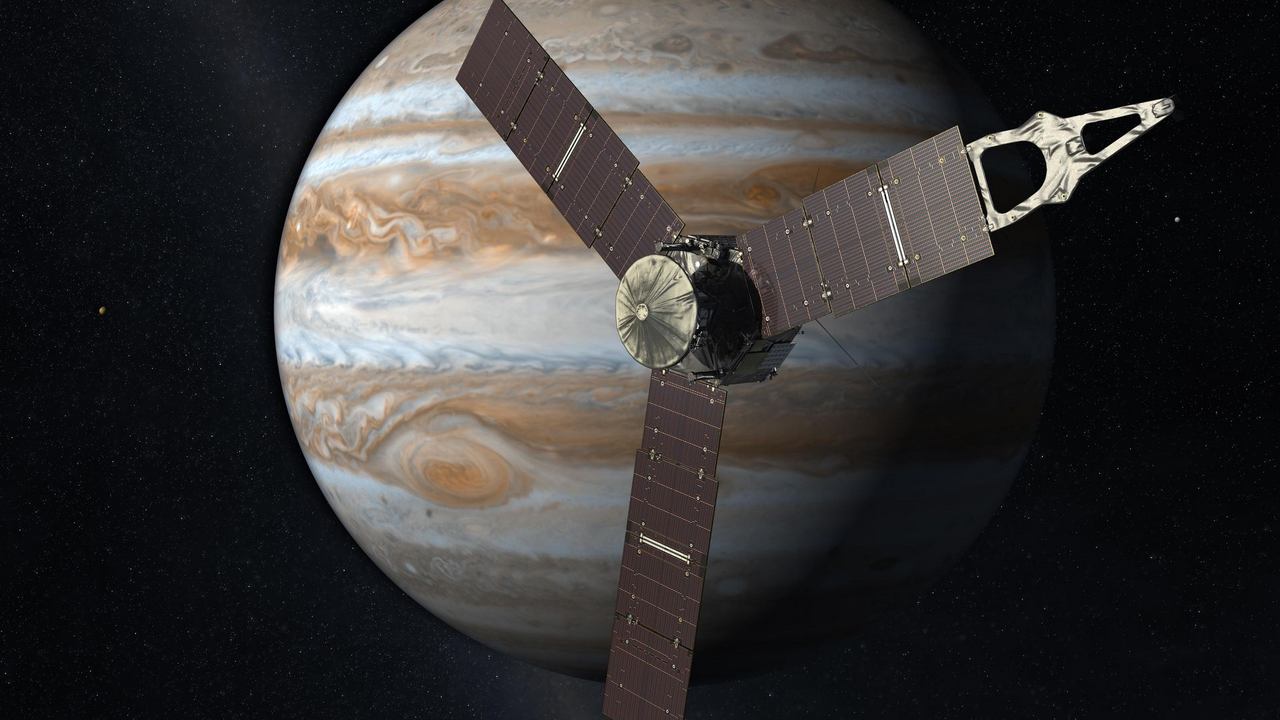
Artistic impression of NASA's Juno mission to Jupiter Image Credit: NASA[/caption]The 3:30-minute-long video begins with Juno approaching Ganymede. The spacecraft flew within 1,038 kilometres of the moon's surface at a relative velocity of 67,000 kph.Then spacecraft flew a little less than 15 hours to reach Jupiter which is around 1.18 million kilometres away. Once there, the viewer is a mere 3,400 kilometres above Jupiter’s spectacular cloud topsCommenting on the video, Scott Bolton, principal investigator of Juno from the Southwest Research Institute in San Antonio said “The animation shows just how beautiful deep space exploration can be.”He also that this animated video is a way for people to explore "our solar system firsthand by seeing what it would be like to be orbiting Jupiter and flying past one of its icy moons."As the space probe flies past the surface, we could see it capturing the cratered surface of Jupiter’s moon. According to a Space.com report, Tros can be seen in the footage. One can see several of the moon’s dark and light regions states NASA. The darker regions are believed to result from ice sublimating into the surrounding vacuum, leaving behind darkened residue.Tros is the largest and the brightest crater of Ganymede and is surrounded by the white rays of ejected material.After Juno captured the images of Ganymede’s surface, the probe took pictures of the surface of Jupiter. Lightning could also be seen in the video in the form of flashes of white light. The white ovals on its surface indicate a set of giant storms. These are known as the ‘string of pearls’ and can be seen in the southern hemisphere of Jupiter.The video footage that has been released by NASA was compiled by citizen scientist Gerald Eichstädt. The team of Juno used the imagery that the JunoCam imager captured in order to prepare this video.

Careless Whispers: Scientists discover that plants can 'talk' to each other using smells
Life on Mars? European Space Agency’s Orbiter discovers ice water deposits at equator
Microsoft briefly overtakes Apple as the most valuable company, Apple back on top again
Even NASA is facing a tough time, starts layoffs following major budget cuts
ISRO, NASA's NISAR satellite to get ready by Jan-end, will monitor Earth's snow-covered regions