
Advertisement


Sections
NASA to study untouched Moon samples from Apollo missions for first time
The samples were vacuum-sealed on the Moon & brought to Earth by Apollo 17 astronauts 50 years ago.

NASA has awarded USD eight million to nine science teams to study the untouched samples collected from the Moon by Apollo missions in the 1970s and carefully stored for nearly 50 years, the US space agency said."By studying these precious lunar samples for the first time, a new generation of scientists will help advance our understanding of our lunar neighbour and prepare for the next era of exploration of the Moon and beyond," Thomas Zurbuchen, Associate Administrator for NASA's Science Mission Directorate, said."This exploration will bring with it new and unique samples into the best labs right here on Earth," Zurbuchen said in a statement.[caption id="attachment_6257651" align="alignnone" width="1280"]![Scientist-astronaut Harrison Schmitt collecting lunar rake samples during the first Apollo 17. Schmitt was the lunar module pilot for the mission. The Lunar Rake is used to collect discrete samples of rocks and rock chips of different sizes. Image courtesy: NASA]() Scientist-astronaut Harrison Schmitt collecting lunar rake samples during the first Apollo 17. Schmitt was the lunar module pilot for the mission. The Lunar Rake is used to collect discrete samples of rocks and rock chips of different sizes. Image courtesy: NASA[/caption]Six of the nine teams will look at one of the three remaining lunar samples, from Apollo missions 15, 16, and 17, which have never been exposed to Earth's atmosphere, NASA said.The particular sample these teams will study came to Earth vacuum-sealed on the Moon by the Apollo 17 astronauts Harrison Schmitt and Gene Cernan in 1972.The Apollo 17 sample comprises about 800 grammes of material, still encased in a "drive tube" that was pounded into the lunar regolith to collect a core of material.[caption id="attachment_5049441" align="alignnone" width="1280"]
Scientist-astronaut Harrison Schmitt collecting lunar rake samples during the first Apollo 17. Schmitt was the lunar module pilot for the mission. The Lunar Rake is used to collect discrete samples of rocks and rock chips of different sizes. Image courtesy: NASA[/caption]Six of the nine teams will look at one of the three remaining lunar samples, from Apollo missions 15, 16, and 17, which have never been exposed to Earth's atmosphere, NASA said.The particular sample these teams will study came to Earth vacuum-sealed on the Moon by the Apollo 17 astronauts Harrison Schmitt and Gene Cernan in 1972.The Apollo 17 sample comprises about 800 grammes of material, still encased in a "drive tube" that was pounded into the lunar regolith to collect a core of material.[caption id="attachment_5049441" align="alignnone" width="1280"]![Lunar soil collected from Apollo 17 displayed in the National Museum of Natural History in . Image courtesy: Wikimedia Commons]() Lunar soil collected from Apollo 17 displayed in the National Museum of Natural History in Washington. Image courtesy: Wikimedia Commons[/caption]That core preserves not just the rocks themselves but also the stratigraphy from below the surface so today's scientists can, in a laboratory, study the rock layers exactly as they existed on the Moon.The core has been carefully stored at NASA's Johnson Space Center in Houston since December 1972.Other teams will be studying samples that have also been specially curated, some from Apollo 17 that were brought to Earth and then kept frozen, and samples from the Apollo 15 mission which have been stored in helium since 1971.[caption id="attachment_6128021" align="alignnone" width="1280"]
Lunar soil collected from Apollo 17 displayed in the National Museum of Natural History in Washington. Image courtesy: Wikimedia Commons[/caption]That core preserves not just the rocks themselves but also the stratigraphy from below the surface so today's scientists can, in a laboratory, study the rock layers exactly as they existed on the Moon.The core has been carefully stored at NASA's Johnson Space Center in Houston since December 1972.Other teams will be studying samples that have also been specially curated, some from Apollo 17 that were brought to Earth and then kept frozen, and samples from the Apollo 15 mission which have been stored in helium since 1971.[caption id="attachment_6128021" align="alignnone" width="1280"]![Moon rocks collected from the Apollo 16 mission. Image: Washington University, St Louis]() Moon rocks collected from the Apollo 16 mission. Image: Washington University, St Louis[/caption]NASA has only collected samples from a few places on the Moon so far, but the US space agency knows from the remote sensing data that the Moon is a complex geologic body.From orbit, the agency has identified types of rocks and minerals that are not present in the Apollo sample collection.
Moon rocks collected from the Apollo 16 mission. Image: Washington University, St Louis[/caption]NASA has only collected samples from a few places on the Moon so far, but the US space agency knows from the remote sensing data that the Moon is a complex geologic body.From orbit, the agency has identified types of rocks and minerals that are not present in the Apollo sample collection.
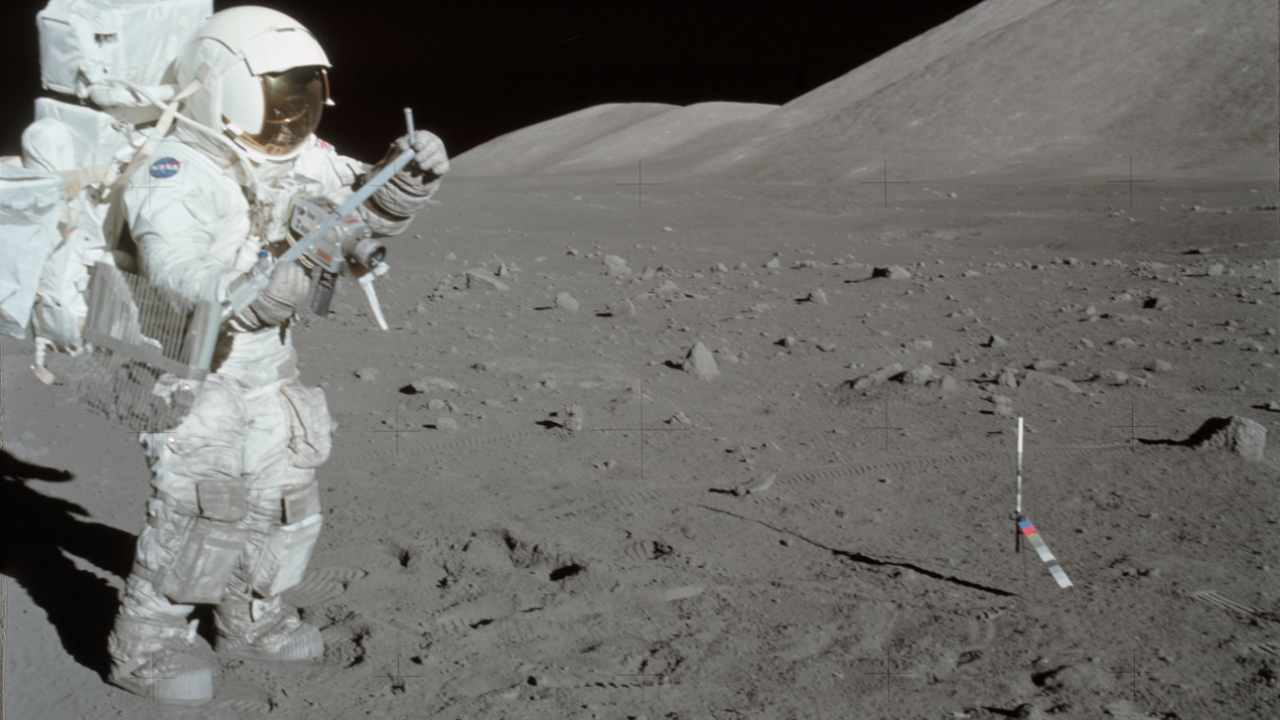 Scientist-astronaut Harrison Schmitt collecting lunar rake samples during the first Apollo 17. Schmitt was the lunar module pilot for the mission. The Lunar Rake is used to collect discrete samples of rocks and rock chips of different sizes. Image courtesy: NASA[/caption]Six of the nine teams will look at one of the three remaining lunar samples, from Apollo missions 15, 16, and 17, which have never been exposed to Earth's atmosphere, NASA said.The particular sample these teams will study came to Earth vacuum-sealed on the Moon by the Apollo 17 astronauts Harrison Schmitt and Gene Cernan in 1972.The Apollo 17 sample comprises about 800 grammes of material, still encased in a "drive tube" that was pounded into the lunar regolith to collect a core of material.[caption id="attachment_5049441" align="alignnone" width="1280"]
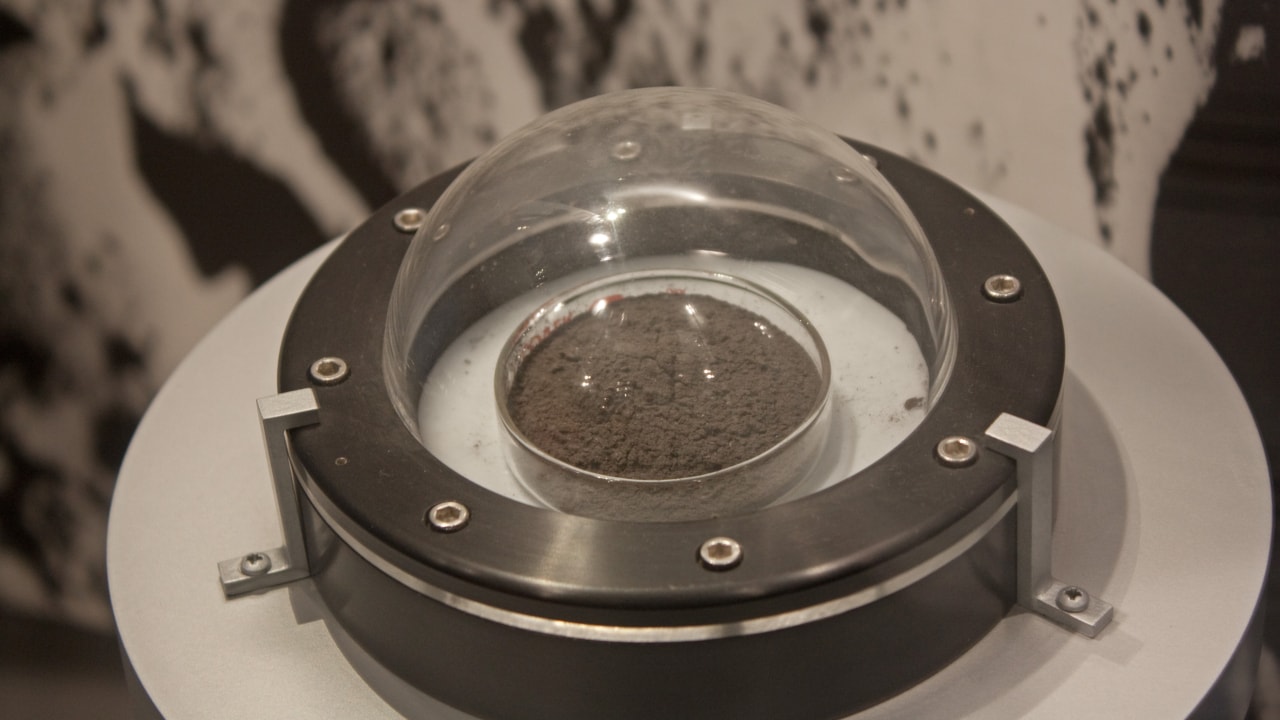 Lunar soil collected from Apollo 17 displayed in the National Museum of Natural History in Washington. Image courtesy: Wikimedia Commons[/caption]That core preserves not just the rocks themselves but also the stratigraphy from below the surface so today's scientists can, in a laboratory, study the rock layers exactly as they existed on the Moon.The core has been carefully stored at NASA's Johnson Space Center in Houston since December 1972.Other teams will be studying samples that have also been specially curated, some from Apollo 17 that were brought to Earth and then kept frozen, and samples from the Apollo 15 mission which have been stored in helium since 1971.[caption id="attachment_6128021" align="alignnone" width="1280"]
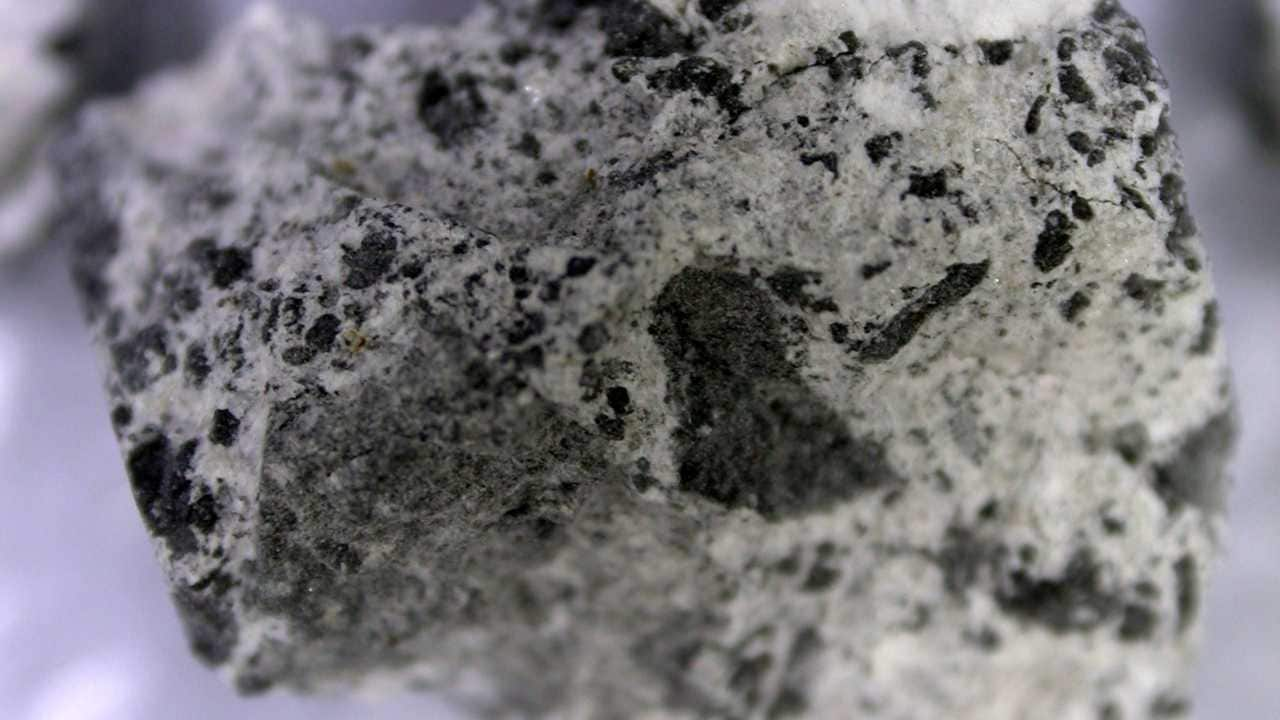 Moon rocks collected from the Apollo 16 mission. Image: Washington University, St Louis[/caption]NASA has only collected samples from a few places on the Moon so far, but the US space agency knows from the remote sensing data that the Moon is a complex geologic body.From orbit, the agency has identified types of rocks and minerals that are not present in the Apollo sample collection.
First Published:Mar 14, 2019, 13:25:54 IST
Advertisement
Advertisement

Careless Whispers: Scientists discover that plants can 'talk' to each other using smells
Japanese scientists have recorded a video that shows plants, in certain conditions, communicate with each other using mists that carry smells. The discovery, reveals that plants release a fine mist of airborne compounds, to warn nearby plants of potential dangers
Life on Mars? European Space Agency’s Orbiter discovers ice water deposits at equator
European Space Agency's Mars Express Orbiter has identified massive ice and ice water deposits beneath the surface of Mars. The Mars Express orbiter was also the first to confirmed the presence of ice on Mars in 2004
Microsoft briefly overtakes Apple as the most valuable company, Apple back on top again
At its peak during the session, Microsoft's value reached $2.903 trillion, with a 2% surge. As of writing this article, Apple closed at $2.89 trillion, whereas Microsoft closed at $2.86 trillion
Even NASA is facing a tough time, starts layoffs following major budget cuts
NASA is facing some massive budget cuts, because of which, it has been forced to postpone some upcoming missions. NASA's Jet Propulsion Laboratory has been hit hard by recent federal budget cuts, resulting in the layoff of 100 contractors last week
ISRO, NASA's NISAR satellite to get ready by Jan-end, will monitor Earth's snow-covered regions
The NISAR satellite which has been developed jointly ISRO and NASA, should be ready for launch by the end of January 2024. The collaboration between NASA and ISRO on NISAR is the first time the two agencies have cooperated on hardware development for an Earth-observing mission
Advertisement
Advertisement