


NASA-SpaceX ends a nine-year launch drought in the US by successfully launching two astronauts
Astronauts Bob Behnken and Doug Hurley are on their way to the ISS and will dock automatically around 7.00 pm IST, 19 hours after the lift-off.

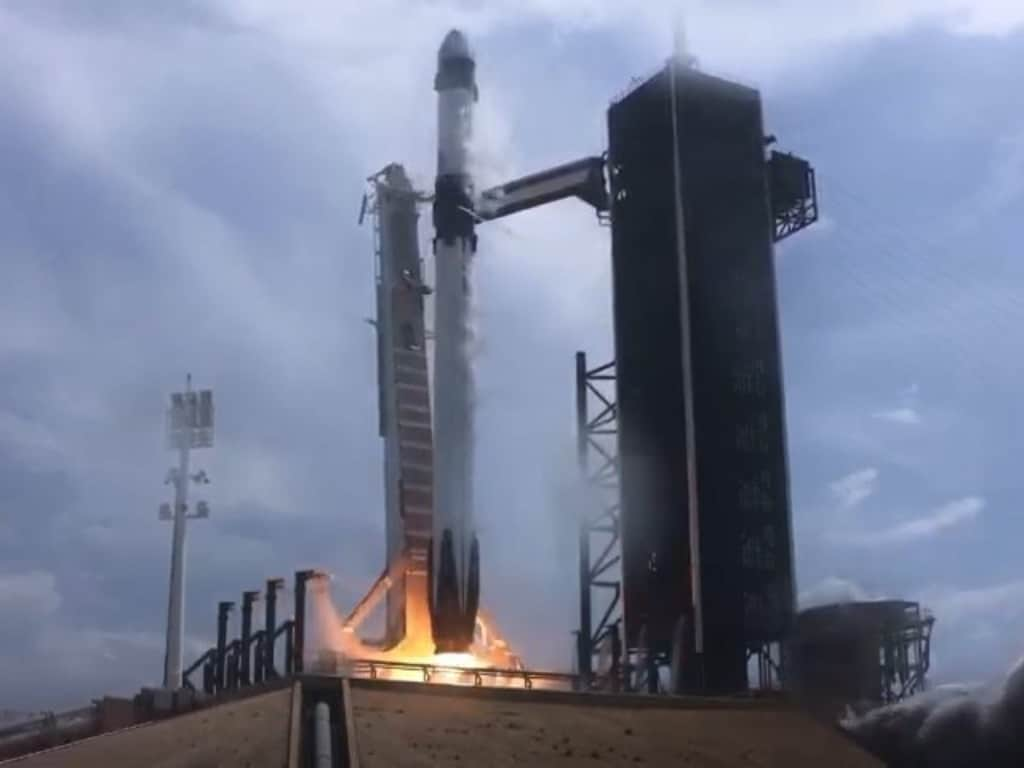
The SpaceX Falcon 9 launches from the Launch Complex 39A from the Kenndy Space Centre, Image credit: NASA/Youtube[/caption]The NASA-SpaceX joint human spaceflight was scheduled for liftoff on Thursday, 28 May, 2.00 am IST (Wednesday, 27 May at 4.32 pm EDT) from the Launch Complex 39A from the Kenndy Space Centre, Florida which was also the launch site for the previous Apollo and Space Shuttle missions and was leased by SpaceX. Due to bad weather, the launch had to be rescheduled on Sunday, 31 May, 12.52 am IST (May 30 at 3:22 p.m. EDT).Astronauts Bob Behnken and Doug Hurley are on their to the International Space Station and will dock automatically around 7.00 pm IST, 19 hours after the lift-off.
There were a lot of doubts if the launch was going to happen today as the weather seems pretty similar to Thursday - cloudy with some rain and chances of lightning. However, 45 minutes before the launch, mission director gave the team the all-clear for the launch and 10 minutes later the propellant was being loaded into the two-stage rocket.President Donald Trump and Vice President Michael Pence also present for the launch like they were for the wet rehearsal as well. Space.com reports that Trump told reporters 'that he felt an obligation as president to watch the historic liftoff.'Elon Musk, CEO of SpaceX was surprisingly missing. Thursday, Musk was seen talking to the astronauts after they suited up in the crew quarters, he was also seen standing with Pence and Bridenstine at the behind exit when the astronauts were leaving the building. He even has a couple of interviews with NASA chief Jim Bridenstine. However, this time around Musk had been replaced with former astronaut and current Director of Kennedy Space Center, Bob Cabana and Jim Morhard, Deputy Administrator at NASA.Post-launch sequence
Mission Background
Hurley, 53 and Behnken, 49 have extensive experience in space and have been involved in NASA's Space Shuttle flights.Behnken will be the joint operations commander in this mission and was selected as a NASA astronaut in 2000. He has completed two space shuttle flights - STS-123 in March 2008 and STS-130 in February 2010 and performed three spacewalks during each mission.Hurley was selected as a NASA astronaut in 2000 and will be the spacecraft commander for Demo-2. He has completed two spaceflights - STS‐127 in July 2009 and STS‐135, the final space shuttle mission, in July 2011. He was the pilot and lead robotics operator for both missions.[caption id="attachment_8429631" align="alignnone" width="1280"]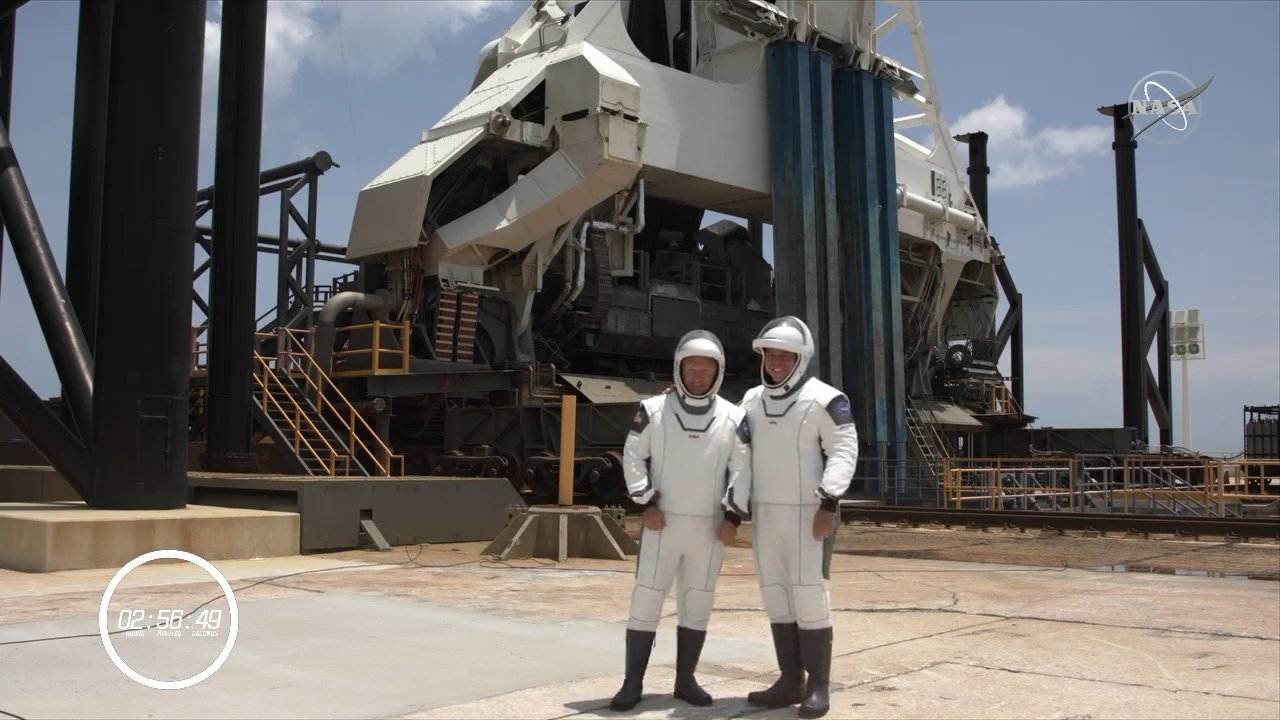
Astronauts Bob Behnken and Doug Hurley stand on the launch pad before they enter the Crew Dragon capsule. Image credit: NASA/Youtube[/caption]NASA awarded two commercial crew program contracts in 2014 NASA and Boeing to develop a spacecraft that will be able to carry people to space by 2017 - Boeing got $ 4.2 billion for its Starliner capsule and SpaceX got $2.6 billion for Crew Dragon. The Demo-2 mission is almost three years behind schedule for this launch.Crew Dragon is capable of carrying up to seven passengers to and from Earth orbit, and beyond but will only be carrying four passengers during NASA human spaceflight launches. The capsule is about three metres in diameter and eight metres high and can carry 6,000 kgs. Before it was modified to carry human beings, SpaceX was using the Dragon as a cargo carrier, for resupply missions to the ISS.Like the rocket and crew capsule, even the astronaut suits were designed and produced in-house and is custom made to fit ever astronaut that will travel in Crew Dragon. The suits include a 3D-printed helmet and touchscreen-compatible gloves and is an integral part of the mission. It provides oxygen for the astronauts to breathe and also helps them in communicating with the ground team.SpaceX's Falcon 9 is a partially-reusable two-stage-to-orbit launch vehicle. Its first stage is capable of re-entering the atmosphere and landing vertically after separating from the second stage, which is why it is partially re-usable. SpaceX successfully landed its first stage during its 20th flight in December 2015. The second stage of the rocket has a single-engine that can deliver its payload to whichever orbit is required. The engine can be restarted multiple times to deliver multiple payloads into different orbits. A two-stage-to-orbit or two-stage rocket launch vehicle is a spacecraft in which two distinct stages provide propulsion consecutively in order to achieve orbital velocity.Demo-2 is supposed to be the final test for SpaceX’s human spaceflight system before it can be certified by NASA for operational crew missions to and from the International Space Station. This mission will also lay the groundwork for all their future missions to the Moon, Mars, and beyond. This test flight will serve as an end-to-end demonstration of SpaceX’s crew transportation system.

Careless Whispers: Scientists discover that plants can 'talk' to each other using smells
Life on Mars? European Space Agency’s Orbiter discovers ice water deposits at equator
Microsoft briefly overtakes Apple as the most valuable company, Apple back on top again
Even NASA is facing a tough time, starts layoffs following major budget cuts
ISRO, NASA's NISAR satellite to get ready by Jan-end, will monitor Earth's snow-covered regions