
Advertisement


Sections
NASA's Perseverance Mars Rover found “human trash” on Mars
The Perseverance Rover has found something very unusual on the surface of Mars. Instead of finding past microbial life forms as part of its mission, the Mars Rover has found a piece of “human trash” on its surface.

All our space exploration initiatives to Mars, be it the Perseverance Mars Rover or the Mangalyaan Mars Orbiter have been desperately looking for some form of microbial life on the planet.![NASA's Perseverance Mars Rover found human trash on Mars]() Well, they did find something bewildering, but not life. Instead, NASA’s Perseverance Mars Rover has found human trash on the red planet. While carrying out one of its regular scheduled inspections of Mars’ surface, NASA's Perseverance rover recently spotted landing debris caught in a jagged rock. The piece of trash that the rover found was a thermal material that the American space agency used to protect the Perseverance spacecraft from extreme temperatures as it journeyed to Mars and plummeted through the Martian atmosphere.In a tweet, the team of NASA engineers handling the Perseverance said, “My team has spotted something unexpected: It’s a piece of a thermal blanket that they think may have come from my descent stage, the rocket-powered jet pack that set me down on landing day back in 2021.” An extremely pertinent question that this piece of foil poses is how did it find its way to the region where it was found, which is about two kilometres away from where the landing gear of the Perseverance mission crashed on Mars."Did this piece land here after that, or was it blown here by the wind?" the space agency wondered.The Perseverance rover landed on Mars in February 2021. On its way down, the spacecraft holding the rover ditched a variety of instruments and objects, including a heat shield, a supersonic parachute, and a rocket-powered sky crane that lowered the rover to the ground. A part of its payload that it ditched, crashlanded on the Martian surface.The Perseverance Rover is now set to enter into the most important phase of its mission. The rover is all set to explore the dried-up river delta in the Jezero Crater. NASA’s planetary scientists suspect this area was filled with water about 3 billion years ago, and if there’s any spot on Mars where they have even the remotest possibility of signs of microscopic life, past or present, this is it.
Well, they did find something bewildering, but not life. Instead, NASA’s Perseverance Mars Rover has found human trash on the red planet. While carrying out one of its regular scheduled inspections of Mars’ surface, NASA's Perseverance rover recently spotted landing debris caught in a jagged rock. The piece of trash that the rover found was a thermal material that the American space agency used to protect the Perseverance spacecraft from extreme temperatures as it journeyed to Mars and plummeted through the Martian atmosphere.In a tweet, the team of NASA engineers handling the Perseverance said, “My team has spotted something unexpected: It’s a piece of a thermal blanket that they think may have come from my descent stage, the rocket-powered jet pack that set me down on landing day back in 2021.” An extremely pertinent question that this piece of foil poses is how did it find its way to the region where it was found, which is about two kilometres away from where the landing gear of the Perseverance mission crashed on Mars."Did this piece land here after that, or was it blown here by the wind?" the space agency wondered.The Perseverance rover landed on Mars in February 2021. On its way down, the spacecraft holding the rover ditched a variety of instruments and objects, including a heat shield, a supersonic parachute, and a rocket-powered sky crane that lowered the rover to the ground. A part of its payload that it ditched, crashlanded on the Martian surface.The Perseverance Rover is now set to enter into the most important phase of its mission. The rover is all set to explore the dried-up river delta in the Jezero Crater. NASA’s planetary scientists suspect this area was filled with water about 3 billion years ago, and if there’s any spot on Mars where they have even the remotest possibility of signs of microscopic life, past or present, this is it.
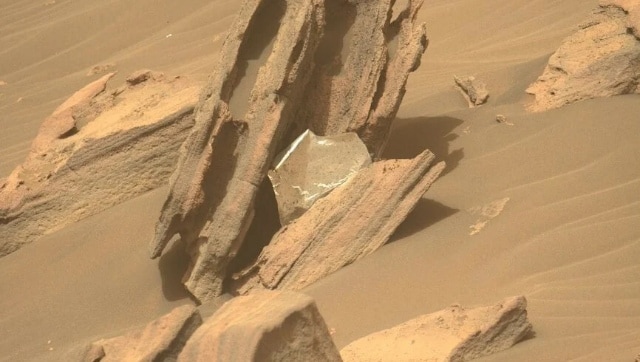 Well, they did find something bewildering, but not life. Instead, NASA’s Perseverance Mars Rover has found human trash on the red planet. While carrying out one of its regular scheduled inspections of Mars’ surface, NASA's Perseverance rover recently spotted landing debris caught in a jagged rock. The piece of trash that the rover found was a thermal material that the American space agency used to protect the Perseverance spacecraft from extreme temperatures as it journeyed to Mars and plummeted through the Martian atmosphere.In a tweet, the team of NASA engineers handling the Perseverance said, “My team has spotted something unexpected: It’s a piece of a thermal blanket that they think may have come from my descent stage, the rocket-powered jet pack that set me down on landing day back in 2021.” An extremely pertinent question that this piece of foil poses is how did it find its way to the region where it was found, which is about two kilometres away from where the landing gear of the Perseverance mission crashed on Mars."Did this piece land here after that, or was it blown here by the wind?" the space agency wondered.The Perseverance rover landed on Mars in February 2021. On its way down, the spacecraft holding the rover ditched a variety of instruments and objects, including a heat shield, a supersonic parachute, and a rocket-powered sky crane that lowered the rover to the ground. A part of its payload that it ditched, crashlanded on the Martian surface.The Perseverance Rover is now set to enter into the most important phase of its mission. The rover is all set to explore the dried-up river delta in the Jezero Crater. NASA’s planetary scientists suspect this area was filled with water about 3 billion years ago, and if there’s any spot on Mars where they have even the remotest possibility of signs of microscopic life, past or present, this is it.
First Published:Jun 16, 2022, 10:30:42 IST
Advertisement
Advertisement

Careless Whispers: Scientists discover that plants can 'talk' to each other using smells
Japanese scientists have recorded a video that shows plants, in certain conditions, communicate with each other using mists that carry smells. The discovery, reveals that plants release a fine mist of airborne compounds, to warn nearby plants of potential dangers
Life on Mars? European Space Agency’s Orbiter discovers ice water deposits at equator
European Space Agency's Mars Express Orbiter has identified massive ice and ice water deposits beneath the surface of Mars. The Mars Express orbiter was also the first to confirmed the presence of ice on Mars in 2004
Microsoft briefly overtakes Apple as the most valuable company, Apple back on top again
At its peak during the session, Microsoft's value reached $2.903 trillion, with a 2% surge. As of writing this article, Apple closed at $2.89 trillion, whereas Microsoft closed at $2.86 trillion
Even NASA is facing a tough time, starts layoffs following major budget cuts
NASA is facing some massive budget cuts, because of which, it has been forced to postpone some upcoming missions. NASA's Jet Propulsion Laboratory has been hit hard by recent federal budget cuts, resulting in the layoff of 100 contractors last week
ISRO, NASA's NISAR satellite to get ready by Jan-end, will monitor Earth's snow-covered regions
The NISAR satellite which has been developed jointly ISRO and NASA, should be ready for launch by the end of January 2024. The collaboration between NASA and ISRO on NISAR is the first time the two agencies have cooperated on hardware development for an Earth-observing mission
Advertisement
Advertisement