


NASA finds Mercury's inner solid core to be nearly the same size as Earth’s core
Some scientists compare Mercury to a 'cannonball' as its metal core fills nearly 85% of the volume.

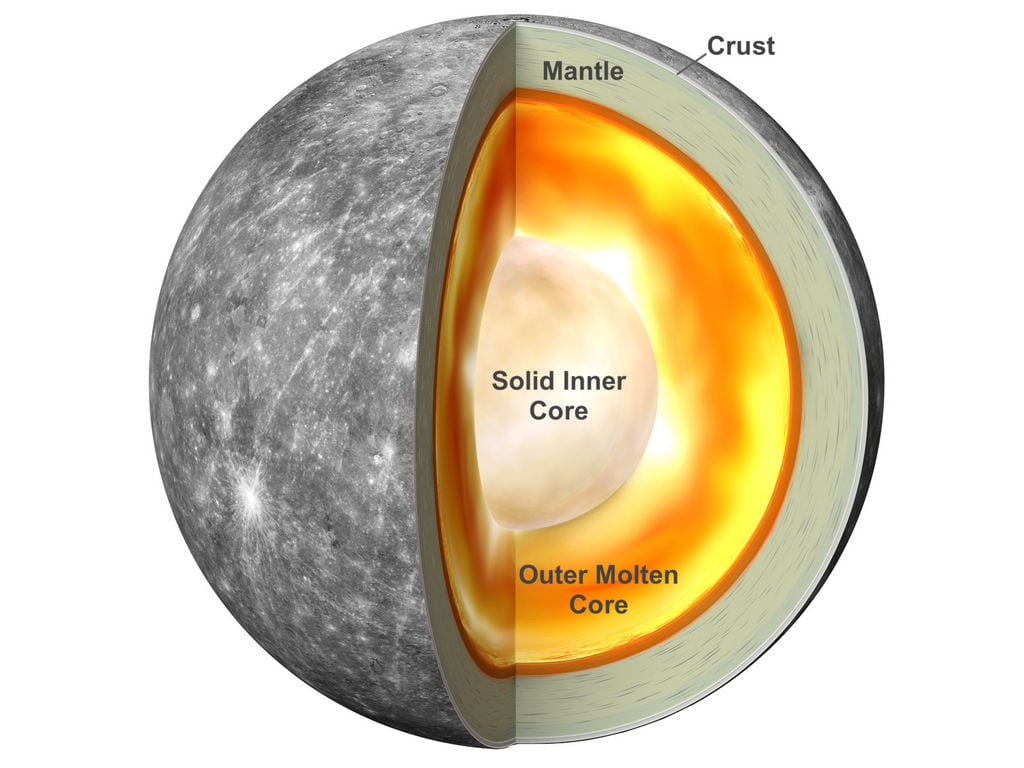
A graphical representation of Mercury’s internal structure. Credit: NASA's Goddard Space Flight Center[/caption]"Mercury’s interior is still active, due to the molten core that powers the planet’s weak magnetic field, relative to Earth's. Mercury’s interior has cooled more rapidly than our planet's. Mercury may help us predict how Earth’s magnetic field will change as the core cools," Genova said in a statement.Some scientists compare Mercury to a "cannonball" because its metal core fills nearly 85 percent of the volume of the planet. It is estimated to be about 2,000 kilometres wide, making up about half of Mercury’s entire core which is 4,000 kilometres wide. In contrast, Earth’s solid core is about 2,400 kilometres across, taking up a little more than a third of this planet’s entire core.The scientists collected and put together all the information from various fields and also through data which has been collected by MESSENGER which orbited closer and closer to Mercury's surface over the course of its mission.The MESSENGER was used to determine "the gravitational anomalies and the location of its rotational pole, which allowed scientists to understand the orientation of the planet."There were radar observations even made from Earth in 2007 which proved some of Mercury's core to be liquid-molten, but did not give a clear picture of whether a solid core was lurking underneath.Such accurate measurements of Mercury’s spin and gravity were said to be made possible only due to sending of spacecrafts to other worlds as they were not possible to be made from Earth."Every new bit of information about our solar system helps us understand the larger universe," Genova said in the statement.

Careless Whispers: Scientists discover that plants can 'talk' to each other using smells
Life on Mars? European Space Agency’s Orbiter discovers ice water deposits at equator
Microsoft briefly overtakes Apple as the most valuable company, Apple back on top again
Even NASA is facing a tough time, starts layoffs following major budget cuts
ISRO, NASA's NISAR satellite to get ready by Jan-end, will monitor Earth's snow-covered regions