


Mercury Transit 2019: Here's how and where to watch Mercury travel across face of the Sun
The planet will pass at 6.05 pm IST and will be visible in the U.S, Canada, and all of Central and South America.

The solar system’s smallest, the innermost planet, Mercury, is putting on a rare celestial show today. It will pass directly between Earth and the Sun at 6.05 pm IST.
The event will last five and a half hours and it is only visible in Eastern US, Canada and all of Central and South America. The rest of North America, Europe and Africa will only be able to view part of the action. However, Asia and Australia will miss the event altogether. But worry not, you can still watch it online.

Mercury passing in front of the Sun as viewed by the Solar Dynamics Observatory. Image credit: NASA[/caption]Mercury is 4,800 kilometres in diameter, compared with the Sun’s 1.4 million kilometres. Unlike its 2016 transit, Mercury will score a near bull’s-eye this time, passing practically dead centre in front of our star.
The planet will cut a diagonal path left to right across the sun on Monday, entering at the bottom left (around the eight-hour mark on a clock) and exiting top right (around the two-hour mark). Although the trek will appear slow, Mercury will zoom across the Sun at roughly 2,41,000 kmph.
 More from Science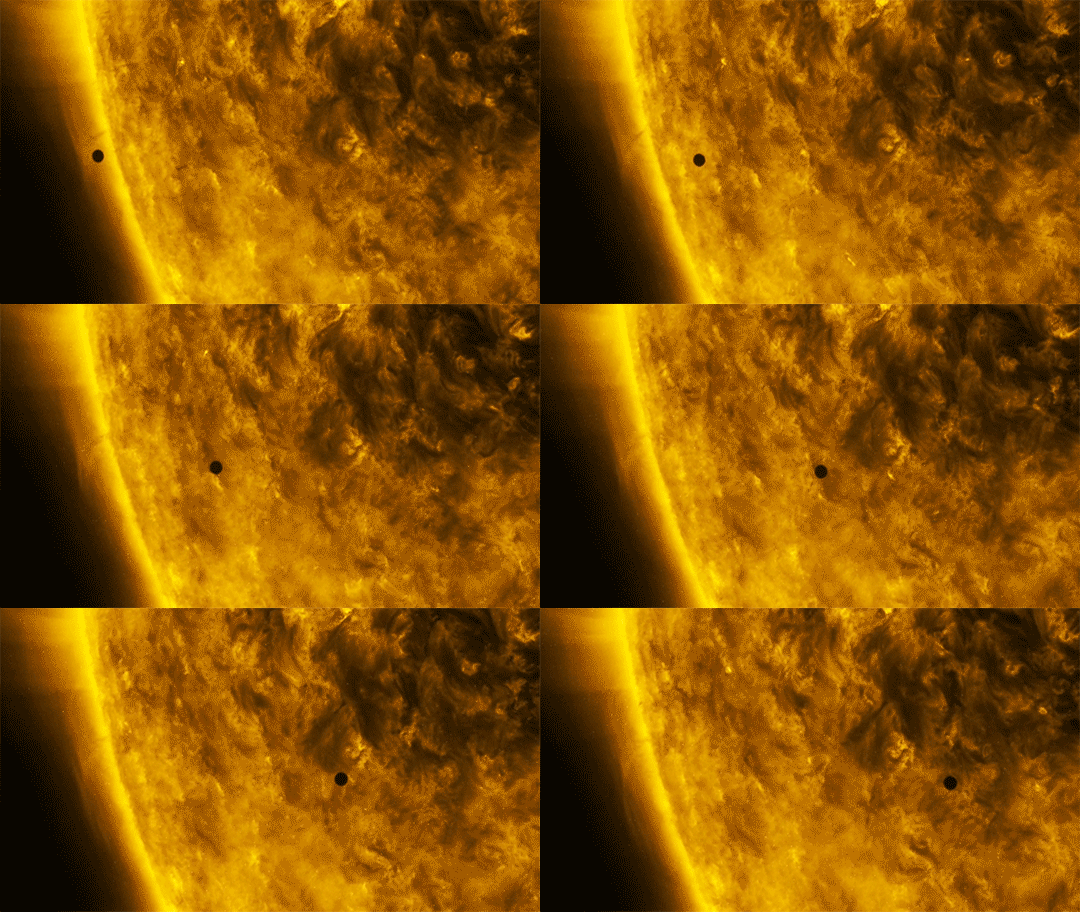
Mercury passing in front of the Sun.[/caption]If you have the chance to watch it in person, here are a few precautions to take while watching the transit. Looking at the Sun directly is never a good idea and Mercury is too small to be seen with the unaided eye. You can use a telescope with proper solar filters. However, using a regular telescope with solar viewing glasses is not advisable.
“Transits are a visible demonstration of how the planets move around the Sun, and everyone with access to the right equipment should take a look,” Mike Cruise, president of the Royal Astronomical Society, said in a statement from England.With inputs from The Associated Press.

Careless Whispers: Scientists discover that plants can 'talk' to each other using smells
Life on Mars? European Space Agency’s Orbiter discovers ice water deposits at equator
Microsoft briefly overtakes Apple as the most valuable company, Apple back on top again
Even NASA is facing a tough time, starts layoffs following major budget cuts
ISRO, NASA's NISAR satellite to get ready by Jan-end, will monitor Earth's snow-covered regions