
Advertisement


Sections
Meet Katie Bouman, the scientist whose algorithm helped image the first black hole
Katie Bouman led the creation of a new algorithm to produce the first-ever image of a black hole.

There were over 200 researchers behind the historic first photograph of a black hole's event horizon released this week. Some to build telescopes, some to map the stars, and others to do a supermassive amount of tweaking and troubleshooting to get that perfect shot.Among the sea of brilliant minds that turned science fiction into science reality is Massachusetts Institute of Technology (MIT) graduate, computer scientist and imaging buff, Katie Bouman. If her contribution had to be summarised in under 280 characters, it'd be this tweet by MIT's Computer Science and Artificial Intelligence Lab.Not only is she a millennial STEM heroine, but she's also the brilliant scientist who, with the help of her team, wrote the algorithm and did what many thought was an impossible feat: photographing a black hole.Bouman's algorithm was at the heart of coordinating eight telescopes scattered across five continents and aiming them at two black holes scientists are particularly eager to study. And it's clear as crystal how committed and certain she was that her effort would pay off in a TED talk she presented way back in 2016."...we'd expect to see a ring of light caused by the gravitational lensing of hot plasma zipping around the black hole. The black hole casts a shadow on this backdrop of bright material, carving out a sphere of darkness....a bright ring reveals the black hole's event horizon, where the gravitational pull becomes so great that not even light can escape," she said.Three years later, we have the first glimpse of the black hole from the M87 Galaxy:[caption id="attachment_6425071" align="alignnone" width="1280"]![The first ever image of a black hole, from the M87 galaxy located in the Virgo constellation in the Milky Way. Image: EHT/NSF]() The first-ever image of a black hole, from the M87 galaxy located in the Virgo constellation in the Milky Way. Image: EHT/NSF[/caption]Isn't that some top-rate visualisation of one's goals? Bouman's description matches the black hole photograph exactly — to the minutiae. Throughout her talk, she breaks down complexities of programming, imaging and black hole physics in simple (and some, hilarious) metaphors.Twitterati were quick to point on her enormous contribution to the study, which seemed to be considerably less than some of the more prominent researchers at the Event Horizon Telescope project.When those very same researchers were in a fix, thinking they needed a telescope the size of Earth to catch a glimpse of a black hole the size of a billion Suns, Bouman and her team of astronomer colleagues came up with a cleverer, sane alternative. And so, the Event Horizon Telescope grew in number, underwent tweaking to varying degrees, and made to join forces to achieve the same result. The EHT network works as good as "a telescope the size of the Earth" would to image black holes.Linked by a bunch of super-accurate atomic clocks, researchers manning each of the EHT's eight (black hole-observing) telescopes freeze light by collecting thousands of terabytes of data of space images. This data is then processed using an algorithm at MIT. As light from the black hole hits each of the eight telescopes, the precise timing of each of these light beams is recorded and matched with the others. By factoring in the exact time difference and location of each of the telescopes on Earth, the eight telescopes were made to work as a massive one. All the weak inputs in the images from the remaining parts of the planet that don't have a telescope were guesstimated by the algorithm.[caption id="attachment_6429981" align="alignnone" width="1280"]
The first-ever image of a black hole, from the M87 galaxy located in the Virgo constellation in the Milky Way. Image: EHT/NSF[/caption]Isn't that some top-rate visualisation of one's goals? Bouman's description matches the black hole photograph exactly — to the minutiae. Throughout her talk, she breaks down complexities of programming, imaging and black hole physics in simple (and some, hilarious) metaphors.Twitterati were quick to point on her enormous contribution to the study, which seemed to be considerably less than some of the more prominent researchers at the Event Horizon Telescope project.When those very same researchers were in a fix, thinking they needed a telescope the size of Earth to catch a glimpse of a black hole the size of a billion Suns, Bouman and her team of astronomer colleagues came up with a cleverer, sane alternative. And so, the Event Horizon Telescope grew in number, underwent tweaking to varying degrees, and made to join forces to achieve the same result. The EHT network works as good as "a telescope the size of the Earth" would to image black holes.Linked by a bunch of super-accurate atomic clocks, researchers manning each of the EHT's eight (black hole-observing) telescopes freeze light by collecting thousands of terabytes of data of space images. This data is then processed using an algorithm at MIT. As light from the black hole hits each of the eight telescopes, the precise timing of each of these light beams is recorded and matched with the others. By factoring in the exact time difference and location of each of the telescopes on Earth, the eight telescopes were made to work as a massive one. All the weak inputs in the images from the remaining parts of the planet that don't have a telescope were guesstimated by the algorithm.[caption id="attachment_6429981" align="alignnone" width="1280"]![Katie Bouman sharing her delight after the image saw the light of day. Image: Katie Bouman/Facebook]() Katie Bouman sharing her delight after the image saw the light of day. Image: Katie Bouman/Facebook[/caption]Just as a forensic sketch artist uses limited descriptions to piece together a picture using their knowledge of face structure, the imaging algorithms I develop use our limited telescope data to guide us to a picture that also looks like stuff in our universe," Bouman says in her TED talk.The project was flexing its muscles back in 2016, and continues to, still. The fact that the EHT caught a black hole photograph is one big step in a long journey till the project realises its full potential. And Bouman's contribution was a crucial one in the recent, epic success that sped that process of trial-and-error considerably.As the Event Horizon Telescope goes on to uncover more truths about black holes, Bouman's work joins the slowly-growing body of proof that women scientists are not any less capable, brilliant, or worthy of recognition as their male counterparts.In Bouman's own words, "(the EHT is) a melting pot of astronomers, physicists, mathematicians and engineers. This is what will make it soon possible to achieve something once thought impossible." And neither age, not gender got in the way. The world could use more of that now (and forever after). Bouman was also the second MIT computer science graduate to make waves in space. Dr Margaret Hamilton (see below) was helped put a man on the moon in 1969. Women, I tell you.
Katie Bouman sharing her delight after the image saw the light of day. Image: Katie Bouman/Facebook[/caption]Just as a forensic sketch artist uses limited descriptions to piece together a picture using their knowledge of face structure, the imaging algorithms I develop use our limited telescope data to guide us to a picture that also looks like stuff in our universe," Bouman says in her TED talk.The project was flexing its muscles back in 2016, and continues to, still. The fact that the EHT caught a black hole photograph is one big step in a long journey till the project realises its full potential. And Bouman's contribution was a crucial one in the recent, epic success that sped that process of trial-and-error considerably.As the Event Horizon Telescope goes on to uncover more truths about black holes, Bouman's work joins the slowly-growing body of proof that women scientists are not any less capable, brilliant, or worthy of recognition as their male counterparts.In Bouman's own words, "(the EHT is) a melting pot of astronomers, physicists, mathematicians and engineers. This is what will make it soon possible to achieve something once thought impossible." And neither age, not gender got in the way. The world could use more of that now (and forever after). Bouman was also the second MIT computer science graduate to make waves in space. Dr Margaret Hamilton (see below) was helped put a man on the moon in 1969. Women, I tell you.
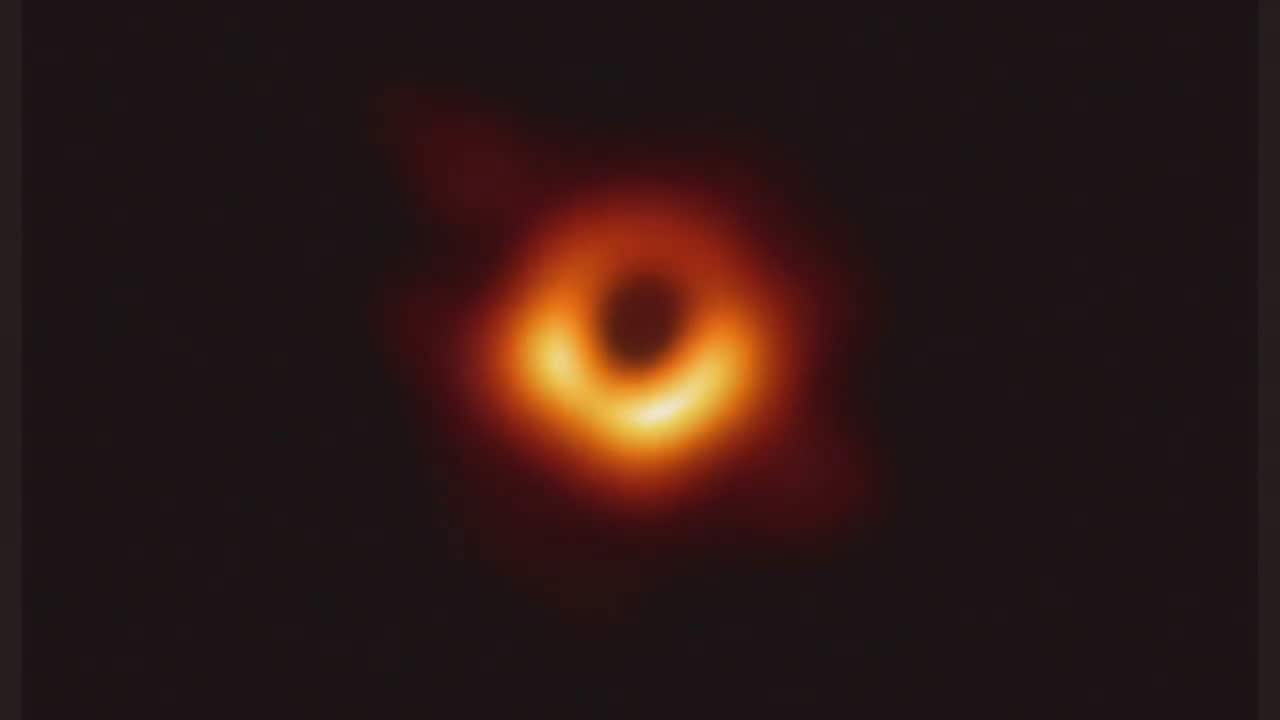 The first-ever image of a black hole, from the M87 galaxy located in the Virgo constellation in the Milky Way. Image: EHT/NSF[/caption]Isn't that some top-rate visualisation of one's goals? Bouman's description matches the black hole photograph exactly — to the minutiae. Throughout her talk, she breaks down complexities of programming, imaging and black hole physics in simple (and some, hilarious) metaphors.Twitterati were quick to point on her enormous contribution to the study, which seemed to be considerably less than some of the more prominent researchers at the Event Horizon Telescope project.When those very same researchers were in a fix, thinking they needed a telescope the size of Earth to catch a glimpse of a black hole the size of a billion Suns, Bouman and her team of astronomer colleagues came up with a cleverer, sane alternative. And so, the Event Horizon Telescope grew in number, underwent tweaking to varying degrees, and made to join forces to achieve the same result. The EHT network works as good as "a telescope the size of the Earth" would to image black holes.Linked by a bunch of super-accurate atomic clocks, researchers manning each of the EHT's eight (black hole-observing) telescopes freeze light by collecting thousands of terabytes of data of space images. This data is then processed using an algorithm at MIT. As light from the black hole hits each of the eight telescopes, the precise timing of each of these light beams is recorded and matched with the others. By factoring in the exact time difference and location of each of the telescopes on Earth, the eight telescopes were made to work as a massive one. All the weak inputs in the images from the remaining parts of the planet that don't have a telescope were guesstimated by the algorithm.[caption id="attachment_6429981" align="alignnone" width="1280"]
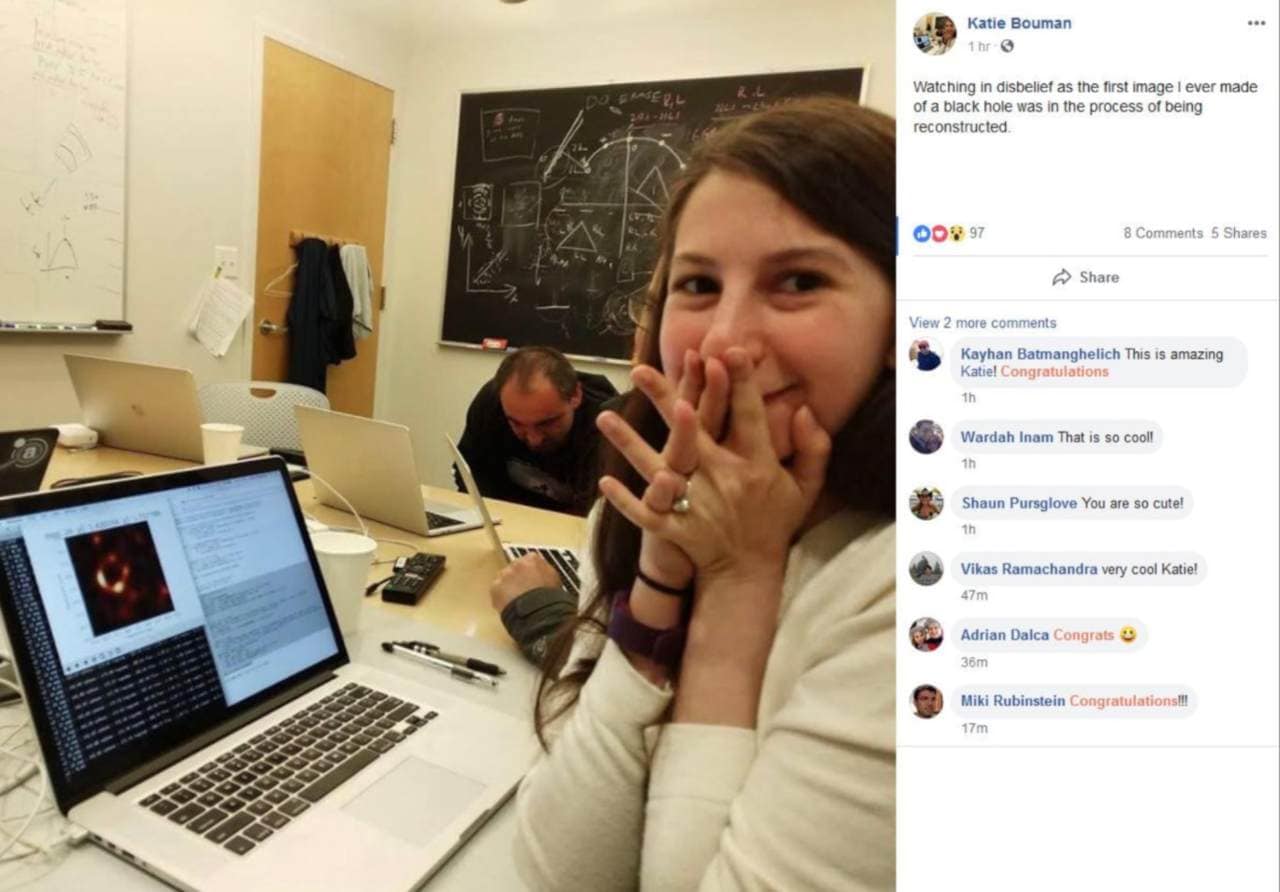 Katie Bouman sharing her delight after the image saw the light of day. Image: Katie Bouman/Facebook[/caption]Just as a forensic sketch artist uses limited descriptions to piece together a picture using their knowledge of face structure, the imaging algorithms I develop use our limited telescope data to guide us to a picture that also looks like stuff in our universe," Bouman says in her TED talk.The project was flexing its muscles back in 2016, and continues to, still. The fact that the EHT caught a black hole photograph is one big step in a long journey till the project realises its full potential. And Bouman's contribution was a crucial one in the recent, epic success that sped that process of trial-and-error considerably.As the Event Horizon Telescope goes on to uncover more truths about black holes, Bouman's work joins the slowly-growing body of proof that women scientists are not any less capable, brilliant, or worthy of recognition as their male counterparts.In Bouman's own words, "(the EHT is) a melting pot of astronomers, physicists, mathematicians and engineers. This is what will make it soon possible to achieve something once thought impossible." And neither age, not gender got in the way. The world could use more of that now (and forever after). Bouman was also the second MIT computer science graduate to make waves in space. Dr Margaret Hamilton (see below) was helped put a man on the moon in 1969. Women, I tell you.
First Published:Apr 11, 2019, 15:51:00 IST
Advertisement
Advertisement

Careless Whispers: Scientists discover that plants can 'talk' to each other using smells
Japanese scientists have recorded a video that shows plants, in certain conditions, communicate with each other using mists that carry smells. The discovery, reveals that plants release a fine mist of airborne compounds, to warn nearby plants of potential dangers
Life on Mars? European Space Agency’s Orbiter discovers ice water deposits at equator
European Space Agency's Mars Express Orbiter has identified massive ice and ice water deposits beneath the surface of Mars. The Mars Express orbiter was also the first to confirmed the presence of ice on Mars in 2004
Microsoft briefly overtakes Apple as the most valuable company, Apple back on top again
At its peak during the session, Microsoft's value reached $2.903 trillion, with a 2% surge. As of writing this article, Apple closed at $2.89 trillion, whereas Microsoft closed at $2.86 trillion
Even NASA is facing a tough time, starts layoffs following major budget cuts
NASA is facing some massive budget cuts, because of which, it has been forced to postpone some upcoming missions. NASA's Jet Propulsion Laboratory has been hit hard by recent federal budget cuts, resulting in the layoff of 100 contractors last week
ISRO, NASA's NISAR satellite to get ready by Jan-end, will monitor Earth's snow-covered regions
The NISAR satellite which has been developed jointly ISRO and NASA, should be ready for launch by the end of January 2024. The collaboration between NASA and ISRO on NISAR is the first time the two agencies have cooperated on hardware development for an Earth-observing mission
Advertisement
Advertisement