


Massive planets orbiting young star could reveal how 'hot Jupiters' and systems form
Images and models show distinct gaps in the system where more gas giants could be orbiting.

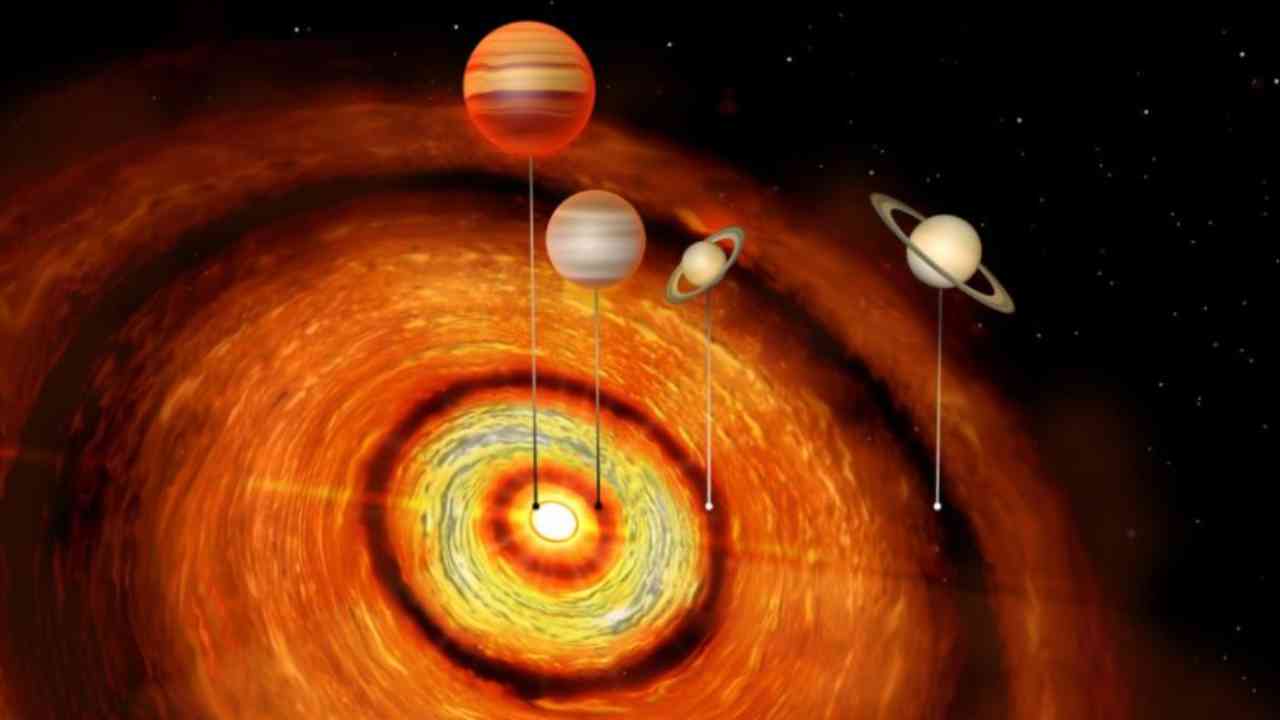
Artist's impression of the four gas giants orbiting the young star, CI Tau. Image courtesy: University of Cambridge[/caption]The two inner planets are roughly one and ten times the mass of Jupiter, respectively, and the outer planets roughly the size of Saturn, the study revealed."It is currently impossible to say whether the extreme planetary architecture seen in CI Tau is common in hot Jupiter systems,” Professor Cathie Clarke, the study's first author told the University press.“The way that these sibling planets were detected — through their effect on the protoplanetary disc — would not work in older systems which no longer have a protoplanetary disc."The researchers are also unclear if the outer planets have a hand in the inner planets being so close to the star."Saturn-mass planets are known to form by accumulating a solid core first and then pulling in a layer of gas on top… these processes are supposed to be very slow, at large distances from the star,” Clarke said.“Most models will struggle to make planets of this mass at this distance."The images captured by the researchers along with theoretical modelling showed three distinct gaps in the system where they believe additional gas giants could be orbiting.The findings from the study were published in the The Astrophysical Journal Letters.The researchers are now studying the system using ALMA at different wavelengths, to capture different features of the star, planets and disc.

Careless Whispers: Scientists discover that plants can 'talk' to each other using smells
Life on Mars? European Space Agency’s Orbiter discovers ice water deposits at equator
Microsoft briefly overtakes Apple as the most valuable company, Apple back on top again
Even NASA is facing a tough time, starts layoffs following major budget cuts
ISRO, NASA's NISAR satellite to get ready by Jan-end, will monitor Earth's snow-covered regions